

NEOM hits milestone with completion of underground parking, light rail systems

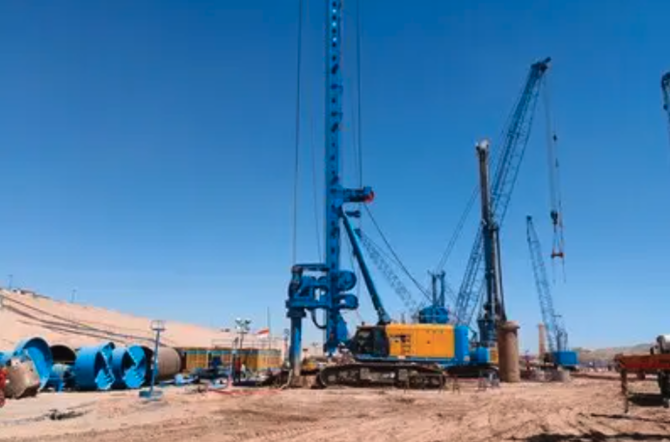
Drilling rigs were provided by Chinese construction manufacturing company XCMG Machinery. XCMG Foundation
Short Url
Updated 01 October 2024
Follow

NEOM hits milestone with completion of underground parking, light rail systems

  • The underground parking and light rail are key elements of NEOM’s advanced sustainable transportation plan
  • NEOM said this accomplishment supports its goal of building a city with zero carbon emissions

RIYADH: Saudi Arabia’s $500 billion megacity NEOM has completed the construction phases of its underground parking and light rail systems, marking a milestone in its ambitious zero-carbon initiative.

Assisted by 10 high-capacity rotary drilling rigs from Chinese construction manufacturing company XCMG Machinery, the world’s largest integrated development project completed three piles per day per drilling rig, according to a press release.

The underground parking and light rail are key elements of NEOM’s advanced sustainable transportation plan. This phase was accelerated by the efficiency of XCMG’s rotary drilling rigs, which handled deep foundation work despite challenging sandy geologies.

Led by the Public Investment Fund, the project will be a futuristic region in northwest Saudi Arabia powered entirely by renewable energy.

NEOM is home to The Line, Oxagon, Trojena, and Sindalah. It prioritizes people and nature, establishing a new model for sustainable living, working, and prospering.

The statement added that this phase was expedited due to the efficiency of XCMG’s rotary drilling rigs, which successfully managed deep foundation work even in difficult desert terrains.

The release noted that the XR600E is the largest-tonnage drilling rig deployed in the construction of NEOM city and the largest model exported from China.

Despite arriving a month later than other machinery, these rigs completed their tasks two weeks ahead of schedule, demonstrating reliability and superior performance in speed and efficiency.

In its statement, NEOM commented that this accomplishment supports its goal of building a city with zero carbon emissions and sustainable energy use.

Over 140,000 construction workers have been engaged on-site since its launch in 2017, and earlier in July it was announced the various projects underconstruction are set to receive cement worth SR104 million ($27.7 million) thanks to a partnership between Saudi Arabia’s Al Jouf Cement Co. and Italy’s Webuild SpA.

Other recent announcements from NEOM include a new marina and community on the Gulf of Aqaba called Jaumur.

The destination will be an exclusive residential community planned around a marina promenade for more than 6,000 residents, and will include 500 marina apartments and around 700 luxury villas.

Earlier this month, NEOM and American hospitality firm Equinox Hotels revealed plans to open a resort in the recently unveiled Magna development, on the coast of the Gulf of Aqaba.

The luxury destination will feature 12 locations along 120 kilometers of coastline, and will include 15 hotels, 1,600 rooms, and over 2,500 residences.


From 2 hours to 30 minutes: Qiddiya Bullet Train to cut Riyadh travel time by 75% 

Updated 6 sec ago
Follow

From 2 hours to 30 minutes: Qiddiya Bullet Train to cut Riyadh travel time by 75% 

RIYADH: Qiddiya is set to become significantly more accessible under plans to link the entertainment and tourism hub to King Salman International Airport and the King Abdullah Financial District through the new Qiddiya Bullet Train, Asharq Al Awsat reported

The project will reduce travel time to around 30 minutes, down from nearly two hours using other transport options, representing a 75 percent cut in commuting time. Operational speeds are expected to reach 250 km per hour, according to the Royal Commission for Riyadh City. 

The railway forms part of a broader transport strategy aimed at improving connectivity across the capital and enhancing mobility between key destinations, in line with population growth and urban expansion in western and southwestern Riyadh. 

In a related development, the commission announced the awarding of the Red Line extension of the Riyadh Metro to Diriyah. The expansion includes 7.1 km of tunnel and 1.3 km of elevated track, with stations at King Saud University and Diriyah. The latter is expected to serve as a future interchange with the planned Line 7. 

Officials estimate the project could remove around 150,000 cars from daily traffic, improving access to tourist destinations such as Bujairi Terrace and Wadi Safar, while supporting more sustainable mobility patterns. 

Bandar Al-Saadoun, vice chairman of Khaleejiah Holding, told Asharq Al-Awsat that the Diriyah development ranks among the largest projects under Vision 2030. He pointed to additional landmark initiatives in Wadi Safar, alongside the Opera House project and King Salman Grand Mosque. 

He said extending the Red Line along King Abdullah Road to Diriyah would generate strong real estate demand, particularly as the rail network integrates routes from King Salman International Airport through KAFD, Diriyah and the New Murabba development. 

Al-Saadoun added that roughly 30 projects have been announced in Qiddiya, raising the prospect of gradual real estate growth along corridors connected to the rail line. The project’s links to major developments — including Expo 2030 Riyadh, New Murabba and The Avenues — as well as the airport, which is expected to become one of the world’s largest by 2030, are likely to reinforce demand. 

Real estate analyst Khaled Almobid said large-scale transport projects such as the Qiddiya Bullet Train do more than lift prices; they reshape market structure and asset values over the medium and long term. 

Historically, properties within one to three km of transport stations see capital appreciation and rising investment demand, particularly for undeveloped “white land,” which often transitions into higher-density projects, he said. 

Almobid expects a dual impact: both redistribution of demand within Riyadh and genuine market expansion driven by what he called “manufactured demand” from Qiddiya, which is projected to attract 17 million visitors and generate 325,000 jobs. He also anticipates a population shift toward western Riyadh and areas surrounding the new stations. 

Land prices near Qiddiya have already risen between 30 percent and 40 percent since 2023, reflecting early market anticipation, he said, predicting more sustainable growth once operations begin and prices align with the tangible value of cutting travel time to 30 minutes between the airport, KAFD and Qiddiya. 

Residential and tourism-related real estate are likely to lead the next phase, supported by Saudi Arabia’s goal of raising homeownership to 70 percent and attracting 150 million annual visitors by 2030, with mixed-use locations along the rail corridor expected to draw the strongest investment interest.