ASEAN says ‘deeply concerned’ over escalating Myanmar violence

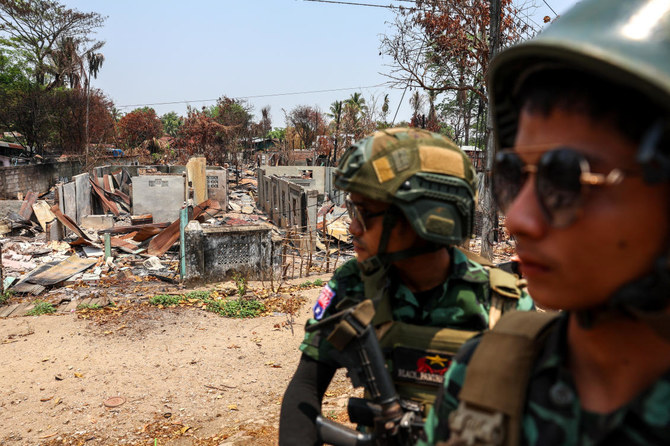
Soldiers from the Karen National Liberation Army patrol next to an area destroyed by Myanmar’s airstrike in Myawaddy near the Thailand-Myanmar border. (Reuters)
Short Url
Updated 19 April 2024
Follow

ASEAN says ‘deeply concerned’ over escalating Myanmar violence

  • ASEAN foreign ministers urge ‘all parties for an immediate cessation of violence’ in Myanmar

BANGKOK: Regional bloc ASEAN said it is “deeply concerned” about a recent upsurge in fighting in Myanmar, after fierce clashes over a key trading hub near the Thai border.
The foreign ministers of the Association of Southeast Asian Nations urged “all parties for an immediate cessation of violence” in Myanmar, which has been roiled by conflict since the military seized power in a February 2021 coup.
The ministers’ statement issued late Thursday said ASEAN was “deeply concerned over the recent escalation of conflicts, including in the area of Myawaddy.”
The military was last week forced to pull its troops out of positions in the valuable trading post after days of battling with the Karen National Union (KNU) — a long-established ethnic minority armed group — and other anti-junta fighters.
It was the latest blow suffered by the junta, which has suffered a string of battlefield losses in recent months, with some analysts warning it is its most significant threat to date.
Myawaddy is Myanmar’s main trade link to Thailand, and usually sees over a billion dollars worth of trade annually.
The clashes saw people flee across the border into Thailand — from where gunfire and the boom of artillery barrages could be heard.
Thailand has said it is ready to receive people from Myanmar, though the kingdom’s foreign minister warned it would not tolerate any violation of its sovereignty.


Sweden plans to tighten rules for gaining citizenship

Updated 2 sec ago
Follow

Sweden plans to tighten rules for gaining citizenship

STOCKHOLM: Sweden said Monday it planned to tighten rules to acquire citizenship, introducing “honest living” and financial requirements, a language and general knowledge test and raising the residency requirement from five to eight years.
If approved by parliament, the new rules would enter into force on June 6, Sweden’s national holiday, and would apply even to applications already being processed.
Migration Minister Johan Forssell, whose right-wing minority government holds a majority with the backing of the far-right Sweden Democrats, told reporters it was currently too easy to acquire Swedish citizenship.
“Citizenship needs to mean more than it does today,” he said.
“Pride is something you feel when you’ve worked hard at something. But working hard is not something that has characterised citizenship.
“It has been possible to become a citizen after five years without knowing a single word of Swedish, without knowing anything about our Swedish society, without having any own income.”
Referring to a case that recently made headlines, he said: “You can even become one while you’re sitting in custody accused of murder.
“This obviously sends completely wrong signals, both to those who do right by themselves and those who are already citizens.”
Following a large influx of migrants to Sweden during the 2015 migrant crisis, successive left- and right-wing governments have tightened asylum and migration rules.
The country has for years struggled to integrate migrants, with many not learning the language and living in disadvantaged areas with higher crime and jobless rates.
Under the new rules, those who have criminal records — in their home country or in Sweden — and who have served their sentence would have to wait up to 17 years before being allowed to apply for citizenship, up from the current 10 years.
In addition, those deemed to not adhere to “honest living” requirements would not be granted citizenship.
That could include racking up mountains of debt, being served restraining orders or even having a drug addiction.
Applicants would also have to have a monthly pre-tax income of 20,000 kronor ($2,225), excluding pensioners and students.
The citizenship tests would be similar to those used in neighboring Denmark and the United States, the government said, with the first tests due to be held in August.