


PESHAWAR: The government in northwestern Pakistan clarified on Thursday that authorities would not carry out any fresh anti-terror military operation in the Khyber Pakhtunkhwa (KP) province, saying that police and its counter-terrorism department would instead take action against militants in the area.
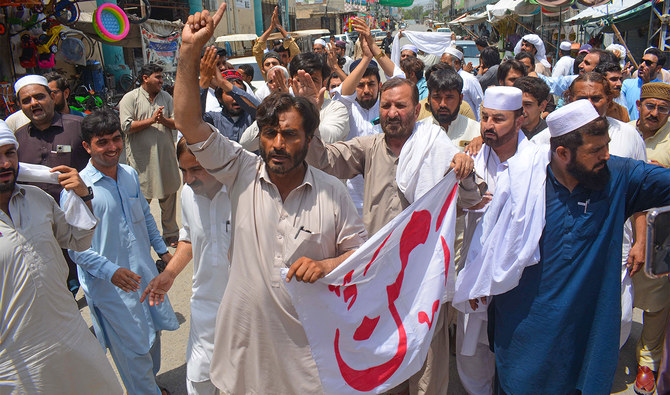
The statement was issued after the KP government held an apex committee meeting on Thursday to discuss the situation in Bannu district, where two people were killed in a shooting incident targeting a large rally demanding peace last Friday, amid a surge in militant violence in the area.
In June, the country’s top national security forum announced the “Operation Azm-e-Istehkam,” or Resolve for Stability, campaign after a meeting of the Central Apex Committee on the National Action Plan (NAP) that was attended by senior military leaders and top government officials from all provinces, including the PTI-backed Khyber Pakhtunkhwa Chief Minister Ali Amin Gandapur.
The announcement had been met with criticism, as Pakistan’s opposition parties accused the government of not taking them on board regarding the decision. However, Pakistan’s military spokesman Lt. Gen Ahmed Sharif Chaudhry clarified that the campaign was not meant to be a full-scale military operation but would invigorate the ones that are already taking place in the country.
“Military institutions have clearly said about the operation that there is no such thing, hence no operation is taking place in the province,” a joint statement from the KP government after the meeting said.
The apex committee meeting was chaired by Gandapur and included senior civil and military officials, apart from some leaders of the group that has organized the Bannu sit-in protests since the shooting incident last Friday.
It said that police and the counter-terrorism department of the KP government would take action against local militants.
However, the statement said it wasn’t possible to take action in some areas without the Pakistan Army’s help due to their geographical location and closeness to the border areas.
“In such a situation, action will be taken as per the situation till the capacity of the CTD and other institutions is at par with the security forces,” the statement said.
The apex committee said that police and CTD’s capabilities were being enhanced by increasing their number of personnel, armored vehicles and firearms.
“Terrorists are condemnable in every form and indiscriminatory action will be taken against them,” the statement warned.
The committee said that the judiciary would be requested to hold a judicial inquiry into the Bannu shooting incident, a demand that had been put forward by Pakistan’s opposition alliance and Bannu protesters.
“Meanwhile, the government will hold its own inquiry and identify the persons responsible,” it added.
The committee said every individual had the right to protest peacefully. However, it said it was also imperative for everyone to abide by the law and refrain from lawlessness and violence.


