

Frankfurt airport open again after climate activists block runway

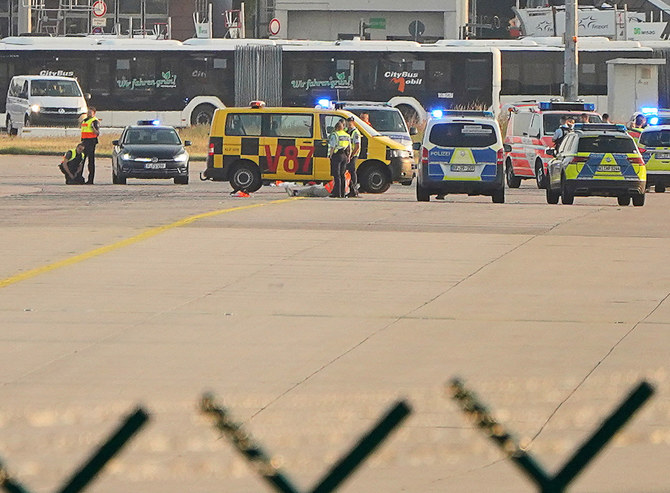
Frankfurt, a vital international transit hub and one of Europe’s biggest airports, said around 140 flights had been canceled out of 1,400 planned on Thursday. Above, police, security and medical staff near the runways at the airport in Frankfurt on July 25, 2024. (Reuters)
Short Url
Updated 01 October 2024
Follow

Frankfurt airport open again after climate activists block runway

  • Last Generation climate activists said in a statement that six protesters had cut through a fence and had reached various points around the Frankfurt airport runways

BERLIN: Frankfurt airport, Germany’s busiest, has resumed operations after suspending flights on Thursday morning when several climate activists blocked runways by gluing themselves to the tarmac.

Planes were able to take off and land again, the airport said on its website, but passengers were still advised to check on their flight status before setting off for the airport.

A spokesperson for Frankfurt, a vital international transit hub and one of Europe’s biggest airports, said around 140 flights had been canceled out of 1,400 planned on Thursday.

Last Generation climate activists said in a statement that six protesters had cut through a fence and had reached various points around the Frankfurt airport runways with posters reading “Oil kills.” Images released by the group showed protesters in orange safety vests with their hand glued to the tarmac.

A federal police spokesperson said several climate activists were on the airport grounds.

The group, which wants the German government to pursue a global agreement to exit oil, gas and coal by 2030, has listed several countries across Europe and North America where similar disruptions are planned as part of a protest campaign that began on Wednesday.

In Norway, around a dozen activists blocked a part of the check-in area of the Oslo Airport, in a second day of actions, but there was no disruption of flights to and from the Norwegian capital, an airport official said.

Germany’s Cologne-Bonn airport, the country’s sixth-largest, suspended flights for several hours on Wednesday after climate activists glued themselves to a runway, while similar actions at other European airports had been foiled by authorities.

German Interior Minister Nancy Faeser, whose ministry wants to punish unauthorized airfield access with up to two years in jail, called the action “dangerous, dumb and criminal.”


The UN aid coordination agency cuts its funding appeal after Western support plunges

Updated 6 sec ago
Follow

The UN aid coordination agency cuts its funding appeal after Western support plunges

  • The UN aid coordinator sought $47 billion for this year and aimed to help 190 million people worldwide. Because of the lower support, it and humanitarian partners reached 25 million fewer people this year than in 2024

GENEVA: The UN’s humanitarian aid coordination office is downsizing its appeal for annual funding in 2026 after support this year, mostly from Westerngovernments, plunged to the lowest level in a decade.
The United Nations Office for the Coordination of Humanitarian Affairs said Monday it was seeking $33 billion to help some 135 million people cope with fallout from wars, climate disasters, earthquakes, epidemics and food shortages. This year, it took in $15 billion, the lowest level in a decade.
The office says next year it wants more than $4.1 billion to reach 3 million people in Palestinian areas, another $2.9 billion for Sudan — home to the world’s largest displacement crisis — and $2.8 billion for a regional plan around Syria.
“In 2025, hunger surged. Food budgets were slashed — even as famines hit parts of Sudan and Gaza. Health systems broke apart,” said OCHA chief Tom Fletcher. “Disease outbreaks spiked. Millions went without essential food, health care and protection. Programs to protect women and girls were slashed, hundreds of aid organizations shut.”
The UN aid coordinator sought $47 billion for this year and aimed to help 190 million people worldwide. Because of the lower support, it and humanitarian partners reached 25 million fewer people this year than in 2024.
The donor fatigue comes as many wealthy European countries face security threats from an increasingly assertive Russia on their eastern flank and have experienced lackluster economic growth in recent years, putting new strains on government budgets and the consumers who pay taxes to sustain them.
“I know budgets are tight right now. Families everywhere are under strain,” Fletcher said. “But the world spent $2.7 trillion on defense last year – on guns and arms. And I’m asking for just over 1 percent of that.”
The UN system this year has slashed thousands of jobs, notably at its migration and refugee agencies, and Secretary-General António Guterres’ office has launched a review of UN operations — which may or may not produce firm results.
Fletcher, who answers to Guterres, has called for “radical transformation” of aid by reducing bureaucracy, boosting efficiency and giving more power to local groups. Fletcher cited “very practical, constructive conversations” almost daily with the Trump administration.
“Do I want to shame the world into responding? Absolutely,” Fletcher said. “But I also want to channel this sense of determination and anger that we have as humanitarians, that we will carry on delivering with what we get.”