

Party of Pakistan’s Imran Khan rejects government medical report, seeks independent eye exam

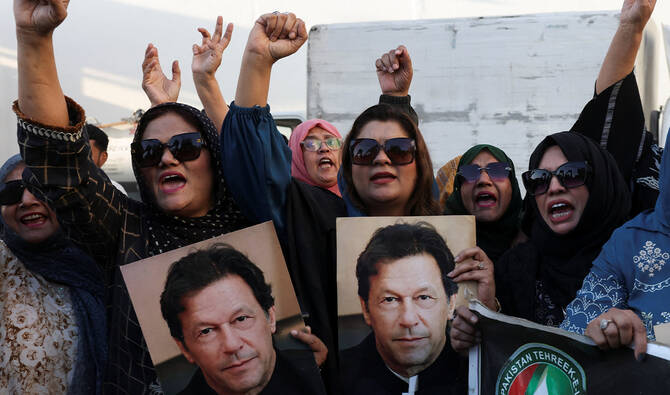
Supporters of jailed former Prime Minister Imran Khan's Pakistan Tehreek-e-Insaf (PTI) party chant slogans during a protest over concerns about their leader's health in Karachi, Pakistan, February 13, 2026. (Reuters/File)
Short Url
Updated 17 February 2026
Follow

Party of Pakistan’s Imran Khan rejects government medical report, seeks independent eye exam

  • Court-appointed lawyer earlier reported “severe vision loss” in custody
  • Party demands access for family doctor and treatment at private hospital

ISLAMABAD: The political party of Pakistan’s jailed former prime minister Imran Khan on Tuesday rejected what it described as a government-issued medical report about his eye condition, demanding authorities allow family members and his personal physician to examine him in prison.

Health concerns emerged last week after a court-appointed lawyer, Barrister Salman Safdar, visited Khan at Rawalpindi’s Adiala Jail and reported that the former premier had suffered “severe vision loss” in his right eye due to central retinal vein occlusion (CRVO), leaving him with about 15 percent sight in the affected eye.

Jail authorities said a team of doctors from multiple hospitals examined Khan on Sunday and submitted findings to a court. A two-page medical document circulated on social media and published by several local media outlets. but not officially released or verified by the government, stated that unaided vision in Khan’s right eye was 6/24 and 6/9 in the left, improving to 6/9 (partial) and 6/6 respectively with glasses.

The document said Khan was examined by Prof. Nadeem Qureshi of Al-Shifa Trust Eye Hospital and Prof. M. Arif of the Pakistan Institute of Medical Sciences, and that his personal physicians were briefed afterward.

“In light of Dr. Asim’s statement on the report issued by the government regarding the eye examination of Imran Khan, in which he said that he neither met Khan nor could he talk to him nor could he examine him or take care of him, therefore he can neither confirm nor deny it, Pakistan Tehreek-e-Insaf rejects this report,” the party said in a statement.

The party reiterated its demand that Khan’s family and personal physician be allowed to meet him and that he be examined at a private facility.

“To issue such a report by having doctors of one’s choice examine him shows that something is definitely being hidden,” it said.

Officials say Khan’s condition has improved and that treatment decisions rest with doctors and courts.

“His eye [condition] has improved and is better than before,” State Minister Tallal Chaudry told reporters on Monday.

“The Supreme Court of Pakistan is involved, and doctors are involved. What medicine he receives, whether he needs to be hospitalized or sent home, these decisions are made by doctors. Neither lawyers nor any political party will decide this.”

Khan’s health has sparked protests by supporters, including demonstrations and road closures in the northwestern Khyber Pakhtunkhwa province where his party governs, and a sit-in outside parliament in Islamabad.

Khan, a former cricket star who served as prime minister from 2018 to 2022 before being removed in a parliamentary vote of no confidence, has been in jail since August 2023 in multiple cases he says are politically motivated. The government denies the allegations.


Pakistan reviews austerity measures amid Middle East crisis, urges strict nationwide implementation

Updated 11 March 2026
Follow

Pakistan reviews austerity measures amid Middle East crisis, urges strict nationwide implementation

  • Deputy Prime Minister Ishaq Dar chairs review meeting of austerity steps
  • Officials briefed on salary cuts, school closures, four‑day week, petrol conservation

ISLAMABAD: Pakistan’s government on Wednesday assessed progress on a sweeping set of austerity measures introduced to mitigate the country’s economic strain from sharply rising global oil prices and supply disruptions linked to the ongoing war in the Middle East.

Prime Minister Shehbaz Sharif this week announced a series of austerity steps, including a four‑day work week for government offices, requiring 50  percent of staff to work from home, cutting fuel allowances for official vehicles by half, grounding up to 60  percent of the government fleet and closing all schools for two weeks to conserve fuel amid the global oil crisis.

The measures were unveiled in response to global oil market volatility triggered by the conflict involving the United States, Israel and Iran, which has disrupted supply routes such as the Strait of Hormuz and pushed crude prices sharply higher, straining Pakistan’s heavily import‑dependent energy sector.

“The meeting stressed the importance of strict and transparent adherence to the austerity measures, promoting fiscal responsibility and prudent use of public resources,” Deputy Prime Minister and Foreign Minister Senator Mohammad Ishaq Dar said in a statement.

He was chairing a meeting of the Committee for Monitoring and Implementation of Conservation and Additional Austerity Measures, constituted under the directions of the PM, bringing together federal and provincial officials to review execution of the broad cost‑cutting plan. 

Dar emphasized the government’s commitment to enforcing the PM’s austerity steps nationwide. The committee’s review also covered reductions in departmental expenditure, deductions from salaries of senior officials earning over Rs. 300,000 ($1,120), and coordination with provincial administrations to ensure uniform implementation of the plan.

Participants at the meeting reiterated that all ministries and divisions must continue strict monitoring and reporting, with transparent oversight mechanisms, as Pakistan navigates the economic pressures from the prolonged Middle East crisis and its fallout on global energy and trade markets.