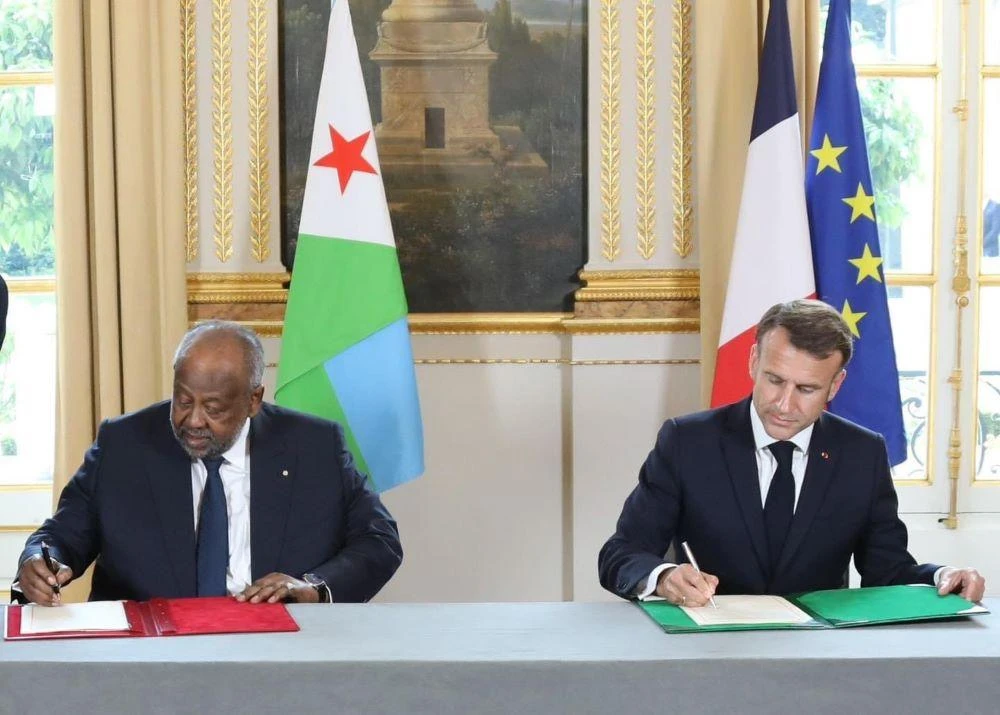
PARIS: French President Emmanuel Macron and his Djibouti counterpart Ismail Omar Guelleh agreed Wednesday to renew the defense partnership between the two countries, following two years of negotiations.
According to a statement from the French presidency, they signed an agreement on “the ambitious reform of the Defense Cooperation Treaty which unites France and Djibouti.”
The accord, signed at Macron’s office, governs the 1,500 French troops based in the small but strategically located East African country.
French troops have recently closed military bases in Mali and Niger following military coups in both countries, but there has never been any question of abandoning Djibouti, France’s largest permanent overseas base.
The country is located opposite Yemen, near an opening to the Red Sea, where a large part of the global trade between Asia and the West passes.
The discussions had been held up by Djibouti’s demands that France greatly increase the rent it pays, according to a source close to the negotiations.
The defense agreement was first signed in 1977 when the former French colony won independence, and was renewed in 2011.
But France only began to pay rent in 2003, following the opening of a US base in the country.
France and Djibouti renew defense partnership
https://arab.news/yy2f8
France and Djibouti renew defense partnership
- Accord, signed at Macron’s office, governs the 1,500 French troops based in the small but strategically located East African country
- Defense agreement was first signed in 1977 when the former French colony won independence, and was renewed in 2011
Russia says foreign forces in Ukraine would be ‘legitimate targets’
- Moscow has repeatedly said it will not tolerate the presence in Ukraine of troops from Western countries
MOSCOW: Russia would regard the deployment of any foreign military forces or infrastructure in Ukraine as foreign intervention and treat those forces as legitimate targets, the Foreign Ministry said on Monday, citing Minister Sergei Lavrov.
The ministry’s comment, one of many it said were in response to questions put to Lavrov, also praised US President Donald Trump’s efforts at working for a resolution of the war and said he understood the fundamental reasons behind the conflict.
“The deployment of military units, facilities, warehouses, and other infrastructure of Western countries in Ukraine is unacceptable to us and will be regarded as foreign intervention posing a direct threat to Russia’s security,” the ministry said on its website.
It said Western countries — which have discussed a possible deployment to Ukraine to help secure any peace deal — had to understand “that all foreign military contingents, including German ones, if deployed in Ukraine, will become legitimate targets for the Russian Armed Forces.”
The United States has spearheaded efforts to hold talks aimed at ending the conflict in Ukraine and a second three-sided meeting with Russian and Ukrainian representatives is to take place this week in the United Arab Emirates.
The issue of ceding internationally recognized Ukrainian territory to Russia remains a major stumbling block. Kyiv rejects Russian calls for it to give up all of its Donbas region, including territory Moscow’s forces have not captured.
Moscow has repeatedly said it will not tolerate the presence in Ukraine of troops from Western countries.
The ministry said Moscow valued the “purposeful efforts” of the Trump administration in working toward a resolution and understanding Russia’s long-running concerns about NATO’s eastward expansion and its overtures to Ukraine.
It described Trump as “one of the few Western politicians who not only immediately refused to advance meaningless and destructive preconditions for starting a substantive dialogue with Moscow on the Ukrainian crisis, but also publicly spoke about its root causes.”