

Historic Jeddah to support securing local workforce with new agreement

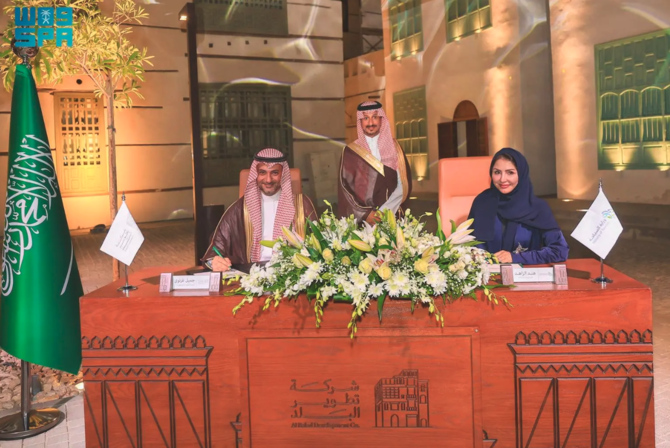
The MoU was signed by Jamil Hasan Ghaznawi, CEO of Al-Balad Development Co., and Hind Al-Zahid, acting deputy for human capital development at the Ministry of Tourism. SPA
Short Url
Updated 24 July 2024
Follow

Historic Jeddah to support securing local workforce with new agreement

  • Deal aims to boost collaboration by leveraging resources to enhance knowledge exchange and empower local talent
  • Saudi Arabia aims to unlock its tourism potential and position the region as a premier global destination

RIYADH: Saudis will receive training and support to help secure hospitality jobs in Historic Jeddah thanks to a new agreement between the Ministry of Tourism and Al-Balad Development Co. 

The memorandum of understanding aims to boost collaboration by leveraging resources to enhance knowledge exchange and empower local talent across the hotel, heritage tourism, and tour guiding industries.

The Public Investment Fund’s wholly-owned company serves as the heritage-focused master developer and asset manager for Jeddah’s Al-Balad area. Spanning 2.5 sq. km along the Red Sea coast, the site recently marked its 10th anniversary on the UNESCO World Heritage List. 

Saudi Arabia aims to unlock its tourism potential and position the region as a premier global destination by facilitating investment, promoting cultural heritage, and encouraging innovation in the hospitality sector. 

The Kingdom targets attracting over 150 million visitors by 2030, creating 1.6 million tourism jobs, and increasing the sector’s contribution to gross domestic product to over 10 percent.  

The MoU was signed by Jamil Hasan Ghaznawi, CEO of Al-Balad Development Co., and Hind Al-Zahid, acting deputy for human capital development at the Ministry of Tourism, with the signing witnessed by Minister of Tourism Ahmed Al-Khateeb, according to the Saudi News Agency. 

Through its Al-Balad Hospitality arm, the firm plans to deliver over 1,800 hotel units in the area in the coming years. 

The company aims to offer visitors unique hotel experiences that blend authenticity and history with modern comforts in the heart of Historic Jeddah. 

Launched in early 2024, Al-Balad Hospitality provides a range of accommodations, from heritage hotels in Jeddah to redefined authentic stays.

The Jeddah Historic District, once a Red Sea fishing village and key Silk Road trading hub, now boasts over 600 historic buildings with distinctive architecture and a rich cultural heritage. 

The Ministry of Culture oversees the Jeddah Historic District program, which aims to revitalize the area and establish it as a cultural and heritage destination.


First EU–Saudi roundtable on critical raw materials reflects shared policy commitment

Updated 16 January 2026
Follow

First EU–Saudi roundtable on critical raw materials reflects shared policy commitment

RIYADH: The EU–Saudi Arabia Business and Investment Dialogue on Advancing Critical Raw Materials Value Chains, held in Riyadh as part of the Future Minerals Forum, brought together senior policymakers, industry leaders, and investors to advance strategic cooperation across critical raw materials value chains.

Organized under a Team Europe approach by the EU–GCC Cooperation on Green Transition Project, in coordination with the EU Delegation to Saudi Arabia, the European Chamber of Commerce in the Kingdom and in close cooperation with FMF, the dialogue provided a high-level platform to explore European actions under the EU Critical Raw Materials Act and ResourceEU alongside the Kingdom’s aspirations for minerals, industrial, and investment priorities.

This is in line with Saudi Vision 2030 and broader regional ambitions across the GCC, MENA, and Africa.

ResourceEU is the EU’s new strategic action plan, launched in late 2025, to secure a reliable supply of critical raw materials like lithium, rare earths, and cobalt, reducing dependency on single suppliers, such as China, by boosting domestic extraction, processing, recycling, stockpiling, and strategic partnerships with resource-rich nations.

The first ever EU–Saudi roundtable on critical raw materials was opened by the bloc’s Ambassador to the Kingdom, Christophe Farnaud, together with Saudi Deputy Minister for Mining Development Turki Al-Babtain, turning policy alignment into concrete cooperation.

Farnaud underlined the central role of international cooperation in the implementation of the EU’s critical raw materials policy framework.

“As the European Union advances the implementation of its Critical Raw Materials policy, international cooperation is indispensable to building secure, diversified, and sustainable value chains. Saudi Arabia is a key partner in this effort. This dialogue reflects our shared commitment to translate policy alignment into concrete business and investment cooperation that supports the green and digital transitions,” said the ambassador.

Discussions focused on strengthening resilient, diversified, and responsible CRM supply chains that are essential to the green and digital transitions.

Participants explored concrete opportunities for EU–Saudi cooperation across the full value chain, including exploration, mining, and processing and refining, as well as recycling, downstream manufacturing, and the mobilization of private investment and sustainable finance, underpinned by high environmental, social, and governance standards.

From the Saudi side, the dialogue was framed as a key contribution to the Kingdom’s industrial transformation and long-term economic diversification agenda under Vision 2030, with a strong focus on responsible resource development and global market integration.

“Developing globally competitive mineral hubs and sustainable value chains is a central pillar of Saudi Vision 2030 and the Kingdom’s industrial transformation. Our engagement with the European Union through this dialogue to strengthen upstream and downstream integration, attract high-quality investment, and advance responsible mining and processing. Enhanced cooperation with the EU, capitalizing on the demand dynamics of the EU Critical Raw Materials Act, will be key to delivering long-term value for both sides,” said Al-Babtain.

Valere Moutarlier, deputy director-general for European industry decarbonization, and directorate-general for the internal market, industry, entrepreneurship and SMEs at European Commission, said the EU Critical Raw Materials Act and ResourceEU provided a clear framework to strengthen Europe’s resilience while deepening its cooperation with international partners.

“Cooperation with Saudi Arabia is essential to advancing secure, sustainable, and diversified critical raw materials value chains. Dialogues such as this play a key role in translating policy ambitions into concrete industrial and investment cooperation,” she added.