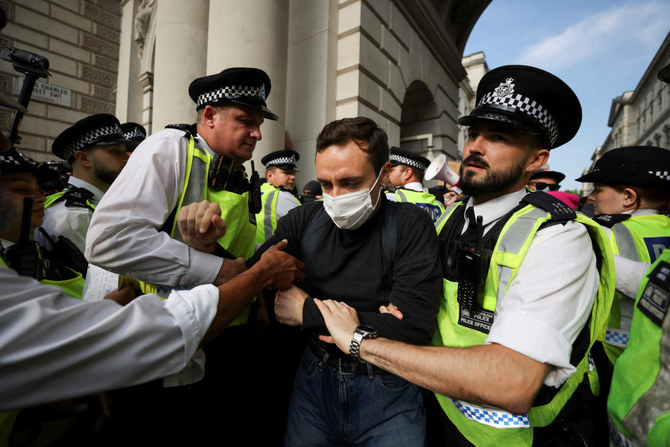
LONDON: British police on Wednesday arrested nine people during a protest against arms exports to Israel that briefly blocked the street outside the foreign ministry, highlighting pressure on the new Labour government over its stance on the Gaza war.
Pro-Palestinian protesters in Britain have been campaigning for a government ban on arms sales to Israel following its offensive on Gaza in response to the Oct. 7 attack.
Last week new Foreign Minister David Lammy, who has said he wants a balanced position on Israel and Gaza, said a blanket ban on arms exports to Israel would not be right, but he would follow a quasi-judicial process in assessing whether sales of offensive weapons that could be used in Gaza could proceed.
London’s Metropolitan Police said protesters arrived outside Britain’s Foreign, Commonwealth & Development Office and blocked pedestrian and vehicle access. Police then said the protest could only continue if it left the central arch of the street clear.
“When the group failed to comply with the conditions, officers intervened and made nine arrests, quickly restoring access,” a Met Police spokesperson said.
While in opposition, Lammy earlier this year said the government should suspend the sale of UK arms if there were a clear risk they might be used in a serious breach of humanitarian law.
Now in government, he said last week he requested on his first day in office an assessment of the legal situation and that he hoped to be able to communicate any decisions with “full accountability and transparency.”
Labour was elected with a huge majority earlier this month, but lost some seats to pro-Gaza candidates.
Campaign group Workers for a Free Palestine, which organized the protest, said that was a sign the government should take a stronger stance on restricting arms sales, and called on Lammy to “practice what he preached in opposition.”
While the previous Conservative government was a strong supporter of Israel’s right to defend itself following the Oct. 7 attack, Reuters found that the value of Britain’s approvals of new arms licenses dropped sharply after the start of the war.


![]()
![]()

Nine arrests during London protest against Israel arms exports

Short Url
https://arab.news/68tc2
Nine arrests during London protest against Israel arms exports
- Last week new Foreign Minister David Lammy said a blanket ban on arms exports to Israel would not be right
- London’s Metropolitan Police said protesters arrived outside Britain’s Foreign, Commonwealth & Development Office and blocked pedestrian and vehicle access


Latest updates


© 2026 SAUDI RESEARCH & PUBLISHING COMPANY, All Rights Reserved And subject to Terms of Use Agreement.