

BEIRUT: The head of the Foreign Affairs Committee in the Lebanese Parliament, MP Fadi Alama, revealed that “the number of attacks on South Lebanon has exceeded 5,736 until July 15, resulting in 538 martyrs, and 1,850 injuries.”
The Foreign Affairs Committee met on Wednesday with several ambassadors from the EU, Switzerland, Norway, Britain, and Canada to present the results of the ongoing Israeli attacks on southern Lebanon, as part of preparations for “the government’s work in the post-ceasefire phase.”
MP Alama said that “representatives of diplomatic missions and international organizations were surprised when we talked about 1,800 hectares intentionally burned by the Israeli enemy. They were also surprised by the number of schools that were targeted and the number of students who were unable to complete their education and moved to other places. Additionally, they were informed of the 28,000 new families who have been displaced from areas that are being targeted daily.”
The parliamentarian said there was urgency for the government to develop a plan and a roadmap as soon as possible.
MP Wael Abu Faour, a member of the Parliamentary Foreign Affairs Committee, stated that “the human, health, urban, agricultural, and environmental losses as a result of Israeli attacks have become enormous. Initial estimates from Lebanese institutions indicate a cost of approximately two $2 billion so far, in addition to other damages and losses.”
Abu Faour said: “This is a new challenge for the Lebanese state that must be dealt with in Lebanon’s Arab and international relations. The state is bankrupt and unable to bear such responsibilities, but at the same time, it cannot abandon its responsibilities towards its citizens regardless of any controversial local political considerations regarding the feasibility of war or its justifications among some parties.”
Hostilities between Hezbollah and the Israeli army continued on Wednesday. According to Israeli media, “43 settlements were evacuated in the north, (and) more than 1,500 buildings, cars, and infrastructure were damaged in the north. Additionally, six industrial zones were affected, and hundreds of businesses were forced to close due to Hezbollah strikes.”
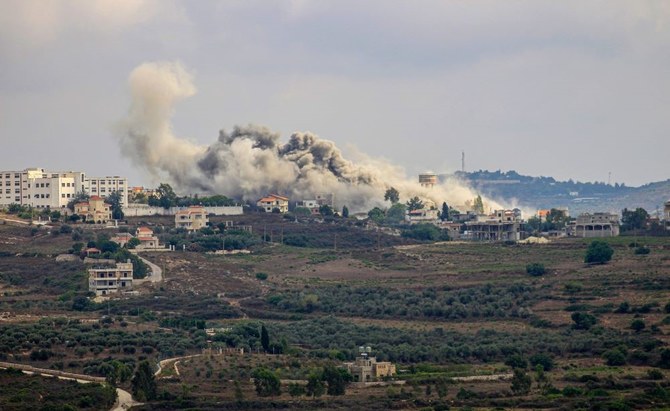
Israel targeted the towns of Kafr Shuba, Tayr Harfa, and Hula on Wednesday with airstrikes and artillery shelling. A raid also targeted a house in the town of Kfar Hammam, leading to its destruction. This small village is located in Hasbaya District on the eastern side of Nabatieh Governorate.
Hezbollah released a new video recorded by the Hudhud drone within Israel, showcasing footage from inside the Ramat David Air Base, located approximately 50 km from the Lebanese border.
According to Hezbollah, “the footage was captured on Tuesday using a drone.”
The new eight-minute video released by Hezbollah showcases several sensitive areas within the base, including aircraft fuel tanks, the headquarters of Squadron 109, an Iron Dome missile defense platform, and ammunition depots. It also reveals the locations of the Squadron 157 and Squadron 105 headquarters. Hezbollah included an image of the base commander’s office, exposing intricate details of the facility.
This is not the first time Hezbollah has employed such tactics. Previously, the group broadcast aerial footage of critical installations captured by similar unmanned aerial vehicles in Haifa and the Golan Heights.
Israeli media reacted strongly, with one outlet stating: “Over eight minutes of Hezbollah video exposing our vulnerability is a disgrace.”
The Israeli military, however, downplayed the incident, claiming the footage was captured by a drone designed solely for photography and did not affect base operations.
A Hezbollah source linked the timing of the video release to Israeli Prime Minister Benjamin Netanyahu’s visit to Washington.
Amid these developments, the Israeli military announced on Wednesday that its “reserve brigade has completed a drill simulating war scenarios in Lebanon.”
Israeli National Security Minister Itamar Ben-Gvir expressed support for a comprehensive war against Hezbollah, stating: “The sooner, the better.”
However, Israel’s Ambassador to Russia Simona Halperin maintained that while Tel Aviv is prepared for military confrontation with Lebanon, it still prefers a diplomatic solution.
She emphasized that Israel is not interested in a large-scale war. “We cannot dismiss a scenario where Israel might be compelled to engage in a wide-ranging war on the northern front,” she added.
Coinciding with Israel’s war rhetoric, the Canadian Embassy in Lebanon issued a renewed advisory to its citizens.
It called on “Canadians, permanent residents, their spouses, and dependent children to heed travel advisories and leave the country while commercial flights are available.”
The embassy emphasized its focus on assisting individuals in obtaining necessary travel documents and keeping families together during this process.
This escalation comes as thousands of Lebanese expatriates with dual citizenship from Canada, the US, and Europe have arrived in Lebanon for summer vacations.