

Punjab’s disaster management authority sets up relief camps in flood-prone areas

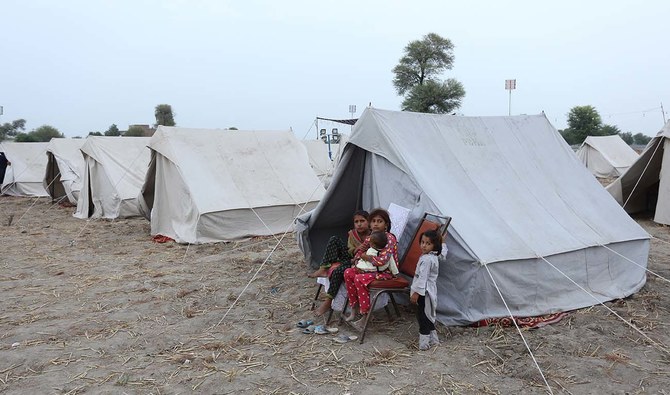
Children are seen in front of a tent in a camp set up by local authorities for flood affected people on August 26, 2023 near Pakpattan. (AFP/File)
Short Url
Updated 24 July 2024
Follow

Punjab’s disaster management authority sets up relief camps in flood-prone areas

  • Current spell of monsoon rains in Punjab expected to continue till July 25, says disaster management authority 
  • Pakistan’s disaster management authorities have warned monsoon rains could trigger “emergency” situation in Punjab

ISLAMABAD: The Punjab Provincial Disaster Management Authority (PDMA) announced on Wednesday that it has set up relief camps in the province’s flood-prone areas, as monsoon rains continue to lash various cities in eastern Pakistan. 

The PDMA spokesperson said rainfall was recorded in Punjab’s Bahawalpur, Rawalpindi, Sheikhupura, Lahore, Joharabad, Attock, Chakwal, Faisalabad, Sialkot and Okara districts of during the last 24 hours.

“PDMA has established flood relief camps in the respective areas given possible flood risk,” Director General PDMA Irfan Ali Kathia said, adding that the current spell of monsoon rains in Punjab is expected to continue till July 25.

“Arrangements are complete because of flood risk in vulnerable districts.”

Heavy monsoon rains have lashed Punjab and Pakistan’s northwestern Khyber Pakhtunkhwa (KP) provinces this week. At least 24 people were killed and 80 injured in Punjab this month as heavy rains lashed many parts of the province, according to official figures.

Highlighting that heavy rains could trigger flash floods that could pass through the Sulaiman Mountains in Pakistan, Kathia said the PDMA’s control room and district emergency operation centers were monitoring the situation 24/7.

He warned people against touching electric wires and poles and advised them against traveling unnecessarily in bad weather. He requested them to undertake preventive measures during the monsoon season.

Kathia said the water flow in all rivers and barrages of Punjab was at the normal level, highlighting that the level of water in Mangla Dam remains at 56 percent and Tarbela at 68 percent. The water levels in the Indian dams on rivers Sutlej and Ravi were up to 37 percent.

Pakistan is recognized as one of the most vulnerable countries in the world to climate change effects. Unusually heavy rains in June 2022 triggered flash floods in many parts of the country, killing over 1,700 people, inflicting losses of around $30 billion, and affecting at least 30 million people.


Pakistan army chief meets world leaders in rare Davos appearance

Updated 6 sec ago
Follow

Pakistan army chief meets world leaders in rare Davos appearance

  • Field Marshal Asim Munir attends World Economic Forum alongside prime minister
  • Pakistan delegation holds meetings with US, Saudi and Azerbaijani leaders

ISLAMABAD: Pakistan’s Chief of Army Staff Field Marshal Syed Asim Munir is attending the World Economic Forum’s annual meeting in Davos this week alongside Prime Minister Shehbaz Sharif, marking a rare appearance by a serving army chief at the global gathering of political and business leaders.

Pakistan’s participation at Davos comes as Islamabad seeks to attract investment, project economic stability and deepen engagement with key international partners following recent reforms aimed at stabilizing the economy. 

While Pakistani leaders routinely attend the World Economic Forum, it is uncommon for a serving army chief to be present. In 2017, former army chief Raheel Sharif addressed the forum only after his retirement, while General Pervez Musharraf spoke at Davos on a number of occasions in his role as president, not as military chief. 

Pakistan’s governance structure has evolved in recent years, particularly through the expanded role of the military in economic decision-making through bodies such as the Special Investment Facilitation Council, a civil-military platform designed to fast-track foreign investment in sectors including minerals, energy, agriculture and technology.

“The Prime Minister and the Field Marshal met with the President of Azerbaijan Ilham Aliyev, United States Secretary of State Marco Rubio, and Saudi Arabia’s Foreign Minister Prince Faisal bin Farhan Al Saud,” Sharif’s office said in a statement.

Officials say the delegation’s engagements focused on strengthening economic ties and maintaining high-level contact with partners in the Middle East, Central Asia and the United States at a time of shifting global economic and strategic alignments.

The World Economic Forum’s annual meeting brings together heads of state, ministers, investors and corporate leaders to discuss global economic risks, investment trends and geopolitical challenges. Davos is not a military forum, and while security issues are discussed there, the physical presence of a serving military chief remains the exception, not the norm, across countries. When military figures do appear, it is usually because they are heads of state or government, retired and speaking as security experts or hold a civilian defense portfolio such as defense minister or national security adviser.