The vanishing roadside book stalls of Rawalpindi

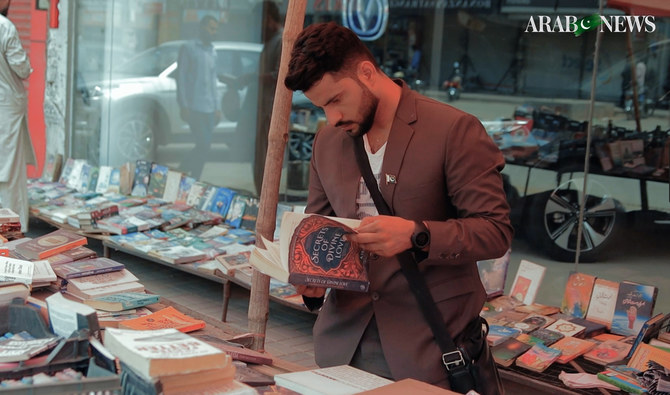
In this photograph taken on July 20, 2024, a man reads a book at a roadside book stall in Rawalpindi. (AN Photo)
Short Url
Updated 24 July 2024
Follow

The vanishing roadside book stalls of Rawalpindi

  • Roadside book bazaar along Rawalpindi’s main Saddar market came up in the eighties, thrived until at least 2010
  • Rise of e-books has changed reading habits, economic factors and urban development have also impacted bazaars

RAWALPINDI: For Kishwar Naheed, one of Pakistan’s greatest living Urdu poets and writers, visiting the hundreds of book stalls stretched along Rawalpindi’s main Saddar market was once a usual Sunday morning activity. 
But as the stalls have dwindled and book hawkers have disappeared, Naheed and others like her have been left only with the memories and a deep sense of loss over a disappearing literary culture and what was once the center of Rawalpindi’s intellectual life.
“Every Sunday morning, Zahid Dar [Urdu poet], Intizar [Hussain] Saab [novelist], myself, all my writer friends, we used to go there [Rawalpindi book bazaar] and try to pick up books,” Naheed told Arab News in an interview this week. “It was a craze for books.”
Rawalpindi’s open-air book stalls came up in the eighties and thrived until at least 2010 when the downfall slowly began, said Fareed-ul-Haq, a 69-year-old book stall owner. 
“I’ve been selling books in this market for 25 years and this roadside book bazaar has been around for 50 years,” he told Arab News, saying people used to travel from other cities to visit the stalls, browsing for hours and often arriving with handwritten notes of titles they wanted. 
“I have seen the high point of this market when the condition was such that it was so crowded it was difficult to walk here. Now people bring their books and it turns out they are their grandparents’ books and the grandson wants to sell them because he doesn’t value books.”
The roadside stalls offer a wide variety of new and old books: antique volumes, school books, historical works, fiction in different languages and all kinds of magazines. 
But the rise of digital media and online bookstores has impacted the viability of book bazaars, sellers and customers said, with smartphones and social media causing a shift worldwide in how people consume information and read.
“We live in an era of social media, online and virtual books and many people don’t prefer reading physical books anymore,” Noaman Sami, a media sciences student at Rawalpindi’s Riphah International University, told Arab News.
Economic factors are also behind the decline in book bazaars, according to Muhammad Hameed Shahid, a Pakistani short story writer, novelist and literary critic.
Rising rents, inflation and the increasing cost of living had made it difficult for many booksellers to sustain their businesses, while customers had less money to spend on luxuries like books. Urban development projects have also displacd book bazaars as the literary corners are repurposed for commercial or residential development.
“Ordinary people often can’t afford expensive books, but at these roadside book stalls, you would find treasures,” Shahid said. “There’s a wide variety of books available, and these vendors sitting on our footpaths deserve support so that through them the flame of knowledge stays alive and books continue to reach our children.”
The bazaar, the writer said, had been a major player in his own literary journey:
“These vendors who used to be sitting on the footpaths with books spread around them, those books, covering all sorts of topics, they played a vital role in my career, they inspired me to become a writer.”
Future generations in Rawalpindi won’t get to experience this, Haq, the bookseller, lamented. 
“I’ve seen this market crowded with people,” he said as he sat alone at his stall on a Sunday morning this month, waiting for customers. “But now, it’s nearly empty.”


Review: Netflix’s ‘The New Yorker at 100’

Updated 14 December 2025
Follow

Review: Netflix’s ‘The New Yorker at 100’

  • Directed by Marshall Curry, the documentary opened the doors to the publication’s meticulous world, offering viewers a rare look inside the issues within the magazine’s issues

Out this month, Netflix’s “The New Yorker at 100” documentary marks the centennial of the weekly that has brought forth arguably some of the most compelling long-form journalism in my lifetime.

As a ferocious reader with an insatiable appetite for print, I vividly recall picking-up a copy of The New Yorker in Saudi Arabia after school as a teen, determined to read it cover-to-cover — only to find myself mentally, intellectually and physically exhausted after deciphering a single lyrical and Herculean-sized long-form piece.

Reading The New Yorker still makes one both feel smarter — and perhaps not smart enough — at the very same time. Just like the documentary.

Much like Vogue’s 2009 documentary, “The September Issue,” which followed (now retired) editor-in-chief Anna Wintour as she prepared for the September 2007 issue; this documentary largely centered on the making of the Feb. 17 & 24, 2025 multi-cover edition.

A quintessentially New York staple that readers either love or loathe — or both — the magazine has long been seen as a highbrow publication for the “elite.”

But The New Yorker is in on the joke. It never did take itself too seriously.

Directed by Marshall Curry, the documentary opened the doors to the publication’s meticulous world, offering viewers a rare look inside the issues within the magazine’s issues.

Narrated by actress Julianne Moore, it included sit-down interviews with famous figures, largely offering gushing testimonials.

It, of course, included many cameos from pop culture references such as from “Seinfeld,” “The Good Place” and others.

It also mentioned New Yorker’s famed late writers Anthony Bourdain and Truman Capote, and Ronan Farrow.

As a journalist myself, I enjoyed the behind-the-scenes peeks into staff meetings and editing discussions, including the line-by-line fact-checking process.

While lovingly headquartered in New York — and now based at One World Trade Center after decades in the heart of Times Square — the magazine has long published dispatches from elsewhere in the country and around the world.

I wish there had been more airtime dedicated to Jeanette “Jane” Cole Grant, who co-founded the magazine with her husband-at-the-time, Harold Ross, during the Roaring Twenties.

Ironically, neither founder hailed from New York — Grant arrived from Missouri at 16 to pursue singing before becoming a journalist on staff at The New York Times — and Ross came from a Colorado mining town.

Perhaps more bizarrely, Ross, who served as the first editor-in-chief of The New Yorker — known today for its intricate reporting and 11 Pulitzer Prizes — had dropped out of school at 13. He served as lead editor for 26 years until his death, guided by instinct and surrounded by talented writers he hired.

As the Pulitzer Prize-winning journalist and the magazine’s fifth editor-in-chief, David Remnick has held the role since 1998. “It is a place that publishes a 15,000-word profile of a musician one week, a 9,000-word account from Southern Lebanon, with gag cartoons interspersed in them,” he said in one scene.

It also offered a glimpse of the leadership of his predecessor, the vivacious and provocative Tina Brown, who served as editor-in-chief for six years starting in 1992.

No woman has held the top editor position before or since her tenure.

Some of the most compelling moments in the documentary, for me, showed journalists scribbling in reporter notebooks in darkened movie theaters, rocking-out in dingy punk shows, and reporting from political rallies while life unfolded around them.

These journalists were not sitting in diners, merely chasing the money or seated in corner offices; they were on the ground, focused on accuracy and texture, intent on portraying what it meant to be a New Yorker who cared about the world, both beyond the city’s borders and within them.

While Arab bylines remain limited, the insights from current marginalized writers and editors showed how the magazine has been trying to diversify and include more contributors of color. They are still working on it.

A century in, this documentary feels like an issue of The New Yorker — except perhaps easier to complete.