Digital Cooperation Organization calls for urgent talks on recent global IT outage implications

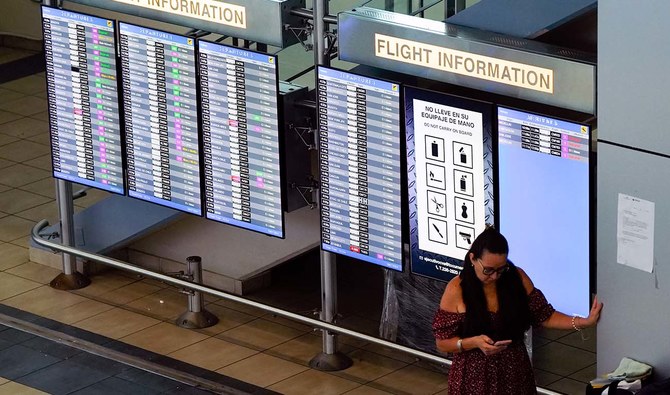
A passenger checks her mobile phone next to monitors display displaying flights information at Tocumen International Airport in Panama City on July 19, 2024, after a bug caused a global outage affecting airports, making it impossible to board planes and forcing multiple delays and cancellations around the world. (AFP/File)
Short Url
Updated 23 July 2024
Follow

Digital Cooperation Organization calls for urgent talks on recent global IT outage implications

  • The DCO, which includes Saudi Arabia, Pakistan and 14 other states, is the world’s first standalone intergovernmental body on digital economy
  • The DCO secretariat states the high level of impact the world witnessed as a result of the outage is ‘alarming’ and requires ‘agile’ cooperation

RIYADH: The Digital Cooperation Organization’s (DCO) General Secretariat said in a statement that it will hold urgent discussions with its Member States and digital economy experts to address the implications of the global IT outage that disrupted vital operations around the world, affecting critical business sectors like aviation, banking, broadcast media, software providers, and more.
The DCO General Secretariat states that “the high level of impact the world witnessed as a result of the unfortunate outage is alarming and indicates the dire need for a more effective and agile international digital cooperation.” The incident raised questions on continuity and sustainability in a world rapidly moving toward being highly dependent on digital channels and platforms. It is very crucial that the international community develops proper policies and protocols to mitigate the risks of such incidents and ensure the continuity of essential operations.
To this end, the DCO General Secretariat has called for an urgent deliberation for its Member States and digital economy experts to capture the lessons learned from this incident, assess its impact on national digital transformation plans in Member States, and plan practical steps to ensure that relevant stakeholders across sectors are aligned and ready to deal with such mishaps.
The Digital Cooperation Organization is the world’s first standalone international intergovernmental organization focusing on the acceleration of the growth of an inclusive and sustainable digital economy. It is a global multilateral organization founded in November 2020 that aims to enable digital prosperity for all.
The 16 DCO Member States include the Kingdom of Bahrain, the People’s Republic of Bangladesh, the Republic of Cyprus, the Republic of Djibouti, the Republic of The Gambia, the Republic of Ghana, the Hellenic Republic (Greece), the Hashemite Kingdom of Jordan, the State of Kuwait, the Kingdom of Morocco, the Federal Republic of Nigeria, the Sultanate of Oman, the Islamic Republic of Pakistan, the State of Qatar, the Republic of Rwanda, and the Kingdom of Saudi Arabia — collectively representing nearly $3.5 trillion in GDP and a market of nearly 800 million people, more than 70 percent of whom are under the age of 35.


India’s prime minister says it has reached a free trade deal with the EU

Updated 4 sec ago
Follow

India’s prime minister says it has reached a free trade deal with the EU

  • It touches a whopping 2 billion people and is one of the biggest bilateral engagements on commerce
  • The timing comes as Washington targets both India and the EU with steep import tariffs
NEW DELHI: Prime Minister Narendra Modi said Tuesday that India and the European Union have reached a free trade agreement to deepen their economic and strategic ties.
The accord, which touches a whopping 2 billion people, was concluded after nearly two decades of negotiations. It was dubbed the “mother of all deals” by both sides.
It is one of the biggest bilateral engagements on commerce. The timing comes as Washington targets both India and the EU with steep import tariffs.
“This agreement will bring major opportunities for the people of India and Europe. It represents 25 percent of the global GDP and one-third of global trade,” Modi said while virtually addressing an energy conference.
The deal comes at a time when Washington is targeting both India and the EU with steep tariffs, disrupting established trade flows and pushing major economies to seek alternate partnerships.
Modi was scheduled to meet with European Commission President Ursula von der Leyen later Tuesday to jointly announce the agreement.
India has stepped up efforts to diversify its export destinations as part of a broader strategy to offset the impact of higher US tariffs.
The tariffs include an extra 25 percent levy on Indian goods for its unabated purchases of discounted Russian oil, bringing the combined tariffs imposed by the United States on its ally to 50 percent.
The deal gives the EU expanded access to one of the world’s fastest-growing major economies, helping European exporters and investors to reduce their reliance on more volatile markets.
Bilateral trade between India and EU stood at $136.5 billion in 2024-25. The two sides hope to increase that to about $200 billion by 2030, India’s Trade Ministry officials said.
“Ultimately, the agreement is about creating a stable commercial corridor between two major markets at a time the global trading system is fragmenting,” said Indian trade analyst Ajay Srivastava.
The EU is still reeling from the aggressive approach of its once-stalwart ally across the Atlantic. There’s a widespread sense of betrayal across the 27-nation bloc from US President Donald Trump’s onslaught of higher tariffs, embrace of far-right parties, and belligerence over Greenland.
Brussels has accelerated its outreach to markets around the world: Over the past year, von der Leyen has signed deals with Japan, Indonesia, Mexico, and South America under the catchphrase “strategic autonomy,” which in practice is akin to decoupling from a US seen by most European leaders as erratic.
“We are showing a fractured world that another way is possible,” she posted on X after arriving in India on Sunday.