

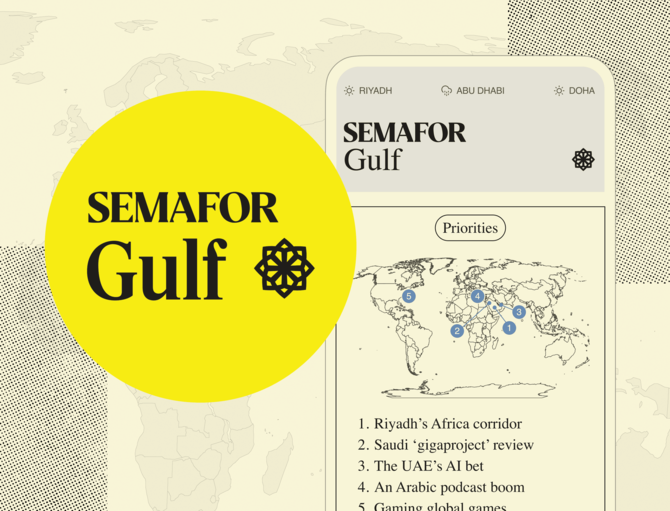

LONDON: News platform Semafor will launch in the Middle East on Sept. 16 with former Dow Jones reporter Mohammed Sergie as editor, marking the firm’s third edition in addition to the US and Sub-Saharan Africa.
Semafor Gulf will feature original reporting and a thrice-weekly newsletter that will analyze the region’s financial, business and geopolitical scenarios and their impact around the world.
“The core of our editorial idea and model around the international news opportunity is this notion that most of the existing dominant English-language news media was created and designed in the 19th century by American and British newspapers, to a large extent, that were domestic news brands,” said Justin Smith, co-founder and CEO of Semafor.
These news brands would then “re-export their content to the rest of the world” almost as an afterthought and send their correspondents around the world to report back for their home country, he told Arab News.
As the world has changed and the number of English-language readers has multiplied, he continued, there is a need for a new model where international reporting “is not done exclusively to report back news for the home country, but rather is created for people around the world — news consumers in the regions where those journalists are, in addition to people who are interested in that region.
“This notion of a foreign correspondent in 2024 is outdated and not as relevant.”
Semafor Gulf, led by Sergie, will launch with a team of staff reporters as well as columnists covering Saudi Arabia, the UAE and Qatar, and will continue to expand through 2025.
Sergie, who began his career in the UAE, previously established the Saudi Arabia bureau for Dow Jones in 2008 and served as an editor at Bloomberg News.
Semafor is, in some ways, different from other news brands in that it is “source-agnostic” and is “trying to tell the story a little bit differently, engaging with a sophisticated audience,” said Sergie.
Being a “multi-source media platform,” Semafor features “expert distillation and curation of the best content out there” along with its original content in order to provide a holistic understanding of a particular story, explained Justin Smith.
And currently, Sergie added, “there is a gap in the market of a smart read that brings in information from all sources.”
For example, in Saudi Arabia, officials often share information through podcasts, which does not necessarily feature in “the traditional media diet people have,” he explained.
There is also a different “scene” in each country across the Gulf — a “renaissance” of sorts across different industries — that Semafor wants to capture and bring to the audience, Sergie told Arab News.

Veteran journalist Mohammed Sergie will lead Semafor Gulf. (Semafor)
In addition to culture and business, the Middle East is a geopolitically charged region posing both challenges and opportunities to news platforms.
“The Gulf is this incredibly important site for politics, and these things (politics and other topics like economy and business) are intertwined,” said Ben Smith, co-founder and editor-in-chief of Semafor (of no relation to Justin).
There will “definitely be a geopolitical aspect” to Semafor Gulf’s coverage, Sergie added.
The firm will hire “at least half a dozen journalists across the region,” Justin Smith said, and roughly half of them will be based in Saudi Arabia owing to it possessing the largest share in the Gulf market.
In line with catering to the region, Sergie said the company would “probably experiment with some other channels” such as WhatsApp to reach a broader audience, specifically in the Gulf Cooperation Council area.
Based on his non-journalistic experience, he believes that most corporate and political leaders are “glued to their email,” so will “always consume that way.” And while he agreed that the average reader does not consume news through email, they are not Semafor’s target audience, he said.
The news brand’s coverage is carefully curated for a specific type of reader. “We see the audience as everybody who is obsessed with this story, which certainly includes lots of people in the region, but also includes lots of people outside the region,” said Ben Smith.
Moreover, Justin Smith asserted: “We are not a mass news brand. We’re not interested in reaching every single person.”
Semafor is for the leadership class and for those people who are based in the region as well as those based outside it, but still “deeply interested” in it, he explained.
And that is a key factor differentiating Semafor Gulf from other English-language news companies in the region.
“My understanding is that some of the big global English-language news brands have not necessarily invested as aggressively into the Gulf region, commensurate with the growth of the Gulf story,” said Justin Smith.
Global legacy news media brands usually report for their home country, but we are going to “flip that on its head and actually report for the region and the world interested in the region,” he continued.
Semafor Gulf’s approach is to tailor its content for readers who are sophisticated and passionate about the region while removing the filter that the US or UK might apply to a regional story to make it more relevant for readers in their home base, explained Ben Smith.
Global news outlets often contextualize stories of and about the region in ways that make them more “exotic” or relevant to readers in their home country, he said.
These global media outlets are in a phase where they are “constantly rediscovering the shifts in Saudi Arabia” as if it is a new story; but Semafor Gulf would like to “write with the assumption that people (readers) actually know what’s going on,” Ben Smith explained.
In terms of distinguishing itself from regional media outlets, Justin Smith said, Semafor Gulf will add a “global lens” and “connect the dots” between global and regional stories resulting in a more international “macro sensibility” that is less “Western-centric.”
He continued: “Semafor is a mosaic of multiple sources put together very carefully and very intentionally to bring ideological balance, and so you will see us looking to bring that kind of geographic and ideological balance together, even in the Gulf.”
And so, Justin Smith added, Semafor describes itself as an “intelligent service, as much as a news brand” because as “readers try to triangulate this incredibly complicated news landscape,” Semafor offers a multitude of expert content for readers to consume “quickly and get a much deeper, more insightful, more balanced understanding of any given news story.”


