BEIRUT: An Israeli air strike in Lebanon about 30 kilometers from the border injured civilians on Saturday, Lebanese state media said, after Hezbollah and its Palestinian ally Hamas fired rockets and explosive-laden drones at Israeli positions.
Hezbollah has traded near-daily cross-border fire with Israeli forces in support of Hamas since the Palestinian militant group’s October 7 attack on southern Israel triggered war in the Gaza Strip.
“The Israeli enemy launched a raid on the town of Adloun” in south Lebanon, the state-run National News Agency said, adding that “a number of civilians have been injured” and traffic on the highway interrupted in both directions.
Videos circulating online showed several big explosions in the coastal town.
“Shrapnel from the explosions flew to surrounding villages,” the NNA said.
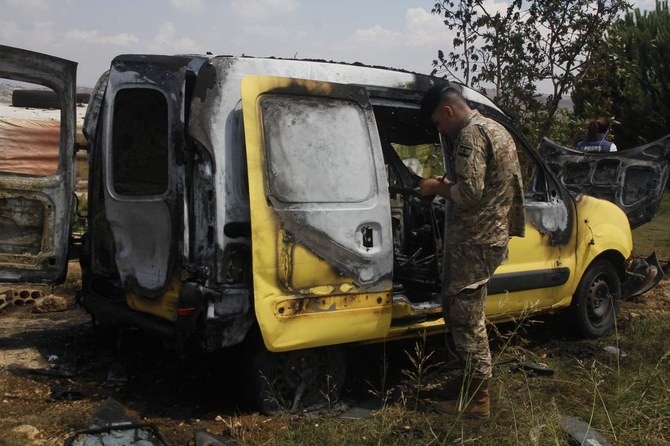
Earlier Saturday, NNA said Syrian nationals, including children, had been injured after an “enemy drone targeted an empty four-wheel drive” near their tent, close to the border.
Doctor Mouenes Kalakesh, who heads the Marjayoun government hospital, said a woman and her three children, two of them minors, had been admitted for shrapnel injuries after the strike outside Burj Al-Muluk.
Among them was an 11-year-old boy in critical condition after he sustained shrapnel injuries and a head wound, Kalakesh told AFP.
Hezbollah said it launched “dozens of Katyusha rockets” on Dafna, an area in Israel’s north that the group said it was targeting for the first time, “in response to the attack on civilians.”
Hamas’s armed wing, the Ezzedine Al-Qassam Brigades, said they also fired a rocket salvo from south Lebanon toward an Israeli military position in the Upper Galilee “in response to the Zionist massacres against civilians in the Gaza Strip.”
Later on Saturday, the Iran-backed Hezbollah said it also had launched “explosive-laden drones” targeting “artillery and missile positions” and Israeli troops at a site in the Golan Heights as well as Iron Dome platforms.
Before the drone attack, the Israeli army said a total of 45 “projectiles” had been fired from Lebanon Saturday afternoon, toward the occupied Golan Heights and the Galilee, reporting no casualties.
The army said it struck “the launcher in southern Lebanon from which the projectiles were launched toward the Golan Heights,” also targeting “an additional Hezbollah launcher.”
Hezbollah leader Hassan Nasrallah had warned that his Iran-backed group would hit new targets in Israel if more civilians were killed in Israeli strikes.
Israeli strikes on Thursday killed at least five people in Lebanon, including the commander of a Hamas-allied group, a security source and militant groups said.
The violence since October has killed at least 515 people in Lebanon, according to an AFP tally.
Most of the dead have been fighters, but they have included at least 104 civilians.
On the Israeli side, 18 soldiers and 13 civilians have been killed, according to Israeli authorities.


![]()
Lebanon state media says civilians injured in Israeli strike
Short Url
https://arab.news/wezcg
Lebanon state media says civilians injured in Israeli strike
- Hezbollah has traded near-daily cross-border fire with Israeli forces in support of Hamas


Latest updates


© 2026 SAUDI RESEARCH & PUBLISHING COMPANY, All Rights Reserved And subject to Terms of Use Agreement.