Fire-hit tanker enters Malaysia terminal area after being detained by coast guard

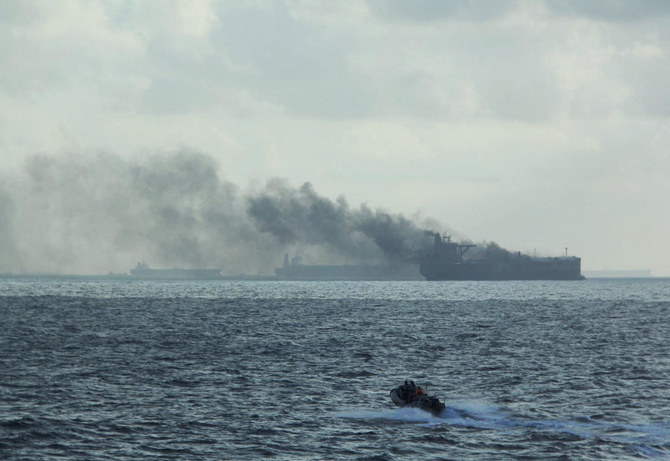
Above, a rigid-hulled inflatable boat in the vicinity of the burning vessels who were involved in a collision about 55km northeast of the Singaporean island of Pedra Branca on July 19, 2024. (Singapore Navy via Reuters)
Short Url
Updated 22 July 2024
Follow

Fire-hit tanker enters Malaysia terminal area after being detained by coast guard

  • The supertanker Ceres I left the scene of a fiery collision with another tanker
  • Singapore is Asia’s biggest oil-trading hub and the world’s largest bunkering port

SINGAPORE: A tanker that was involved in a collision near Singapore last week entered the area of Malaysia’s Bertam floating oil terminal on Monday morning after it was intercepted by local authorities on Sunday, shipping data from LSEG and Kpler showed.
The Sao Tome and Principe-flagged supertanker Ceres I left the scene of a fiery collision with another tanker, the Singapore-flagged Hafnia Nile, on Friday.
The Ceres I was found in Malaysian waters with two tugboats towing it, the coast guard said in a statement on Sunday.
The Ceres I and the two tugboats have been detained by the coast guard for further investigation, it said.
The Bertam floating production, storage and offloading (FPSO) terminal is located in the South China Sea off the east coast of Peninsular Malaysia.
The Ceres I is a very large crude carrier (VLCC) supertanker capable of carrying around 2 million barrels of oil. AIS data on LSEG showed that Ceres I is empty.
Ceres I has loaded crude and fuel oil from Iran and Venezuela through ship-to-ship transfers between 2019 and March 2024, Kpler data showed.
Shanghai Prosperity Ship Management is the manager of the Ceres I, according to LSEG data. The company could not be immediately reached for comment.
Separately, Hafnia, the manager of Hafnia Nile, said over the weekend it was in discussions with Malaysian authorities to safely move the vessel.
The Hafnia Nile, a 74,000-deadweight-tons capacity Panamax tanker, was carrying about 300,000 barrels naphtha for Japan, according to ship-tracking data from Kpler and LSEG. Naphtha is a raw material for making petrochemicals.
Singapore is Asia’s biggest oil-trading hub and the world’s largest bunkering port. Its surrounding waters are among the busiest global sea lanes.
Malaysia’s coast guard said on Sunday that aerial surveys conducted by the coast guard found minor traces of an oil spill at the location of the collision between the Ceres I and the Hafnia Nile, which occurred in the waters about 55 km (35 miles) northeast of the Singaporean island of Pedra Branca.
“The environment department has been informed and will conduct further monitoring,” it said.


Thai villagers stay behind to guard empty homes as border clashes force mass evacuations

Updated 2 sec ago
Follow

Thai villagers stay behind to guard empty homes as border clashes force mass evacuations

SURIN: Fighting that has flared along the Thai-Cambodian border has sent hundreds of thousands of Thai villagers fleeing from their homes close to the frontier since Monday. Their once-bustling communities have fallen largely silent except for the distant rumble of firing across the fields.
Yet in several of these villages, where normally a few hundred people live, a few dozen residents have chosen to stay behind despite the constant sounds of danger.
In a village in Buriram province, about 6 miles (10 kilometers) from the border, Somjai Kraiprakon and roughly 20 of her neighbors gathered around a roadside house, keeping watch over nearby homes. Appointed by the local administration as Village Security Volunteers, they guarded the empty homes after many residents were forced to flee and with fewer security officials stationed nearby than usual.
The latest large-scale fighting derailed a ceasefire pushed by US President Donald Trump, which halted five days of clashes in July triggered by longstanding territorial disputes. As of Saturday, around two dozen people had been reported killed in the renewed violence.
At a house on the village’s main intersection, now a meeting point, kitchen and sleeping area, explosions were a regular backdrop, with the constant risk of stray ammunition landing nearby. Somjai rarely flinched, but when the blasts came too close, she would sprint to a makeshift bunker beside the house, built on an empty plot from large precast concrete drainage pipes reinforced with dirt, sandbags and car tires.
She volunteered shortly after the July fighting. The 52-year-old completed a three-day training course with the district administration that included gun training and patrol techniques before she was appointed in November. The volunteer village guards are permitted to carry firearms provided by relevant authorities.
The army has emphasized the importance of volunteers like Somjai in this new phase of fighting, saying they help “provide the highest possible confidence and safety for the public.”
According to the army, volunteers “conduct patrols, establish checkpoints, stand guard inside villages, protect the property of local people, and monitor suspicious individuals who may attempt to infiltrate the area to gather intelligence.”
Somjai said the volunteer team performs all these duties, keeping close watch on strangers and patrolling at night to discourage thieves from entering abandoned homes. Her main responsibility, however, is not monitoring threats but caring for about 70 dogs left behind in the community.
“This is my priority. The other things I let the men take care of them. I’m not good at going out patrolling at night. Fortunately I’m good with dogs,” she said, adding that she first fed a few using her own money, but as donations began coming in, she was able to expand her feeding efforts.
In a nearby village, chief Praden Prajuabsook sat with about a dozen members of his village security team along a roadside in front of a local school. Around there, most shops were already closed and few cars could be seen passing once in a while.
Wearing navy blue uniforms and striped purple and blue scarves, the men and women chatted casually while keeping shotguns close and watching strangers carefully. Praden said the team stationed at different spots during the day, then started patrolling when night fell.
He noted that their guard duty is around the clock, and it comes with no compensation and relies entirely on volunteers. “We do it with our own will, for the brothers and sisters in our village,” he said.
Beyond guarding empty homes, Praden’s team, like Somjai, also ensures pets, cattle and other animals are fed. During the day, some members ride motorbikes from house to house to feed pigs, chickens and dogs left behind by their owners.
Although his village is close to the battlegrounds, Praden said he is not afraid of the sounds of fighting.
“We want our people to be safe… we are willing to safeguard the village for the people who have evacuated,” he said.