

Jordanian trade delegation visits Tunisia to enhance economic ties

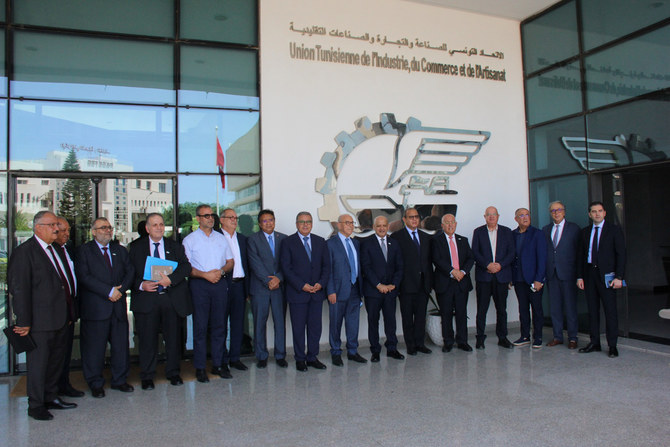
A Jordanian trade delegation on Sunday concluded a trip to Tunisia. (Petra)
Short Url
Updated 21 July 2024
Follow

Jordanian trade delegation visits Tunisia to enhance economic ties

  • Key discussions highlighted the potential to enhance tourism cooperation

AMMAN: A Jordanian trade delegation on Sunday concluded a trip to Tunisia aimed at strengthening economic relations, Jordan News Agency reported.

The visit was organized by the Amman Chamber of Commerce in collaboration with the Tunisian Embassy in Amman. It included a series of meetings with companies, visits to several factories, and discussions with various professional unions, associations and commercial and industrial sectors in Tunis, Sousse and Sfax.

During the multiday visit, the delegation identified promising investment opportunities across diverse sectors, including textiles, automotive parts manufacturing, food industries, tourism, logistics, and medical supplies.

Key discussions highlighted the potential to enhance tourism cooperation, promoting each country as a destination through reciprocal initiatives.

The delegation emphasized the importance of regular exchanges and exhibitions to deepen business ties between Jordan and Tunisia, supported by an updated joint database on economic and investment opportunities.

Talks resulted in a series of understandings and the renewal of agreements, paving the way for broader economic engagement aligned with the mutual interests of both countries.

Immediate plans include organizing sector-specific visits for business owners from both countries, with the first delegation focused on the clothing and footwear sector scheduled to visit Tunisia within the next two months, Petra reported.

The ACC highlighted the economic agreements linking Jordan and Tunisia with various global economic blocs, facilitating their presence in regional markets such as Europe and Africa.

In 2023, bilateral trade between Jordan and Tunisia reached $35 million. Jordan’s exports were primarily in chemicals, plastics, textiles, metals, food products and agricultural goods.

In meetings with Tunisian Minister of Trade and Export Development Kalthoum Ben Rejeb, ACC Chairman Khalil Haj Tawfiq called for strengthened cooperation between businesses in the two countries.

He proposed addressing impediments to trade flow in the legislative, logistical and administrative domains, while suggesting the establishment of a joint higher committee to facilitate joint exhibitions and networking events.

Ben Rejeb emphasised the importance of such meetings in enhancing economic ties and identifying new avenues for trade, particularly in strategic sectors such as pharmaceuticals, automotive components, electrical goods and food industries.

She underscored Tunisia’s role as a gateway to Africa and Jordan’s strategic positioning for Gulf markets, highlighting the potential for enhanced economic integration.


Lebanon finance minister defends tax hike after outcry

Updated 5 sec ago
Follow

Lebanon finance minister defends tax hike after outcry

  • Jaber said the wage hike would cost the state $620 million, hence the decision to raise taxes was made to “preserve financial balance”
  • The decision was not unanimous, with Energy Minister Joe Saddi saying he had “objected”

BEIRUT: Lebanon’s finance minister defended on Tuesday his government’s decision to raise taxes to finance a hike in public sector wages, which sparked an outcry from a major union and a protest that briefly blocked a Beirut artery.
The cabinet’s decision the day before aimed to increase by sixfold rock-bottom wages and pension payments for hundreds of thousands of civil servants and retirees in a country still reeling from a devastating economic crisis that started in 2019.
In addition to the crisis, Lebanon is also suffering the aftereffects of a recent war between Iran-backed Hezbollah and Israel, with the international community conditioning aid on public reforms.
The new decision raises the value-added tax (VAT) to 12 percent, from 11 percent before, and adds 300,000 Lebanese pounds (around $3.30) per 20-liter can of gasoline.
Finance Minister Yassin Jaber said in a press conference on Tuesday that the wage hike would cost the state $620 million, hence the decision to raise taxes was made to “preserve financial balance, because any imbalance would lead us to a crisis.”
The decision was not unanimous, with Energy Minister Joe Saddi saying he had “objected... to approving any tax increases at this stage.”
Lebanon has around 320,000 public servants, including 120,000 security forces members, according to Jaber.
Their salaries have shrunk due to the severe depreciation of the Lebanese pound’s value over the past six years.
Under the decision, public sector wages would increase to about 28 percent of their value before the 2019 crisis, Walid Geagea, head of the Public Sector Employees Association, told AFP.
But Geagea rejected the government’s move, saying “you give us a sixfold increase and it goes away (by paying for) fuel and taxes.”
Bassam Tlais, head of Federations and Unions of the Land Transport Sector, said in a statement they “support improving wages, but we refuse to place this additional burden on citizens and the transport sector.”
“Our demand is to find fair alternatives that don’t burden people financially.”
Taxi drivers briefly blocked a road in central Beirut earlier on Tuesday to protest the decision.
Senior financial adviser Michel Kozah told AFP that the cabinet’s move “will create inflation,” adding that “the central bank will be forced to increase the money in circulation.”