

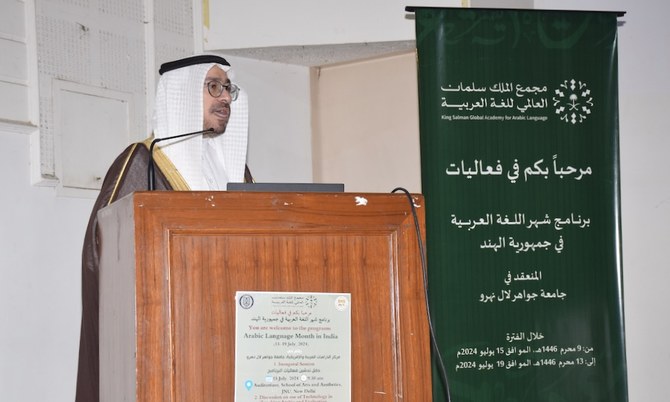
King Salman Global Academy spotlights India’s role in promoting Arabic language

King Salman Global Academy for Arabic Language Secretary-General Dr. Abdullah bin Saleh Al-Washmi speaks to Indian scholars during the Arabic Language Month in New Delhi. (KSGAAL)
Short Url
Updated 20 July 2024
Follow

King Salman Global Academy spotlights India’s role in promoting Arabic language

  • KSGAAL is hosting Arabic Language Month for Indian students and teachers
  • Initiative is in line with Human Capability Development Program of Vision 2030

NEW DELHI: India plays a significant role in promoting the Arabic language in the wake of growing commercial exchanges with Saudi Arabia, the Kingdom’s top linguistic institution has said, as it conducted a series of programs for Indian scholars and learners.

Students and lecturers from the Indian universities and colleges that teach Arabic courses are taking part in training sessions, workshops and competitions as part of the Arabic Language Month organized by the King Salman Global Academy for Arabic Language.

The event, which aims to develop and improve the teaching of Arabic for non-native speakers in the world’s most populous nation, began online in late June and runs until July 26.

The main host is Jawaharlal Nehru University in New Delhi, which has been teaching Arabic for decades.

“India plays a significant role in promoting the Arabic language, driven by a growing demand for learning Arabic within its vast and diverse human, linguistic and cultural landscape,” KSGAAL Secretary-General Dr. Abdullah bin Saleh Al-Washmi told Arab News on Friday.

“Despite India’s diverse multilingual landscape, there is a growing interest in learning Arabic, fueled by increasing commercial activities and cultural exchanges.”

The Arabic Language Month in India features a range of educational activities led by Saudi linguists affiliated with the KSGAAL — from competitions and workshops to enhance Arabic language teaching curricula at different educational institutions, to specialized sessions for instructors to familiarize them with the most recent teaching methodology.

“These activities are conducted in different educational institutions across India, with the primary goal of fostering stronger relationships with Indian universities that have an interest in teaching Arabic,” Al-Washmi said.

“Moreover, the Arabic Language Month serves as a platform to highlight the Kingdom of Saudi Arabia’s efforts in promoting and teaching the Arabic language through innovative methods. This initiative is in line with the objectives of the Human Capability Development Program, a key component of the Kingdom’s Vision 2030.”

Upholding and promoting the Arabic language is part of the Vision 2030 transformation strategy, which also focuses on the development of skills and academia.

“The program also focuses on enhancing the teaching skills of Arabic language educators, both locally and globally, particularly in non-native speaking communities,” Al-Washmi said.

“These initiatives include supporting modern activities for teaching Arabic to non-native speakers, enhancing the teaching competencies of instructors, and organizing scientific competitions to discover and encourage individuals with linguistic talents.”


Separation of Somali conjoined twins Rahma and Ramla begins in Riyadh

Updated 14 sec ago
Follow

Separation of Somali conjoined twins Rahma and Ramla begins in Riyadh

  • Surgery to take 14 hours in 8 stages with 37-member team
  • Initiative is led by leading surgeon Dr. Abdullah Al-Rabeeah

RIYADH: Surgery to separate Somali conjoined twins Rahma and Ramla is underway at the King Abdullah Specialized Children’s Hospital of the Ministry of the National Guard in Riyadh.

The children came with their parents to Saudi Arabia upon King Salman’s directives in May last year and were transferred to the hospital for tests to determine whether the operation would be safe.

An official of the Saudi Conjoined Twins Program told Arab News that in addition to the complexity of the intervention, there was also a waiting list of other children.

Dr. Abdullah Al-Rabeeah, who heads the SCTP’s teams and is also supervisor-general of the Saudi aid agency KSrelief, said the 13-month-old girls who arrived on May 6 were joined at the lower abdomen and pelvis. 

“Each twin has two complete lower limbs, and they share a pelvic bone, colon and rectum, with overlaps in the urinary and reproductive systems,” said Al-Rabeeah.

He explained that Ramla suffers from complete atrophy of both kidneys and would need immediate dialysis after separation.

Rahma suffers from complete atrophy of her left kidney, and there are cysts in her right kidney, which is currently functioning adequately but would require close monitoring following surgery to ensure its continued function, he added. 

Al-Rabeeah said the risk was 40 percent due to the case’s medical challenges. The situation was explained in detail to the twins’ parents, who accepted the plan to separate the girls, he added.

He said the procedure is expected to take about 14 hours in eight stages, and would involve 37 consultants, specialists, nurses and staff in the fields of anesthesia, pediatrics, orthopedics and plastic surgery.

He said Rahma and Ramla will be the 68th pair of conjoined twins to be separated under the program, which began 35 years ago. 

Al-Rabeeah thanked the Saudi leadership for supporting the initiative over the years. He prayed for the success of the separation, which he said would give the girls the best chance to live happy and healthy lives.