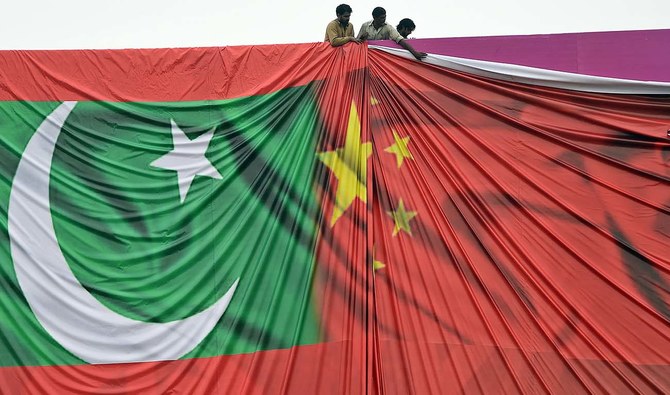
ISLAMABAD: Pakistan has decided to invite Chinese companies for investment in seven major sectors of the economy, Privatization Minister Abdul Aleem Khan said on Saturday, amid the South Asian country’s quest for foreign funds to support its economy.
The statement came after a meeting attended by Khan, Commerce Minister Jam Kamal Khan with regard to bilateral trade between Pakistan and China, according to Pakistan’s Privatization Commission.
These major sectors include medical appliances, plastics, clothing, leather, meat, fruit and vegetables, and waste and fodder, while a strategy for joint ventures between Chinese and Pakistani companies has been finalized.
“Cooperation between Chinese companies can increase bilateral trade by $1 billion,” Khan, who is also the chairman of Pakistan’s Board of Investment (BOI), was quoted as saying in a statement by Privatization Commission. “Pakistan wants to open new doors of bilateral trade with China in various fields.”
Khan asked officials to immediately discuss the proposals with investment firms and take measures to set up new industries where maximum supply of electricity was possible. “For Chinese companies, the Pakistani embassy in Beijing should also be taken on board,” he said.
Commerce Minister Jam Kamal also held detailed discussions regarding Chinese companies and trade affairs, according to the statement. He directed his ministry to fully cooperate with and join efforts of the Board of Investment.
Pakistan, which has been facing low foreign exchange reserves, currency devaluation and high inflation, this month reached a staff-level agreement with the International Monetary Fund (IMF) for a $7 billion loan.
The South Asian country is making desperate attempts to boost foreign investment to cut its reliance on foreign debts to support its $350 billion fragile economy.


![]()

Pakistan to invite Chinese companies for investment in seven major sectors
Short Url
https://arab.news/wq2eh
Pakistan to invite Chinese companies for investment in seven major sectors
- Development comes days after Pakistan reached a staff-level agreement with the IMF for a $7 billion loan
- Islamabad is trying to boost foreign investment to cut its reliance on foreign debts to support economy
Latest updates


© 2026 SAUDI RESEARCH & PUBLISHING COMPANY, All Rights Reserved And subject to Terms of Use Agreement.