

Bangladesh wakes to torched government buildings, internet blackout

Smoke rises from the burning vehicles after protesters set them on fire near the Disaster Management Directorate office, during the ongoing anti-quota protest in Dhaka on July 18, 2024. (FP)
Short Url
Updated 19 July 2024
Follow

Bangladesh wakes to torched government buildings, internet blackout

  • This week's unrest has killed at least 39 people including 32 on Thursday, with the toll expected to rise further
  • Protesters have called for an end to a quota system that reserves over half of civil service posts for specific groups

Dhaka: Bangladesh woke Friday to survey destruction left by the deadliest day of ongoing student protests so far, which saw government buildings torched by demonstrators and a nationwide internet blackout put into effect.

This week's unrest has killed at least 39 people including 32 on Thursday, with the toll expected to rise further after reports of clashes in nearly half of the country's 64 districts.

A police statement issued after a near-total shutdown of the nation's internet said protesters had torched, vandalised and carried out "destructive activities" on numerous police and government offices.

Among them was the Dhaka headquarters of state broadcaster Bangladesh Television, which remains offline after hundreds of incensed students stormed the premises and set fire to a building.

"About 100 policemen were injured in the clashes yesterday," Faruk Hossain, a spokesman for the capital's police force, told AFP. "Around 50 police booths were burnt".
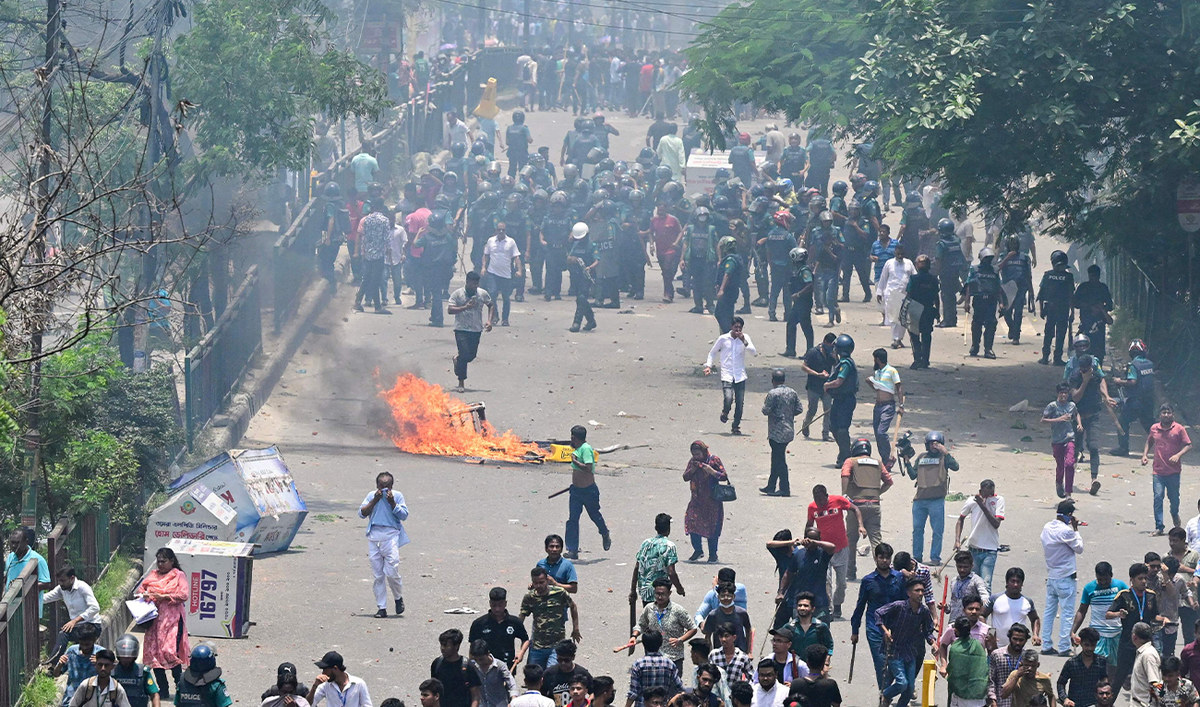


Anti-quota protesters clash with the police in Dhaka on July 18, 2024. (AFP)

The police statement said that if the destruction continued, they would "be forced to make maximum use of law".

Police fire was the cause of at least two-thirds of deaths reported so far, based on descriptions given to AFP by hospital staff.

At least 26 districts around the country reported clashes on Thursday, broadcaster Independent Television reported.

The network said more than 700 had been wounded through the day including 104 police officers and 30 journalists.

Near-daily marches this month have called for an end to a quota system that reserves more than half of civil service posts for specific groups, including children of veterans from the country's 1971 liberation war against Pakistan.

Critics say the scheme benefits children of pro-government groups that back Prime Minister Sheikh Hasina, 76, who has ruled the country since 2009 and won her fourth consecutive election in January after a vote without genuine opposition.

Hasina's government is accused by rights groups of misusing state institutions to entrench its hold on power and stamp out dissent, including by the extrajudicial killing of opposition activists.

Her administration this week ordered schools and universities to close indefinitely as police step up efforts to bring the deteriorating law and order situation under control.

Mubashar Hasan, a Bangladesh expert at the University of Oslo in Norway, told AFP Thursday that the protests had grown into a wider expression of discontent with Hasina's autocratic rule.

"They are protesting against the repressive nature of the state," he told AFP. "The students are in fact calling her a dictator."

Students have vowed to continue their campaign despite Hasina giving a national address on the now-offline state broadcaster seeking to calm the situation.

"Our first demand is that the prime minister must apologise to us," protester Bidisha Rimjhim, 18, told AFP on Thursday.

"Secondly, justice must be ensured for our killed brothers," she added.

London-based watchdog Netblocks said Friday that a "nation-scale" internet shutdown remained in effect.

"The disruption prevents families from contacting each other and stifles efforts to document human rights violations," it wrote in a social media post on X.


Sarkozy describes his prison stay and advises on appealing to the far right in his new book

Updated 2 sec ago
Follow

Sarkozy describes his prison stay and advises on appealing to the far right in his new book

PARIS: Former French President Nicolas Sarkozy described the prison where he spent 20 days as a noisy, harsh “all-grey” world of “inhuman violence” in a book released Wednesday that also offered political advice about how his conservative party should appeal to far-right voters.
In “Diary of a Prisoner,” the 70-year-old says his own tough-on-crime stance has taken on a new perspective as he recounts the uncommon turn in his life after being found guilty of criminal association in financing his winning 2007 campaign with funds from Libya.
The court sentenced him in September to five years in prison, a ruling he appealed. He was granted release under judicial supervision after 20 days behind bars.
The book provides a rare look inside Paris’ La Santé prison, where Sarkozy was held in solitary confinement and kept strictly away from other inmates for security reasons. His loneliness was broken only by regular visits from his wife, supermodel-turned-singer Carla Bruni-Sarkozy, and his lawyers.
Sarkozy wrote that his cell looked like a “cheap hotel, except for the armored door and the bars,” with a hard mattress, a plastic-like pillow and a shower that produced only a thin stream of water. He described the “deafening noise” of the prison, much of it at night.
Opening the window on his first day behind bars, he heard an inmate who “was relentlessly striking the bars of his cell with a metal object.”
“The atmosphere was threatening. Welcome to hell!”
Sarkozy said he declined the meals served in small plastic trays along with a “mushy, soggy baguette” — their smell, he wrote, made him nauseous. Instead, he ate dairy products and cereal bars. He was allowed one hour a day in a small gym room, where he mostly used a basic treadmill.
Sarkozy says he was informed of several violent incidents that took place during his time behind bars, which he called “a nightmare.”
“The most inhumane violence was the daily reality of this place,” he wrote, raising questions about the prison system’s ability to reintegrate people once their sentences are served.
Sarkozy, known for his touch rhetoric on punishing criminals, said he promised himself that “upon my release, my comments would be more elaborate and nuanced than what I had previously expressed on all these topics.”
Political reflections
Beyond recounting prison life, Sarkozy used the book to offer strategic political advice for his conservative Republicans party and revealed he spoke by phone from prison with far-right leader Marine Le Pen, once a fierce rival.
Le Pen’s National Rally is “not a danger for the Republic,” he wrote. “We do not share the same ideas when it comes to economic policy, we do not share the same history … and I note that there may still be some problematic figures among them. But they represent so many French people, respect the results of the elections and participate in the functioning of our democracy.”
Sarkozy argued that the reconstruction of his weakened Republicans party “can only be achieved through the broadest possible spirit of unity.”
The Republicans party has in recent years been moving away from a position held among parties for decades that any electoral strategy must be aimed at containing the far right, even if it means losing a district to another competitor.
Still, political analyst Roland Cayrol said Sarkozy’s comments came like “a thunderclap” in the decades-long position of French conservatives that the National Rally doesn’t “share the same values” and “no electoral alliance is possible” with the far right.
The former president from 2007 to 2012 has been retired from active politics for years but remains very influential, especially in conservative circles.
In the wake of Sarkozy’s comments, the Republicans’ top officials have stopped short of calling for any actual cooperation deal with the National Rally, but instead indicated they want to focus on ways to get far-right voters to choose conservative candidates.
Strained ties with Macron
Sarkozy also mentioned his former friendship with centrist President Emmanuel Macron. The two men met at the Élysée presidential palace just days before Sarkozy entered prison.
According to Sarkozy, Macron raised security concerns at La Santé prison and offered to transfer him to another facility, which he declined. Instead, two police officers were assigned to the neighboring cell to protect him around the clock.
Sarkozy said he lost trust in Macron after the president did not intervene to prevent him from being stripped of the Legion of Honor, France’s highest distinction, in June.
Last month, Sarkozy was convicted of illegal campaign financing of his 2012 reelection bid, in a major blow to his legacy and reputation. He was sentenced to a year in prison, half of it suspended, which he now will be able to serve at home, monitored with an electronic bracelet or other requirements to be set by a judge.
Last year, France’s top court upheld an appeals court decision that had found Sarkozy guilty of trying to bribe a magistrate in exchange for information about legal proceedings in which he was involved.