

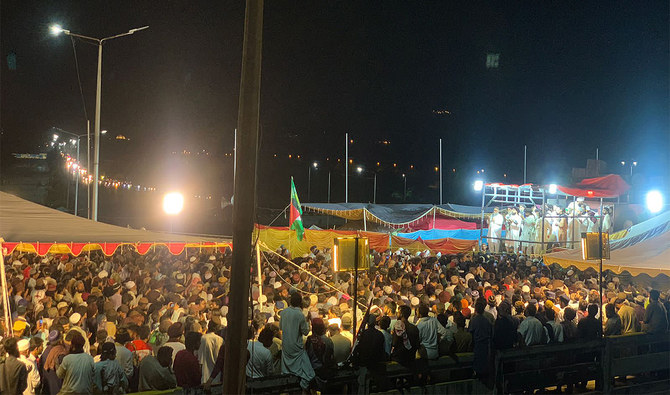
Talks with government continue as Pakistani religious party’s pro-Palestine sit-in enters seventh day

Saad Hussain Rizvi, chief of Tehreek-e-Labbaik Pakistan (TLP) religious party, is addressing the protestors in Rawalpindi, Pakistan on July 16, 2024. (@overseasteamtlp/X)
Short Url
Updated 19 July 2024
Follow

Talks with government continue as Pakistani religious party’s pro-Palestine sit-in enters seventh day

  • Thousands of Tehreek-e-Labbaik Pakistan supporters have camped at Faizabad Interchange connecting Islamabad and Rawalpindi
  • TLP supporters demand the Pakistani government officially boycott Israeli products, send aid to Gaza and declare Israeli PM a ‘terrorist’

ISLAMABAD: A pro-Palestine sit-in by Tehreek-e-Labbaik Pakistan (TLP) religious party entered its seventh day on Friday, with the party saying that it was in talks with the government regarding its demands.

The TLP has asked the government to officially boycott Israeli products and send food and medical aid to Palestinians suffering Israel’s relentless military campaign in Gaza. They have also called on Pakistan’s government to declare Israeli Prime Minister Benjamin Netanyahu a “terrorist.”

The demands were laid after TLP supporters, led by its young leader Saad Rizvi, rallied from Liaquat Bagh in Rawalpindi to Faizabad Interchange that connects it with Islamabad last Saturday before deciding to set up a protest camp there. Known for its hard-line stance on blasphemy laws, the party has previously staged sit-ins at the key interchange, significantly disrupting traffic.

The TLP said several of its members have been part of negotiations with a government team, which comprises Information Minister Ataullah Tarar, Adviser to PM on Political Affairs Rana Sanaullah, Islamabad inspector-general and deputy inspector-general.

“TLP negotiations with the federal government are still ongoing,” the party said in a statement on Thursday night.

Israel’s war on Gaza has so far claimed at least 39,000 lives, many of them women and children. The casualties have sparked anger and protests worldwide, including in Pakistan, where the country’s civil society and political factions have consistently led pro-Palestine rallies.

Pakistan does not recognize the state of Israel and calls for an independent Palestinian state based on “internationally agreed parameters.” Since the beginning of Israel’s war in October 2023, the South Asian country has dispatched several aid consignments, repeatedly raised the issue at various forums and demanded the world stop Israeli military actions in the Palestinian territory.

The large number of protesters at the Faizabad Interchange have effectively blocked the Islamabad Expressway, causing difficulty for commuters and creating gridlocks in the area.

Earlier, Sajjad Saifi, a member of the TLP’s consultative council, told Arab News that over 50,000 of their supporters, led by party chief Rizvi, were camped at the Faizabad Interchange.

“We will continue our dharna [sit-in] till all three of our demands are fully met,” he said.

Asked why the party decided to stage a sit-in protest nine months into the war, Saifi said the TLP had mobilized the public since October last year through rallies across Pakistan.

“Tens of thousands of our supporters have been waiting for the leadership’s call to join the dharna in Islamabad,” he said. “We are doing it for a cause, for the people of Palestine. We don’t have any political agenda to achieve through this dharna.”

Asked about the protest and the inconvenience being caused to the public, Information Minister Tarar said on Thursday: “Don’t worry, we are on it.”


UN torture expert decries Pakistan ex-PM Khan’s detention

Updated 12 December 2025
Follow

UN torture expert decries Pakistan ex-PM Khan’s detention

  • Khan’s party alleges government is holding him in solitary confinement, barring prison visits
  • Pakistan’s government rejects allegations former premier is being denied basic rights in prison

GENEVA: Pakistan’s former prime minister Imran Khan is being held in conditions that could amount to torture and other inhuman or degrading treatment, the United Nations’ special rapporteur on torture warned Friday.

Alice Jill Edwards urged Pakistan to take immediate and effective action to address reports of the 73-year-old’s inhumane and undignified detention conditions.

“I call on Pakistani authorities to ensure that Khan’s conditions of detention fully comply with international norms and standards,” Edwards said in a statement.

“Since his transfer to Adiala Jail in Rawalpindi on September 26, 2023, Imran Khan has reportedly been held for excessive periods in solitary confinement, confined for 23 hours a day in his cell, and with highly restricted access to the outside world,” she said.

“His cell is reportedly under constant camera surveillance.”

Khan an all-rounder who captained Pakistan to victory in the 1992 Cricket World Cup, upended Pakistani politics by becoming the prime minister in 2018.

Edwards said prolonged or indefinite solitary confinement is prohibited under international human rights law and constitutes a form of psychological torture when it lasts longer than 15 days.

“Khan’s solitary confinement should be lifted without delay. Not only is it an unlawful measure, extended isolation can bring about very harmful consequences for his physical and mental health,” she said.

UN special rapporteurs are independent experts mandated by the Human Rights Council. They do not, therefore, speak for the United Nations itself.

Initially a strong backer of the country’s powerful military leadership, Khan was ousted in a no-confidence vote in 2022, and has since been jailed on a slew of corruption charges that he denies.

He has accused the military of orchestrating his downfall and pursuing his Tehreek-e-Insaf (PTI) party and its allies.

Khan’s supporters say he is being denied prison visits from lawyers and family after a fiery social media post this month accusing army leader Field Marshal Asim Munir of persecuting him.

According to information Edwards has received, visits from Khan’s lawyers and relatives are frequently interrupted or ended prematurely, while he is held in a small cell lacking natural light and adequate ventilation.

“Anyone deprived of liberty must be treated with humanity and dignity,” the UN expert said.

“Detention conditions must reflect the individual’s age and health situation, including appropriate sleeping arrangements, climatic protection, adequate space, lighting, heating, and ventilation.”

Edwards has raised Khan’s situation with the Pakistani government.