

Global financial information service warns political risk could threaten Pakistan’s economic gains

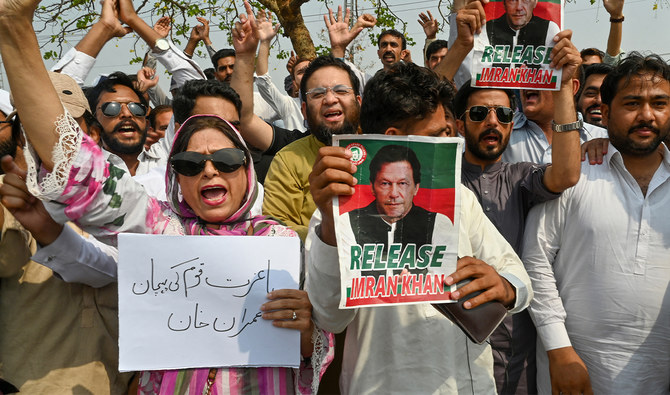
Pakistan's former prime minister Imran Khan's supporters protest outside the court in Islamabad. (AFP/File)
Short Url
Updated 18 July 2024
Follow

Global financial information service warns political risk could threaten Pakistan’s economic gains

  • Fitch’s BMI says another flood or drought in Pakistan may pose a significant risk to the country’s agricultural economy
  • It says if the current government is replaced, Pakistan will be run by technocrats instead of moving toward fresh polls

ISLAMABAD: A leading international financial information service warned on Wednesday Pakistan’s current political turmoil could derail its fragile national economy, despite recent improvements in macroeconomic indicators.

The warning was issued by Business Monitor International (BMI), part of Fitch Group, in a comprehensive country risk report on Pakistan, including 10-year forecasts extending to 2033.

The report noted the country’s economic activity in the last fiscal year was stronger than most analysts had expected.

However, it also highlighted several internal and external risk factors that could impact the ongoing economic efforts of Pakistan’s current coalition administration.

“The country’s fragile political situation could ... derail the recovery,” the BMI report noted. “While Pakistan’s establishment parties were successful in creating a new coalition government following the February election, the strong electoral performance of independent candidates backed by jailed opposition leader Imran Khan suggests that there is significant dissatisfaction with the current political elite. Another round of protests in urban areas could disrupt economic activity.”

The report also maintained Pakistan’s economy remained prone to other shocks.

“Given that 40 percent of Pakistanis work in agriculture, another flood or drought would pose a significant risk to the economy,” it added.

The BMI report said Pakistani policymakers were likely to miss their ambitious budget targets, though they would manage to narrow the deficit, “slipping from 7.4 percent in FY2023/24 to 6.7 percent of GDP in FY2024/25.”

It also predicted that the current government would remain in power over the coming 18 months and succeed in pushing through with the fiscal reforms recommended by the International Monetary Fund (IMF).

“In the unlikely event that the government is replaced,” it continued, “the most likely alternative is a military-backed technocratic administration rather than fresh elections.”


Pakistan army chief tells Kabul to choose Islamabad or Taliban militants amid strained ties

Updated 21 December 2025
Follow

Pakistan army chief tells Kabul to choose Islamabad or Taliban militants amid strained ties

  • Pakistan blames Afghanistan for facilitating cross-border attacks in its territory, allegations that Kabul denies 
  • Ties remain strained since October, when deadly border clashes left dozens dead on both sides of the border

ISLAMABAD: Pakistan’s Chief of Defense Forces Field Marshal Syed Asim Munir has told Afghanistan to choose between Islamabad and the outlawed Tehreek-e-Taliban Pakistan (TTP) militants, state media reported on Sunday as ties between both neighbors remain strained. 

Pakistan’s army and civilian government have both blamed the Afghan Taliban recently for facilitating cross-border attacks in Pakistan, a charge Kabul denies. Afghanistan says it does not allow its territory to be used for attacks against Pakistan and cannot be held responsible for Islamabad’s security challenges. 

Both countries were involved in deadly border clashes in October that saw dozens of soldiers killed and wounded on both sides. Officials from Afghanistan and Pakistan have held peace talks in Qatar, Türkiye and Saudi Arabia over the past few months but failed to reach an agreement. 

“Chief of Army Staff and Chief of Defense Forces Field Marshal Syed Asim Munir has said Afghanistan will have to choose between Fitna Al-Khawarij and Pakistan,” state broadcaster Radio Pakistan reported. 

Munir was addressing the National Ulema and Mashaikh Conference held in Islamabad earlier this month, the state media said.

“Fitna Al-Khawarij” is a term the Pakistan military frequently uses for the TTP. 

Munir highlighted that 70 percent of the TTP’s formations that enter Pakistan from Afghanistan comprise Afghan nationals. 

“He said innocent citizens, including children, are being targeted through terrorism with the backing of the Afghan Taliban,” Radio Pakistan reported. 

While Pakistan and Afghanistan have agreed to a temporary ceasefire, tensions persist between the two nations as militant attacks persist in Pakistan. 

Pakistan summoned Afghanistan’s deputy head of mission on Friday and demanded “decisive action” against TTP militants after four Pakistani soldiers were killed in an attack on a military camp in northwest Pakistan. 

The foreign office said the Afghan government had been informed that Pakistan “reserves the right to defend its sovereignty and protect its citizens” and would take all necessary measures to respond to attacks originating from Afghan territory.

Afghanistan has warned Pakistan in the past against attacking its territory, saying it reserves the right to respond to such provocations.