

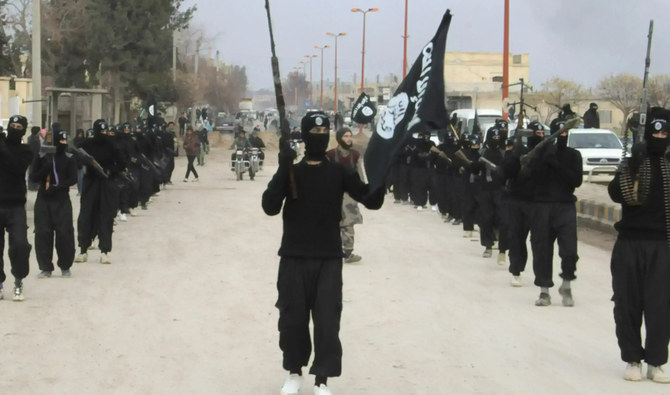
Daesh ‘trying to reconstitute’ in Iraq, Syria, says US Central Command

A coalition of more than 80 countries, led by the US, was formed to fight Daesh, which lost its hold on the territory it controlled in Iraq in 2017 and in Syria in 2019. (Reuters)
Short Url
Updated 17 July 2024
Follow

Daesh ‘trying to reconstitute’ in Iraq, Syria, says US Central Command

  • Attacks double compared to 2023

BAGHDAD: The US Central Command said on Wednesday that the Daesh group is trying “to reconstitute” as the number of attacks in Syria and Iraq is on track to double this year, compared to the year before.

Daesh claimed 153 attacks in the two countries in the first six months of 2024, CENTCOM said in a statement. 

According to a US defense official, who spoke on condition of anonymity as he wasn’t allowed to speak publicly on the matter, the group was behind 121 attacks in Syria and Iraq in 2023.

“The increase in attacks indicates Daesh is attempting to reconstitute following several years of decreased capability,” CENTCOM said.

In northeastern Syria, Kurdish-led authorities issued a general amnesty on Wednesday that would include hundreds of Syrians who have been held by the main US-backed force over their roles within IS.

The US-backed and Kurdish-led Syrian Democratic Forces, or SDF, are holding over 10,000 captured Daesh fighters in around two dozen detention facilities — including 2,000 foreigners whose home countries have refused to repatriate them. The SDF captured the last sliver of land in Syria from Daesh in March 2019.

The Autonomous Administration of North and East Syria said a life sentence will be reduced to 15 years in jail, while those detainees serving life sentences who have incurable diseases will be set free, as will those who have reached the age of 75. 

It said the amnesty will not include Daesh officials and members who fought against the SDF, nor those who carried out attacks with explosives that killed people. Legal expert Khaled Jabr said the amnesty will include some 600 Syrian citizens who are held on terrorism charges and links to Daesh, as long as their hands are not tainted with blood or they were detained while fighting SDF members. The announcement comes just after the 10-year mark since the militant group declared its caliphate in large parts of Iraq and Syria. 

At its peak, the group ruled an area half the size of the UK where it attempted to enforce its extreme interpretation of Islam, which included attacks on religious minority groups and harsh punishment of Muslims deemed to be apostates.


Lebanon approves financial gap draft law despite opposition from Hezbollah and Lebanese Forces

Lebanon's Prime Minister Nawaf Salam speaking during a press conference after a cabinet session in Beirut on December 26, 2025.
Updated 8 sec ago
Follow

Lebanon approves financial gap draft law despite opposition from Hezbollah and Lebanese Forces

  • Legislation aims to address the fate of billions of dollars in deposits that have been inaccessible to Lebanese citizens during the country’s financial meltdown

BEIRUT: Lebanon’s Cabinet on Friday approved a controversial draft law to regulate financial recovery and return frozen bank deposits to citizens. The move is seen as a key step in long-delayed economic reforms demanded by the International Monetary Fund.

The decision, which passed with 13 ministers voting in favor and nine against, came after marathon discussions over the so-called “financial gap” or deposit recovery bill, stalled for years since the banking crisis erupted in 2019. The ministers of culture and foreign affairs were absent from the session.

The legislation aims to address the fate of billions of dollars in deposits that have been inaccessible to Lebanese citizens during the country’s financial meltdown.

The vote was opposed by three ministers from the Lebanese Forces Party, three ministers from Hezbollah and the Amal Movement, as well as the minister of youth and sports, Nora Bayrakdarian, the minister of communications, Charles Al-Hajj, and the minister of justice, Adel Nassar.

Finance Minister Yassin Jaber broke ranks with his Hezbollah and Amal allies, voting in favor of the bill. He described his decision as being in line with “Lebanon’s supreme financial interest and its obligations to the IMF and the international community.”

The draft law triggered fierce backlash from depositors who reject any suggestion they shoulder responsibility for the financial collapse. It has also drawn strong criticism from the Association of Banks and parliamentary blocs, fueling fears the law will face intense political wrangling in Parliament ahead of elections scheduled in six months.

Prime Minister Nawaf Salam confirmed the Cabinet had approved the bill and referred it to Parliament for debate and amendments before final ratification. Addressing public concerns, he emphasized that the law includes provisions for forensic auditing and accountability.

“Depositors with accounts under $100,000 will be repaid in full with interest and without any deductions,” Salam said. “Large depositors will also receive their first $100,000 in full, and the remainder will be issued as negotiable bonds backed by the assets of the Central Bank, valued at around $50 billion.”

He said further that bondholders will receive an initial 2 percent payout after the first tranche of repayments is completed.

The law also includes a clause requiring criminal accountability. “Anyone who smuggled funds abroad or benefited from unjustified profits will be fined 30 percent,” Salam said.

He emphasized that Lebanon’s gold reserves will remain untouched. “A clear provision reaffirms the 1986 law barring the sale or mortgaging of gold without parliamentary approval,” he said, dismissing speculation about using the reserves to cover financial losses.

Salam admitted that the law was not perfect but called it “a fair step toward restoring rights.”

“The banking sector’s credibility has been severely damaged. This law aims to revive it by valuing assets, recapitalizing banks, and ending Lebanon’s dangerous reliance on a cash economy,” he said. “Each day of delay further erodes people’s rights.”

While the Association of Banks did not release an immediate response after the vote, it previously argued during discussions that the law would destroy remaining deposits. Bank representatives said lenders would struggle to secure more than $20 billion to cover the initial repayment tier and accused the state of absolving itself of responsibility while effectively granting amnesty for decades of financial mismanagement and corruption.

The law’s fate now rests with Parliament, where political competition ahead of the 2025 elections could complicate or delay its passage.

Lebanon’s banking sector has been at the heart of the country’s economic collapse, with informal capital controls locking depositors out of their savings and trust in state institutions plunging. International donors, including the IMF, have made reforms to the sector a key condition for any financial assistance.