Kingdom and Airbus can fly high together, says company chief

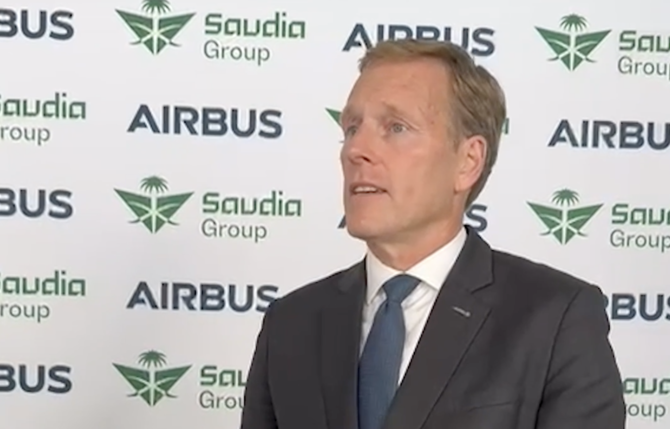
Wouter van Wersch, president in charge of Airbus’s international operations, speaking to Arab News about the Saudia-Airbus deal. (AN Photo)
Short Url
Updated 01 October 2024
Follow

Kingdom and Airbus can fly high together, says company chief

  • $19 billion aviation agreement ‘will help Saudia to grow and also help the country to achieve its Vision 2030’
  • Saudia signed a deal with Airbus in May for 105 aircraft, the largest agreement in Saudi aviation history

HAMBURG: Saudi Arabia and the aircraft manufacturer Airbus can build on their $19 billion aviation agreement to expand their partnership even further, one of the company’s top managers told Arab News on Tuesday.

Airbus and Saudia airline signed a deal in May for the supply of 105 A320neo and A321neo planes, the largest aircraft agreement in Saudi aviation history.

Now Saudi Vision 2030 offers opportunities to develop the partnership, said Wouter van Wersch, president in charge of Airbus’s international operations. “I think it touches on a lot of very important points,” he said. “The whole sustainability angle, everything that the Kingdom wants to achieve in terms of energy, but also transportation, the NEOM opportunities.


“I think the future, airports, I think it really covers a lot of topics. And, you know, we need countries to take the lead on this.

“We, as Airbus, have a very clear strategy on what we want to do in terms of sustainability. You know, we work on innovation, bringing the best aircraft to the market today. But also tomorrow. We look at hydrogen. We look at sustainable aviation fuel. So, there’s a wide array of topics that need to be addressed and to be successful.

“You know, we've been in Saudi Arabia for a long time. We have a strong local team, of course, in commercial aircraft, but also in helicopters and in defense and space. So look, we want to do more. We are very committed to continue to work closely with the Kingdom and we’ll have to see what happens.”


The acquisition of the A321neo aircraft will help Saudia to grow, van Wersch said. “We have had a fantastic relationship with Saudia for many years. And I think this is a new confirmation of the partnership,” he said “You know, the first aircraft that we brought to Saudi Arabia was in the 1980s. So, it’s been a long while and we’ve gone from strength to strength.

“I think Saudia has a great vision. I think the Kingdom has a great vision on what it wants to achieve by 2030 and bringing this fantastic A321neo aircraft will really help to contribute, to satisfy and to realize this vision.

“I think the Vision 2030 of the country needs more transportation. And Airbus is a leader in aviation. So, we are very keen to contribute and look forward to great times together.”


Islamic finance in Oman poised for 25% growth: Fitch 

Updated 01 February 2026
Follow

Islamic finance in Oman poised for 25% growth: Fitch 

RIYADH: Oman’s Islamic finance sector is on track to reach $45 billion this year, rising from $36 billion at the end of 2025, supported by a favorable macroeconomic environment, according to a report by Fitch Ratings. 

The rating agency said the anticipated 25 percent year-on-year growth will be underpinned by increasing demand for sukuk as both a funding mechanism and a public policy tool, alongside government-led initiatives and growing grassroots demand for Shariah-compliant financial products. 

Sukuk accounted for around 60 percent of US dollar-denominated debt issuance in 2025, a sharp decline from 94.3 percent previously, with the remaining share comprising conventional bonds. Despite this progress, Fitch highlighted ongoing structural challenges, including the absence of Islamic treasury bills and derivatives, an underdeveloped Omani rial sukuk and bond market, and the limited role of Islamic non-bank financial institutions. 

The performance of Oman’s banking sector continues to reflect steady advancement toward Vision 2040, the country’s long-term development strategy focused on economic diversification, private sector expansion, and enhanced financial resilience. 

Operating conditions remain supportive for both Islamic and conventional banks in Oman, buoyed by elevated, though gradually moderating, oil prices, the report noted. 

Expanding credit flows — particularly to non-financial corporates and households — are helping drive the growth of small and medium-sized enterprises and boost domestic investment. These trends are reinforcing Oman’s efforts to reduce dependence on hydrocarbons and build a more diversified economic base. 

Fitch projects loan growth of 6 to 7 percent in 2026, fueled by rising demand across both retail and corporate segments. In addition, the proposed 5 percent personal income tax, scheduled for implementation from 2028, is expected to have only a limited overall impact on banks, according to the agency. 

Islamic banking in Oman was introduced following the Central Bank of Oman’s preliminary licensing guidelines issued in May 2011, which allowed the establishment of full-fledged Islamic banks and Islamic banking windows operating alongside conventional institutions. 

This regulatory framework was formally entrenched in December 2012 through a royal decree amending the Banking Law, requiring the creation of Shariah supervisory boards and granting the central bank authority to establish a High Shariah Supervisory Authority.