
RIYADH: Saudi Arabia’s Public Investment Fund has partnered with the world’s second-largest manufacturer of solar cell components for a $2.8 billion-power production plant in the Kingdom.
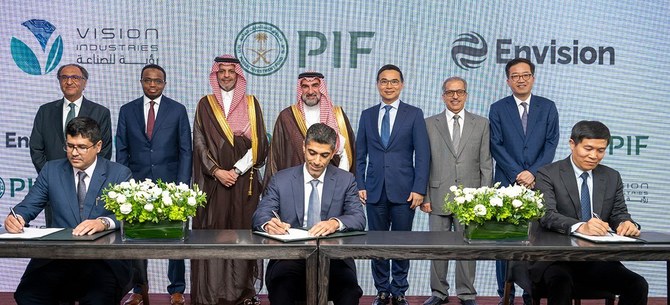
A statement from TCL Zhonghuan Renewable Energy Technology Co. confirmed the agreement, which is one of three signed off by the sovereign wealth fund on July 16 as it seeks to boost Saudi Arabia’s renewable energy sector.
The deals – entered into by the PIF subsidiary Renewable Energy Localization Co. – all involve creating joint ventures with Saudi firm Vision Industries.
One plan will see RELC working with Envision Energy to transform Saudi Arabia into a manufacturer of wind turbines and components.
The third deal involves an agreement with Jinko Solar to localize production of photovoltaic cells and modules.
Saudi Arabia has invested heavily in diversifying its energy mix toward renewable sources to meet its pledge to cut carbon emissions and promote sustainable development. By 2030, the country aims to source at least 50 percent of its electricity from renewables.
Welcoming the deals, Yazeed Al-Humied, deputy governor and head of MENA Investments at PIF, said: “The new agreements are part of PIF’s efforts to localize advanced technologies in the renewable sector in Saudi Arabia and meet commitments to increase the share of local content, as well as contribute to localizing the production of 75 percent of the components in Saudi Arabia’s renewable projects by 2030 in line with the Ministry of Energy’s National Renewable Energy Program.
“These projects will also enable Saudi Arabia to become a global hub for export of renewable technologies. PIF aims to achieve these targets through its projects and portfolio companies, including RELC, which support PIF’s progress in renewable energy and investment, and enhance partnership with the private sector.”
In a press release setting out more details of the deals, it was revealed that the agreement with TCL Zhonghuan Renewable Energy subsidiary Lumetech S.A. PTE. will localize production of solar photovoltaic ingots and wafers with the capacity to generate 20 gigawatts of power a year.
Under this agreement, RELC will hold 40 percent of the JV, with Lumetech holding 40 percent and Vision Industries having 20 percent.
The JV with Envision Energy will involve the manufacture and assembly of wind turbine components, including blades, with an estimated annual generation capacity of 4 GW.
In this arrangement, RELC will once again hold 40 percent of the JV, with Envision holding 50 percent and Vision Industries holding 10 percent.
The agreement with Jinko Solar entails localizing the manufacture of photovoltaic cells and modules for high-efficiency solar generation. Under the agreement, which envisages annual production of 10 GW generation capacity, RELC will hold 40 percent of the JV, with Jinko Solar holding the same amount and Vision Industries accounting for the final 20 percent.
Overall, PIF, through Acwa Power and Badeel, is currently developing a total of eight renewable energy projects with a total capacity of 13.6 GW, involving over $9 billion of investment from the wealth fund and its partners.
Saudi Arabia’s Minister of Energy, Prince Abdulaziz Al-Saud, recently launched the Geographic Survey Project for Renewable Energy, aimed at identifying optimal sites for solar and wind power initiatives across the Kingdom, marking it as an unprecedented endeavor.