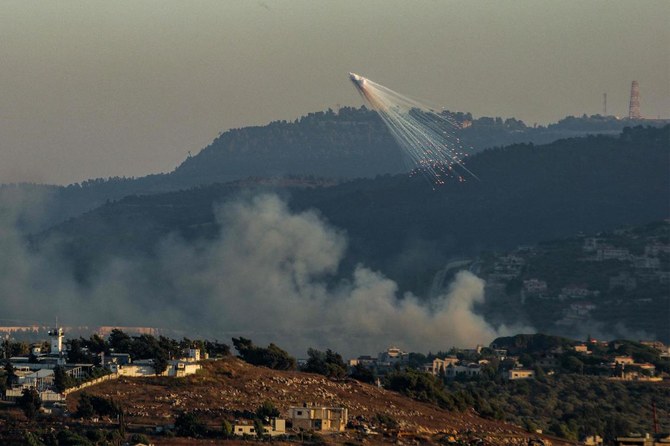
BEIRUT: An Israeli airstrike killed two civilians in southern Lebanon on Saturday.
Najib Halawi and Musa Suleiman were targeted by an Israeli drone while driving on the Khirbet Daoud Road, which connects Nabatieh to Marjayoun and is used by travelers heading to the Western Bekaa region.
An initial security report said that the two victims routinely drove their jeep to a water spring in the village of Kafr Kila on the border to collect water for their livestock.
Halawi and Suleiman were, respectively, the father and uncle of Hezbollah member Mohammed Halawi, who was killed at the start of Israel’s attacks in Lebanon’s south. According to the National News Agency, Suleiman was a local council member for Hezbollah allies the Amal Movement in the nearby village of Kfar Kila. The Amal Movement confirmed that one of its members, aged 60, had been killed.
A source close to Hezbollah stressed that both men were “civilians, not fighters.” Hezbollah vowed to respond to the killing of civilians.
Elsewhere on Saturday, Israeli forces targeted the outskirts of the border town of Rmeich with machine guns from their positions in Al-Raheb and Hermon, causing damage to several houses. Hezbollah, meanwhile, said that it targeted a group of Israeli soldiers in the vicinity of the Mitat Barracks with missile weapons and “successfully hit them.”
Israeli sirens were activated in settlements opposite the town of Kafr Kila following the appearance of a series of drones, and three rockets reportedly fell near Kiryat Shmona in Upper Galilee.
The Lebanese Resistance Brigades, a non-sectarian group established by Hezbollah in 1997, issued a statement on Friday night announcing the execution of its first military action against Israeli forces during the current fighting.
“The martyrs Abdul Aal group in the Lebanese Resistance Brigades attacked the Roueisat Al-Qarn site in the occupied Lebanese Shebaa Farms with rockets and directly hit it,” the statement read.
Israeli army spokesman Avichay Adraee said two suspicious aerial targets that were on their way toward Israeli territory were intercepted on Friday night. Alarms were activated in an industrial area near Eilat, where air defenses and warplanes intercepted the two targets. There were no injuries.
Al-Arabiya quoted an American source on Saturday saying that Washington is refusing to deliver heavy bombs to Israel in order to prevent a war in Lebanon, but added that US forces in the region were working on evacuation plans in case such a war breaks out.
The US source told Al-Arabiya: “Israel is capable of launching a massive attack on Lebanon and capable of destroying Beirut Airport and the buildings in its vicinity and in the southern suburbs.”
Hussein Hajj Hassan, head of Lebanon’s Baalbek-Hermel parliamentary bloc, warned Israel against an escalation of aggression against Lebanon.
“If Israel decides to commit this folly, the resistance is prepared and has many surprises regarding numbers, munitions, weapons, and quality and quantity of weapons,” he said, adding that the resistance front in southern Lebanon “is very strong and fully prepared for any scenario that the enemy may carry out.”


![]()

Israeli airstrike kills 2 civilians in southern Lebanon
Short Url
https://arab.news/zz8hu
Israeli airstrike kills 2 civilians in southern Lebanon
- Hezbollah's retaliatory rocket attacks target border town of Kiryat Shmona in Upper Galilee
- The Amal Movement confirmed that one of its members, aged 60, had been killed


Latest updates





© 2026 SAUDI RESEARCH & PUBLISHING COMPANY, All Rights Reserved And subject to Terms of Use Agreement.