


Argentina designates Hamas a terrorist group in show of support for Israel

1 / 2
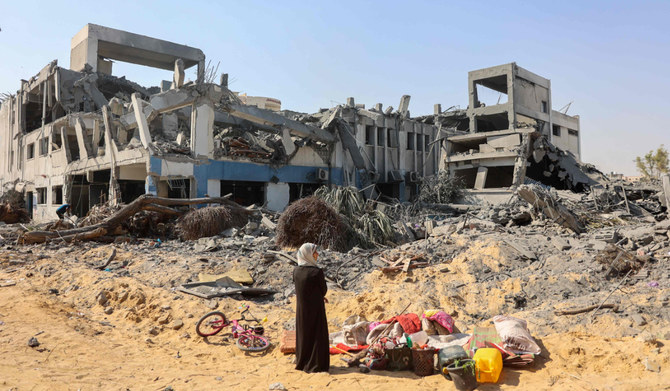
A woman looks around as she salvages items at the damaged UN Relief and Works Agency for Palestine Refugees (UNRWA) building complex in western Gaza City's Al-Sinaa neighbouhood on July 12, 2024, following the withdrawal of Israeli troops from the area amid the ongoing conflict between Israel and the militant Hamas group in the besieged Palestinian territory. (AFP)
2 / 2
Argentine President Javier Milei leaves the Holocaust museum after attending and event marking the International Day in Memory of the Victims of the Holocaust in Buenos Aires, Argentina, Friday, Jan. 26, 2024. (AP)
Short Url
Updated 13 July 2024
Follow

Argentina designates Hamas a terrorist group in show of support for Israel

  • The US, European Union and several other countries long put a terrorist designation on Hamas, which ruled the Gaza Strip before its current war with Israel
  • Israel has killed more than 38,000 Palestinians, displaced over 80 percent of the territory’s people and triggered a humanitarian disaster

BUENOS AIRES, Argentina: Argentina designated Hamas a terrorist organization Friday and ordered a freeze on the financial assets of the Palestinian group, a largely symbolic move as President Javier Milei seeks to align Argentina strongly with the US and Israel.
Announcing the decision, Milei’s office cited the militant Palestinian group’s cross-border attack on Israel last Oct. 7 that killed some 1,200 people and took 250 others hostage, in the deadliest assault in Israel’s 76-year history.
The statement also mentioned Hamas’ close ties to Iran, which Argentina blames for two deadly militant attacks on Jewish sites in the country.
The move comes just days before the 30th anniversary of one of those attacks, the 1994 bombing of a Jewish community center in Buenos Aires. It killed 85 people and wounded hundreds more in the worst such attack in Argentina’s modern history.
The other attack on the Israeli Embassy in Buenos Aires, in 1992, killed more than 20 people. Argentina’s judiciary has accused members of Lebanon’s Iran-backed Hezbollah militant group of carrying out the two attacks.
Friday’s announcement professed Milei’s “unwavering commitment to recognizing terrorists for what they are,” adding that “it’s the first time that there is a political will to do so.”
The US, European Union and several other countries long put a terrorist designation on Hamas, which ruled the Gaza Strip before its current war with Israel.
Previous left-leaning Peronist governments in Argentina, home to the largest Jewish community in Latin America, have maintained friendly ties with Israel but also voiced support for Palestinian statehood.
Since coming into office in December, Milei has set himself apart from even Israel’s closest allies in his vocal support for Prime Minister Benjamin Netanyahu. A huge swell in global pressure has left Israel deeply isolated over its military campaign in Gaza, which has killed more than 38,000 Palestinians, displaced over 80 percent of the territory’s people and triggered a humanitarian disaster.
“Argentina must once again align itself with Western civilization,” Milei’s office said Friday.
For his first state visit as president earlier this year, Milei flew to Jerusalem in a show of support for the Israeli government and promised to move his nation’s embassy to the contested capital — drawing praise from Netanyahu and ire from Hamas.
Although raised a Roman Catholic, Milei says he has a deep spiritual connection with Judaism.


Tourism on hold as Middle East war casts uncertainty

Updated 2 sec ago
Follow

Tourism on hold as Middle East war casts uncertainty

  • Cancelled flights, postponed trips and a great deal of uncertainty: the war in the Middle East is casting a long shadow over the tourism outlook for the region
PARIS: Cancelled flights, postponed trips and a great deal of uncertainty: the war in the Middle East is casting a long shadow over the tourism outlook for a region that has become a prized destination for travelers worldwide.
“My last group of tourists left three days ago, and all the other groups planned for March have been canceled,” said Nazih Rawashdeh, a tour guide near Irbid, in northern Jordan.
“This is the start of the high season here. It’s catastrophic,” he told AFP.
“And yet there’s no problem in Jordan. It’s perfectly safe.”
Across the world, tour operators are scrambling to find solutions for clients stranded in the region or who had trips planned there.
“The priority is getting those already there back home,” said Alain Capestan, president of the French tour operator Comptoir des Voyages.
He said however that the war was also affecting customers who have traveled to other parts of the world, as the Gulf region is home to several major aviation hubs — Dubai, Abu Dhabi and Doha.
Like other companies, the German tour operators surveyed by AFP — Alltours, Dertour, Schauinsland-Reisen — announced they would cover the cost of extra nights for clients stranded in the Middle East. They also canceled trips to the UAE and Oman until at least March 7.
Swiss operator MSC Cruises, which has a ship stranded in Dubai, told AFP on Thursday it was sending five charter flights to airlift nearly 1,000 passengers.
The firm said it expected the passengers to be out of the region by Saturday, without specifying the destinations of the flights or the nationalities of the holidaymakers.
The British travel industry association ABTA said agencies “would not be sending customers to the region for as long as the British Foreign Office advises against all non-essential travel.”
Customers whose holidays were canceled in recent days will be able to rebook or receive a refund, it said.
- Economic impact -
The war is disrupting a sector that had been booming in the region.
According to UN Tourism, in 2025 around 100 million tourists visited the Middle East — nearly seven percent of all international tourists recorded worldwide. That figure had grown three percent year-on-year and 39 percent compared to the pre-pandemic period.
Depending on the destination, Europeans make up a large share of visitors, followed by tourists from South Asia, the Americas, and other Middle Eastern countries.
For example, nearby markets accounted for 26 percent of total visitors to Dubai in 2025, according to its Ministry of Tourism and Economy.
Against this backdrop analysts Oxford Economics warns that “a decline in tourist flows to the region will deal a more severe economic blow than in the past, as tourism’s share of GDP has grown, as has employment in the sector.”
“We estimate inbound arrivals to the Middle East could decline 11-27 percent year-on-year in 2026 due to the conflict, compared to our December forecast that projected 13 percent growth,” said Director of Global Forecasting Helen McDermott.
That would translate, according to the firm, to between 23 and 38 million fewer international visitors compared to the prior scenario, and a loss of $34 to $56 billion in tourist spending.
After Covid and then the conflict in Gaza, tourists had been coming back, said Rawashdeh, the Jordanian tour guide.
“For the past six months, people working in tourism here had hope. And now there’s a war. This is going to be terrible for the economy,” he said.
“We’ve definitely noticed an understandable slowdown in new bookings from our partners right now, but we fully expect that to bounce back as soon as things settle down and travelers feel more confident,” said Ibrahim Mohamed, marketing director of Middle East Travel Alliance, which offers direct tours to American and British operators.
He remains optimistic: “The Middle East has always been an incredibly resilient market, and demand always bounces back fast once stability returns.”