WASHINGTON: Western intelligence agencies have uncovered Russian plots to carry out assassinations, arson and other sabotage in Europe against companies and people linked to support for Ukraine’s military — one of the most serious being a plan to kill the head of a German arms manufacturer, a Western government official said.
The plots have sometimes involved recruiting common criminals in foreign countries to conduct the attacks, said the official, who is familiar with the situation but not authorized to comment and spoke on the condition of anonymity.
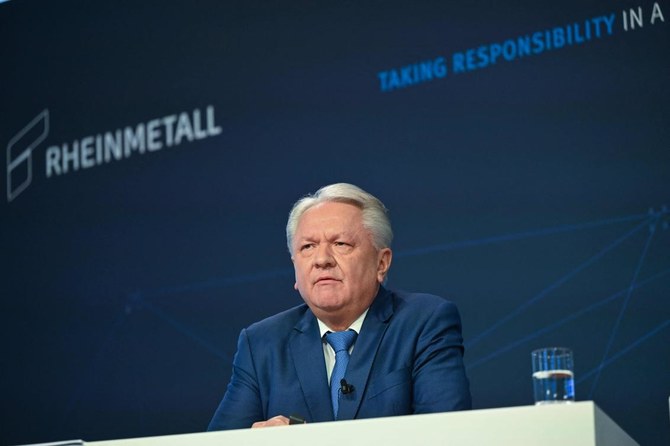
One major plot recently uncovered had targeted Armin Papperger, CEO of defense company Rheinmetall, the official said.
The official declined to offer any details on other plots, which were first reported by CNN. The CNN report said the US informed Germany, whose security services were able to protect Papperger and foil the plot.
Rheinmetall is a major supplier of military technology and artillery rounds for Ukraine as it fights off Russian forces. The company last month opened an armored vehicle maintenance and repair facility in western Ukraine and also aims to start production inside the country.
White House National Security Council spokesperson Adrienne Watson declined to comment on the alleged plot to kill Papperger but said, “Russia’s intensifying campaign of subversion is something that we are taking extremely seriously and have been intently focused on over the past few months.”
“The United States has been discussing this issue with our NATO allies, and we are actively working together to expose and disrupt these activities,” Watson added. “We have also been clear that Russia’s actions will not deter allies from continuing to support Ukraine.”
Neither Rheinmetall nor the German government would comment Friday on the reported plot against Papperger. The Interior Ministry can’t comment on “individual threat situations,” spokesperson Maximilian Kall said, but he added that more broadly, “we take the significantly increased threat from Russian aggression very seriously.”
“We know that (Russian President Vladimir) Putin’s regime wants above all to undermine our support for Ukraine in its defense against the Russian war of aggression, but the German government won’t be intimidated,” Kall said.
He noted that German security measures have increased significantly since 2022 and that “the threats range from espionage and sabotage, through cyberattacks, to state terrorism.”
European officials gathered for the NATO summit in Washington this week spoke of dealing with an escalation of “hybrid” attacks that they blame on Russia and its allies.
That includes what authorities called suspicious recent fires at industrial and commercial sites in Lithuania, Poland, the United Kingdom, Germany and other nations, and charges that Russia-allied Belarus was sending large numbers of migrants from the Middle East and North Africa to the borders of Poland, Latvia and other countries belonging to NATO.
When asked at a news conference at the NATO summit Thursday, NATO Secretary-General Jens Stoltenberg said he could not comment on the CNN report. He did note a widespread campaign by Russian security services to conduct “hostile actions” against NATO allies, including sabotage, cyberattacks and arson.
“These are not standalone instances. These are part of a pattern, part of an ongoing Russian campaign. And the purpose of this campaign is, of course, to intimidate NATO allies from supporting Ukraine,” Stoltenberg said.
In April, German investigators arrested two German-Russian men on suspicion of espionage, one of them accused of agreeing to carry out attacks on potential targets, including US military facilities, in hopes of sabotaging aid for Ukraine.
Germany has become the second-biggest supplier of weapons to Ukraine after the United States since Russia started its full-scale invasion of Ukraine more than two years ago.
Kremlin spokesperson Dmitry Peskov dismissed the report of a plan to kill Papperger. “All of this is again presented in the fake style, so such reports cannot be taken seriously,” he told reporters Friday.
US Defense Secretary Lloyd Austin spoke to his Russian counterpart, Andrei Belousov, on Friday, their second call in less than a month, Pentagon deputy press secretary Sabrina Singh announced at a briefing Friday. The call was initiated by the Russian defense minister, Singh said.
She did not have further details to share, including whether the two leaders spoke about the accusations that Russia had attempted to assassinate top officials of Western defense firms producing weapons systems that are sent to Ukraine, but said “maintaining lines of communication is incredibly important right now.”

Russian assassination plots against those supporting Ukraine uncovered in Europe, official says
https://arab.news/y5jev
Russian assassination plots against those supporting Ukraine uncovered in Europe, official says
- The plots have sometimes involved recruiting common criminals in foreign countries to conduct the attacks
- One major plot recently uncovered had targeted Armin Papperger, CEO of defense company Rheinmetall
Rubio fields questions on Russia-Ukraine, Gaza and Venezuela at wide-ranging news conference
- “There’s no peace deal unless Ukraine agrees to it. But there’s also no peace deal unless Russia agrees to it,” Rubio said
- “We have a limited amount of money that can be dedicated to foreign aid and humanitarian assistance“
WASHINGTON: Secretary of State Marco Rubio weighed in on Russia-Ukraine and Israel-Hamas peace efforts and defended the Trump administration’s increasing military pressure on Venezuela during a rare, end-of-year news conference Friday.
In a freewheeling, more than hourlong meeting with reporters, Rubio also defended President Donald Trump’s radical overhaul in foreign assistance and detailed the administration’s work to reach a humanitarian ceasefire in Sudan in time for the new year.
Rubio’s appearance in the State Department briefing room comes as key meetings on Gaza and Russia-Ukraine are set to be held in Miami on Friday and Saturday after a tumultuous year in US foreign policy. Rubio has assumed the additional role of national security adviser and emerged as a staunch defender of Trump’s “America First” priorities on issues ranging from visa restrictions to a shakeup of the State Department bureaucracy.
“When I was a senator, I represented the state of Florida,” he said. Now, “my job is to implement the president’s foreign policy — provide advice, provide counsel, provide ideas, provide for opportunities and ways in which his foreign policy can be implemented.”
The news conference is taking place just hours before Trump’s special envoy Steve Witkoff meets with senior officials from Egypt, Turkiye and Qatar to discuss the next phase of the Republican president’s Gaza ceasefire plan, progress on which has moved slowly since it was announced in October.
Witkoff and other US officials, including Trump son-in-law and informal adviser Jared Kushner, have been pushing to get the Gaza plan implemented by setting up a “Board of Peace” that will oversee the territory after two years of war and create an international stabilization force that would police the area.
On Saturday, Witkoff, Kushner and Rubio, who will be at his home in Florida for the holidays, are to meet with Russian President Vladimir Putin’s adviser Kirill Dmitriev in Miami to go over the latest iteration of a US-proposed plan to end the Russia-Ukraine war.
“There’s no peace deal unless Ukraine agrees to it. But there’s also no peace deal unless Russia agrees to it,” Rubio said. ″So our job is not to force anything on anyone. It is to try to figure out if we can nudge both sides to a common place.”
The US proposal has been through numerous versions with Trump seesawing back and forth between offering support and encouragement for Ukraine and then seemingly sympathizing with Putin’s hard-line stances by pushing Ukrainian President Volodymyr Zelensky to agree to territorial concessions. Kyiv has rejected that concession in return for security guarantees intended to protect Ukraine from future Russian incursions.
On Venezuela, Rubio has been a leading proponent of military operations against suspected drug-running vessels that have been targeted by the Pentagon in the Caribbean Sea and the eastern Pacific Ocean since early September. The Trump administration’s actions have ramped up pressure on leftist Venezuelan President Nicolás Maduro, who has been charged with narco-terrorism in the US
In an interview with NBC News on Friday, Trump would not rule out a war with Venezuela. But Rubio and Defense Secretary Pete Hegseth have publicly maintained that the current operations are directed at “narco-terrorists” trying to smuggle deadly drugs into the United States. Maduro has insisted the real purpose of the US military operations is to force him from office.
Rubio sidestepped a direct question about whether the US wants “regime change in 2026” in the South American country.
“We have a regime that’s illegitimate, that cooperates with Iran, that cooperates with Hezbollah, that cooperates with narco-trafficking and narco-terrorist organizations,” Rubio said, “including not just protecting their shipments and allowing them to operate with impunity, but also allows some of them to control territory.”
Rubio’s news conference comes just two days after the Trump administration announced a massive $11 billion package of arms sales to Taiwan, a move that infuriated Beijing, which has vowed to retake the island by force if necessary.
Trump has veered between conciliatory and aggressive messages to China since returning to the Oval Office in January, hitting Chinese imports with major tariffs but at the same time offering to ease commercial pressure on Beijing in conversations with China’s President Xi Jinping. The Trump administration, though, has consistently decried China’s increasingly aggressive posture toward Taiwan and its smaller neighbors in disputes over the South China Sea.
Since taking over the State Department, Rubio has moved swiftly to implement Trump’s “America First” agenda, helping dismantle the US Agency for International Development and reducing the size of the diplomatic corps through a significant reorganization. Previous administrations have distributed billions of dollars in foreign assistance over the past five decades through USAID.
Critics have said the decision to eliminate USAID and slash foreign aid spending has cost lives overseas, although Rubio and others have denied this, pointing to ongoing disaster relief operations in the Philippines, the Caribbean and elsewhere, along with new global health compacts being signed with countries that previously had programs run by USAID.
“We have a limited amount of money that can be dedicated to foreign aid and humanitarian assistance,” Rubio said. “And that has to be applied in a way that furthers our national interest.”


