US keeps barring Chinese officials over rights

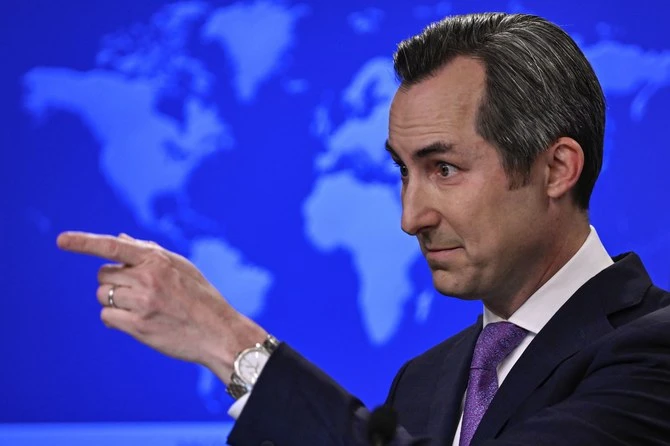
State Department spokesman Matthew Miller said that United States was restricting visas to current or former officials "for their involvement in repression of marginalized religious and ethnic communities." (Getty/File)
Short Url
Updated 12 July 2024
Follow

US keeps barring Chinese officials over rights

  • The State Department didn’t identify or give a number of those who would be denied visas
  • The US has kept up pressure on China, including by expanding restrictions on technology exports

WAHSINGTON: The United States said Friday it would keep denying visas to Chinese officials over human rights concerns in Xinjiang, Tibet and elsewhere, vowing accountability despite a thaw in tensions between the powers.
Unlike previous high-profile actions against Chinese officials, the State Department did not identify or give a number of those who would be denied visas or specify if additional people were being blacklisted.
State Department spokesman Matthew Miller said that United States was restricting visas to current or former officials “for their involvement in repression of marginalized religious and ethnic communities.”
Beijing “has not lived up to its commitments to respect and protect human rights, as demonstrated by the ongoing genocide and crimes against humanity in Xinjiang, the erosion of fundamental freedoms in Hong Kong, persistent human rights abuses in Tibet and transnational repression around the world,” he said in a statement.
He called on China to accept recommendations in the latest UN review of its rights record, including releasing citizens “it has arbitrarily and unjustly detained.”
Under previous president Donald Trump, the United States publicly named several officials who would be denied entry including Chen Quanguo, the architect of China’s hard-line policies in Tibet and then Xinjiang who has since retired.
Under President Joe Biden, the United States has kept up pressure on China, including by expanding restrictions on technology exports, but has also pursued dialogue to keep tensions in check.
The United States says that China is carrying out genocide against the mostly Muslim Uyghur people in Xinjiang, pointing to accounts of vast detention camps, allegations strongly rejected by Beijing.
Brazil’s Lula accuses Trump of seeking to forge ‘new UN’

Brazil's President Luiz Inacio Lula da Silva (L) and US President Donald Trump. (AFP file photo)
Updated 24 January 2026
Follow

Brazil’s Lula accuses Trump of seeking to forge ‘new UN’

  • Lula defended multilateralism against what he called “the law of the jungle” in global affairs
  • Key US allies including France and Britain have also expressed doubts

BRASILIA: Brazilian President Luiz Inacio Lula da Silva accused Donald Trump on Friday of trying to create “a new UN” with his proposed “Board of Peace.”
The veteran leftist joins other world leaders who have avoided signing up for Trump’s new global conflict resolution organization, where a permanent seat costs $1 billion and the chairman is Trump himself.
“Instead of fixing” the United Nations, “what’s happening? President Trump is proposing to create a new UN where only he is the owner,” Lula said.
Trump unveiled his “Board of Peace” at the World Economic Forum in the Swiss ski resort of Davos Thursday, joined on stage by leaders and officials from 19 countries to sign its founding charter.
Lula defended multilateralism against what he called “the law of the jungle” in global affairs.
His remarks come a day after he spoke by phone with Chinese leader Xi Jinping, who urged his counterpart to safeguard the “central role” of the United Nations in international affairs.
In his remarks on Friday, Lula said “the UN charter is being torn.”
Although originally intended to oversee Gaza’s rebuilding, the board’s charter does not seem to limit its role to the Palestinian territory and appears to want to rival the United Nations.
Key US allies including France and Britain have also expressed doubts.
London balked at the inclusion of Russian President Vladimir Putin, whose forces are fighting in Ukraine after invading in 2022.
France said the charter as it currently stood was “incompatible” with its international commitments, especially its UN membership.