

The collapse of a school in northern Nigeria leaves 22 students dead, officials say

1 / 4
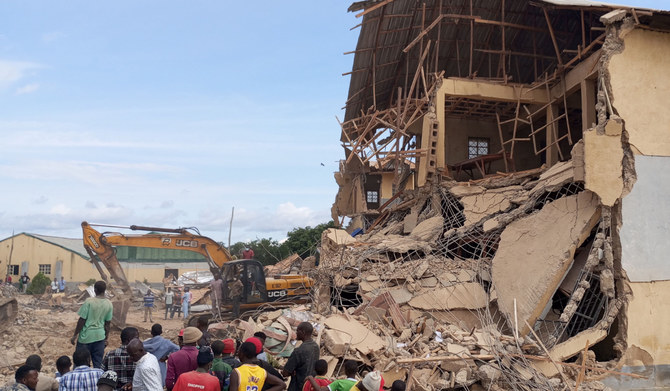
Bystanders gather next to the ruins of a school collapsed earlier in Jos, on July 12, 2024 as heavy machinery is seen at work on the site. (AFP)
2 / 4
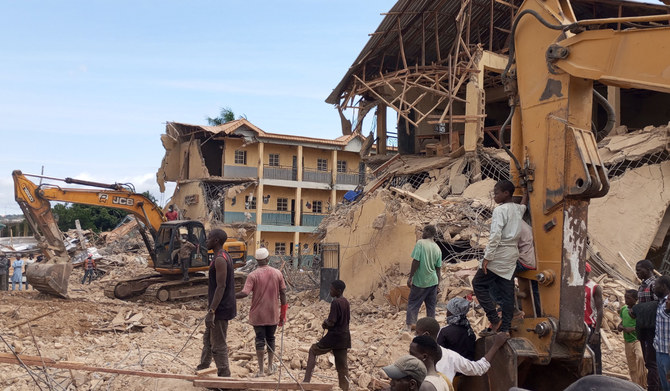
Bystanders gather next to heavy machinery working at the site of a school collapsed earlier in Jos, on July 12, 2024. (AFP)
3 / 4
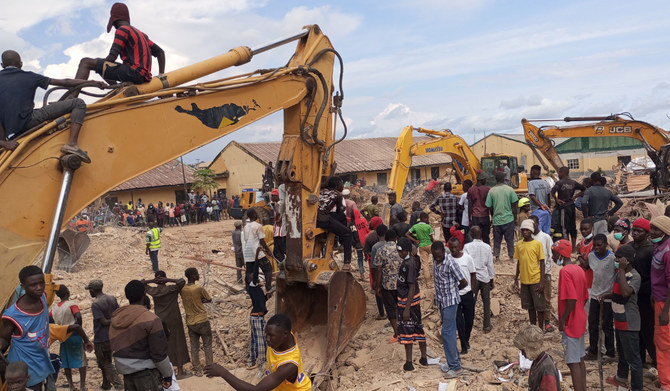
Bystanders gather next to heavy machinery working at the site of a school collapsed earlier in Jos, on July 12, 2024. (AFP)
4 / 4
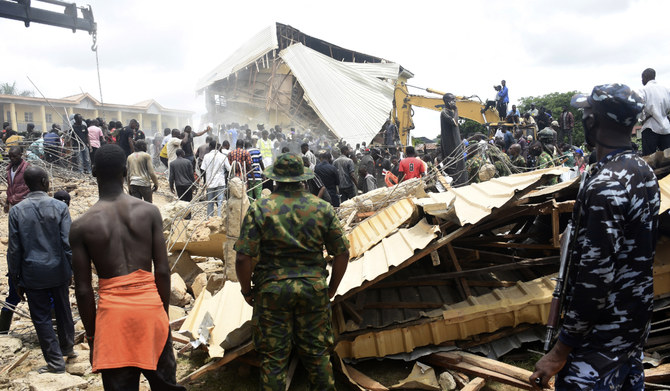
People gather at the scene of a collapsed two-storey building in Jos, Nigeria, Friday, July, 12, 2024. (AP)
Short Url
Updated 13 July 2024
Follow

The collapse of a school in northern Nigeria leaves 22 students dead, officials say

  • A local television station reported 12 deaths
  • “Approximately 120 people were trapped, with many evacuated,” Plateau Commissioner for Information Musa Ashoms said

ABUJA, Nigeria: A two-story school collapsed during morning classes Friday in north-central Nigeria, killing 22 students and sending rescuers on a frantic search for more than 100 people trapped in the rubble, authorities said.
The Saints Academy college in Plateau state’s Busa Buji community collapsed shortly after students, many of whom were 15 years old or younger, arrived for classes.
A total of 154 students were initially trapped in the rubble but Plateau police spokesman Alfred Alabo later said 132 of them had been rescued and were being treated for injuries in various hospitals. He said 22 students died. An earlier report by local media had said that at least 12 people were killed.
Dozens of villagers gathered near the school, some weeping and others offering to help, as excavators combed through the debris from the part of the building that had caved in.
One woman was seen wailing and attempting to go closer to the rubble as others held her back.
Nigeria’s National Emergency Management Agency said rescue and health workers as well as security forces had been deployed at the scene immediately after the collapse, launching a search for the trapped students.
“To ensure prompt medical attention, the government has instructed hospitals to prioritize treatment without documentation or payment,” Plateau state’s Commissioner for Information Musa Ashoms said in a statement.
The state government blamed the tragedy on the school’s “weak structure and location near a riverbank.” It urged schools facing similar issues to shut down.
Building collapses are becoming common in Nigeria, Africa’s most populous country with more than a dozen such incidents recorded in the last two years. Authorities often blame such disasters on a failure to enforce building safety regulations and on poor maintenance.


Power outages hit Ukraine and Moldova as Kyiv struggles against the winter cold

Updated 10 sec ago
Follow

Power outages hit Ukraine and Moldova as Kyiv struggles against the winter cold

  • Outages had been caused by a technical malfunction affecting power lines linking Ukraine and Moldova
  • Blackouts were reported in Kyiv, as well as Zhytomyr and Kharkiv regions

KYIV: Emergency power cuts swept across several Ukrainian cities as well as neighboring Moldova on Saturday, officials said, amid a commitment from the Kremlin to US President Donald Trump to pause strikes on Kyiv as Ukraine battles one of its bleakest winters in years.
Ukraine’s Energy Minister Denys Shmyhal said that the outages had been caused by a technical malfunction affecting power lines linking Ukraine and Moldova.
The failure “caused a cascading outage in Ukraine’s power grid,” triggering automatic protection systems, he said.
Blackouts were reported in Kyiv, as well as Zhytomyr and Kharkiv regions, in the center and northeast of the country respectively. The outage cut water supplies to the Ukrainian capital, officials said, while the city’s subway system was temporarily suspended because of low voltage on the network.
Moldova also experienced major power outages, including in the capital Chisinau, officials said.
“Due to the loss of power lines on the territory of Ukraine, the automatic protection system was triggered, which disconnected the electricity supply,” Moldova’s Energy Minister Dorin Junghietu said in a post on Facebook. “I encourage the population to stay calm until electricity is restored.”
Weaponizing winter
The large-scale outage followed weeks of Russian strikes against Ukraine’s already struggling energy grid, which have triggered long stretches of severe power shortages.
Moscow has sought to deny Ukrainian civilians heat, light and running water over the course of the war, in a strategy that Ukrainian officials describe as “weaponizing winter.”
While Russia has used similar tactics throughout the course of its almost four-year invasion of Ukraine, temperatures throughout this winter have fallen further than usual, bringing widespread hardship to civilians.
Forecasters say Ukraine will experience a brutally cold period stretching into next week. Temperatures in some areas will drop to minus 30 degrees Celsius (minus 22 Fahrenheit), Ukraine’s State Emergency Service said.
Trump said late Thursday that President Vladimir Putin had agreed to a temporary pause in targeting Kyiv and other Ukrainian towns amid the extreme weather.
“I personally asked President Putin not to fire on Kyiv and the cities and towns for a week during this ... extraordinary cold,” Trump said during a Cabinet meeting at the White House. Putin has “agreed to that,” he said, without elaborating on when the request to the Russian leader was made.
The White House didn’t immediately respond to a query seeking clarity about the scope and timing of any limited pause.
Kremlin spokesperson Dmitry Peskov confirmed Friday that Trump “made a personal request” to Putin to stop targeting Kyiv until Sunday “in order to create favorable conditions for negotiations.”
Talks are expected to take place between US, Russian and Ukrainian officials on Feb. 1 in Abu Dhabi. The teams previously met in late January in the first known time that officials from the Trump administration simultaneously met with negotiators from both Ukraine and Russia. However, it’s unclear many obstacles to peace remain. Disagreement over what happens to occupied Ukrainian territory, and Moscow’s demand for possession of territory it hasn’t captured, are a key issue holding up a peace deal, Zelensky said Thursday.
Russian presidential envoy Kirill Dmitriev said on social media Saturday that he was in Miami, where talks between Russian and US negotiators have previously taken place.
Russia struck Ukrainian energy assets in several regions on Thursday but there were no strikes on those facilities overnight, Ukraine’s President Volodymyr Zelensky said Friday.
In a post on social media, Zelensky also noted that Russia has turned its attention to targeting Ukrainian logistics networks, and that Russian drones and missiles hit residential areas of Ukraine overnight, as they have most nights during the war.
Trump has framed Putin’s acceptance of the pause in strikes as a concession. But Zelensky was skeptical as Russia’s invasion approaches its fourth anniversary on Feb. 24 with no sign that Moscow is willing to reach a peace settlement despite a US-led push to end the fighting.
“I do not believe that Russia wants to end the war. There is a great deal of evidence to the contrary,” Zelensky said Thursday.