

‘We can’t wait another year’: disaster-hit nations call for climate aid

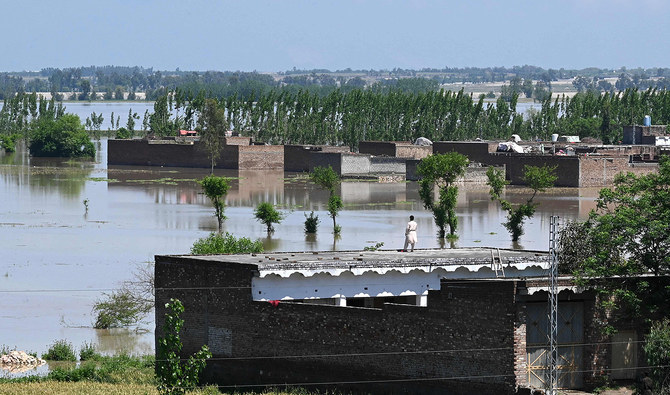
A man stands on the roof of his deluged house after heavy rains in Nowshera district, Khyber-Pakhtunkhwa province on April 16, 2024. (AFP)
Short Url
Updated 12 July 2024
Follow

‘We can’t wait another year’: disaster-hit nations call for climate aid

  • This year has witnessed a string of catastrophes on multiple continents, from floods and landslides to heatwaves and wildfires
  • Unprecedented flooding in Pakistan in 2022 killed over 1,7000, caused more than $30 billion in damages and economic losses

PARIS: Countries on the frontlines of climate change have warned they cannot wait another year for long-sought aid to recover from disasters as floods and hurricanes wreak havoc across the globe.

The appeal came during a meeting of the “loss and damage” fund that will conclude Friday amid concerns it is unlikely to be able to approve climate aid until 2025.

“We cannot wait until the end of 2025 for the first funds to get out the door,” Adao Soares Barbosa, a board member from East Timor and a long-standing negotiator for the world’s poorest nations, told AFP.

“Loss and damage isn’t waiting for us.”

Nearly 200 nations agreed at the UN COP28 summit last November to launch a fund responsible for distributing aid to developing countries to rebuild in the wake of climate disasters.

That historic moment has given way to complex negotiations to finalize the fund’s design, which some countries worry will not move at a pace or scale that matches the tempo of extreme-weather disasters afflicting their people.

“The urgency of needs of vulnerable countries and communities cannot be left until we have every hair in place for this fund,” said Barbosa.

Damage bills for climate disasters can run into the billions and there is barely enough cash set aside for loss and damage at present to cover just one such event, experts say.

This year has witnessed a string of catastrophes on multiple continents, from floods and landslides to heatwaves and wildfires.

Delegates met in South Korea for the second meeting of the loss and damage fund this week as Hurricane Beryl left a trail of destruction across the Caribbean and North America.

The “massive” destruction witnessed in recent weeks “puts immense pressure on us to deliver on our work,” Richard Sherman, the South African co-chair of the board steering the negotiations, told the meeting.

The fund said it wanted money approved “as soon as possible, but realistically by mid-2025,” according to an official document seen by AFP.

In an appeal for faster action, Elizabeth Thompson, a board member from Barbados, said Hurricane Beryl alone had caused “apocalyptic” damage worth “multiple billion dollars.”

“In five islands of the Grenadines... 90 percent of the housing is gone... Houses look like packs of cards and strips of wood, roofs are gone, trees are gone, there is no food, there is no water, there is no power,” she said.

“We cannot keep talking while people live and die in a crisis that they do not cause.”

Thompson said the fund needed to reflect “the urgency and the scale required to respond to... the risk, the damage and the devastation faced by people across the world who need this fund.”

Wealthy nations have so far pledged around $661 million to the loss and damage fund. South Korea contributed an additional $7 million at the start of this week’s meeting.

“That would hardly cover the likely losses from one major climate-related disaster,” Camilla More, of the International Institute for Environment and Development, told AFP.

Some estimates suggest developing countries need over $400 billion annually to rebuild after climate-related disasters. One study put the global bill at between $290 billion and $580 billion a year by 2030, and rising after that.

In one example in 2022, unprecedented flooding in Pakistan caused more than $30 billion in damages and economic losses, according to a UN-backed assessment.

Developing nations had been pushing for a specific fund to distribute aid to recover from climate impacts for 30 years, and the agreement struck in November was hailed a major diplomatic breakthrough.

“(But) ee can’t have a fund without money,” said Brandon Wu from ActionAid.

Technical discussions are taking place this year over the details of the loss and damage fund, including with the World Bank which will house the fund on an interim basis.

The Philippines was chosen this week to host the fund’s board.

Contentious discussions remain to decide how the money is allocated and in what form it should be made available to countries.

On Tuesday, more than 350 nongovernmental organizations sent a letter to the fund’s board demanding that a substantial share of the money be made directly available as small grants to local communities and indigenous groups.


Pakistan plans 3,000 EV charging stations as green mobility push gathers pace

Updated 10 sec ago
Follow

Pakistan plans 3,000 EV charging stations as green mobility push gathers pace

  • Roadmap unveiled by energy efficiency regulator and a private conglomerate amid early-stage EV rollout
  • New EV Policy and related plans aim to install 3,000 EV stations by 2030, including 240 stations in current fiscal year

ISLAMABAD: Pakistan’s energy efficiency regulator and a private conglomerate have unveiled an approved roadmap to establish 3,000 electric vehicle (EV) charging stations across the country, state-run Associated Press of Pakistan (APP) reported on Tuesday.

The announcement comes as Pakistan looks to build out basic EV charging infrastructure, which remains limited and unevenly distributed, largely concentrated in major cities. Despite policy commitments to promote electric mobility as part of climate and energy-efficiency goals, the absence of a nationwide charging network has slowed broader EV adoption.

Pakistan’s EV ecosystem is still at a formative stage, with progress constrained by regulatory approvals, grid connectivity issues and coordination challenges among utilities, regulators and fuel retailers. Expanding charging infrastructure is widely seen as a prerequisite for scaling electric transport for both private and commercial use.

According to APP, the roadmap was presented during a meeting between Malik Group Chief Executive Officer Malik Khuda Baksh and National Energy Efficiency and Conservation Authority Managing Director and Additional Secretary Humayon Khan.

“Baksh ... in a meeting with Khan, unveiled the approved roadmap for establishing 3,000 electric vehicle charging stations across Pakistan,” APP reported. “Khan reaffirmed the authority’s full institutional backing and pledged to expand the initiative to 6,000 EV charging stations nationwide.”

The discussion reviewed hurdles delaying the rollout, including EV charger imports, customs duties, regulatory documentation and inter-agency coordination.

APP said Khan welcomed the proposal and sought recommendations for “internationally compliant EV charger brands,” while asking for a detailed “issue-and-solutions report within three days” to facilitate timely implementation of the national green mobility initiative.

Despite the issuance of 13 licenses by NEECA and the arrival of five EV charging units at designated sites, progress has been slowed by procedural bottlenecks, officials said. These include delays in electricity connections, prolonged installation of separate meters and pending no-objection certificates from power distribution companies and oil marketing firms, which continue to stall operational readiness.

Pakistan’s electric vehicle ecosystem is still in its early stages, with charging infrastructure far behind levels seen in more advanced markets. The government’s New Energy Vehicle Policy and related plans aim to install 3,000 EV charging stations by 2030, including 240 stations planned in the current fiscal year, but actual deployment remains limited and uneven, mostly clustered in major cities and along key urban corridors.

Despite regulatory backing, including the 2024 Electric Vehicles Charging Infrastructure and Battery Swapping Stations framework, progress has been slow. Many proposed stations have yet to become operational due to delays in grid connections and approvals, and public maps of nationwide charging coverage are not yet available.

Private players are beginning to install more chargers, and there are over 20 public EV charging points reported in urban centers, offering both slower AC chargers and faster DC options. However, such infrastructure is still sparse compared with the growing number of electric vehicles and the government’s long-term targets.