

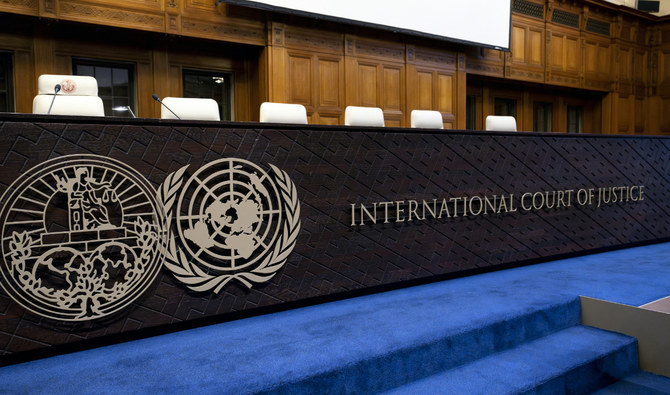

UNITED NATIONS: A leading South African judge said on Thursday that “hardly anything” will deter Israel’s Gaza offensive, but Pretoria’s case against Israel at the International Court of Justice remains vital to highlight the dire situation.
South Africa’s case brought in December 2023 alleges that Israel’s Gaza offensive, launched in retaliation for an unprecedented Hamas attack on Israel, breached the 1948 UN Genocide Convention. Israel has strongly denied the accusation.
In an interview with AFP, Nambitha Dambuza, a judge of appeal in the Supreme Court of South Africa, lamented that Israel faces few constraints in prosecuting its war.
“The cause of the state concerned, Israel, is so deep and they’re convinced they’re in the right and they know there’s hardly anything that’s going to happen if they continue with their conduct,” Dambuza said.
“Accountability can be a choice among states and I’m not saying all states are the same. Some are more sensitive to pressure, and they might adjust their conduct accordingly, but others will not,” added Dambuza who was in New York for the UN’s High Level Political Forum.
South Africa’s case, which Spain said last month it would join along with several Latin American nations, has resulted in several rulings against Israel.
Last month the ICJ ordered Israel to ensure “unimpeded access” to UN-mandated investigators to look into allegations of genocide.
In a ruling on January 26, the ICJ also ordered Israel to do everything it could to prevent acts of genocide during its military operation in Gaza.
South Africa has gone to the ICJ several times arguing that the dire humanitarian situation means the court should issue further fresh emergency measures.
On May 24, the court ordered Israel to immediately halt its military offensive in the city of Rafah and keep open the key border crossing there for unhindered humanitarian aid.
It also called for the unconditional release of hostages taken by Palestinian militant group Hamas during its October 7 assault that sparked the war.
While ICJ rulings are legally binding, the court has no concrete means to enforce them. Dambuza said that even bringing the case publicized the situation and drew attention to the alleged violations.
“It did bring pressure,” she said. “Although the process didn’t result in any tangible relief... putting these issues out in the public, society gets to see justice — or attempts at justice.”
The war was sparked by Hamas’s October 7 attack on Israel, which resulted in the deaths of 1,194 people, mostly civilians, according to an AFP tally based on Israeli official figures.
The militants also seized hostages, 116 of whom remain in Gaza, including 42 the military says are dead.
Israel’s retaliatory military offensive has killed at least 38,345 people in Gaza, also mostly civilians, according to the Hamas-run territory’s health ministry.
Turning to ecological problems, Dambuza, chair of the Africa Judicial Network on Environmental Law, called for an international environmental court to be set up.
She also said traditional courts, which are run by community leaders and are common in rural South Africa, had an important role to play in adjudicating environmental disputes globally.


