ISLAMABAD: Pakistan condemns Israeli bombardment of tents for displaced Palestinians in the southern Gaza city of Rafah that killed dozens of people, the Pakistani Foreign Office said on Monday.
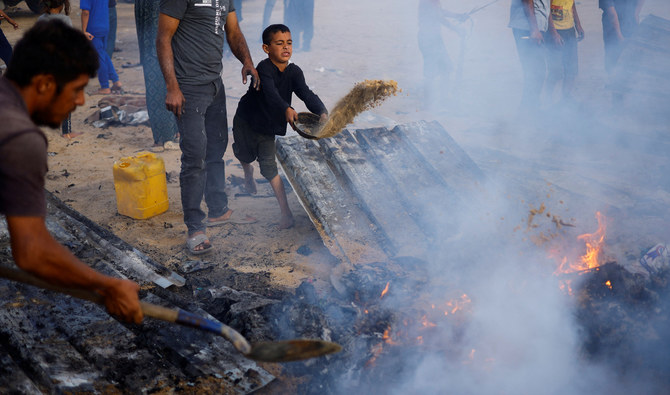
Palestinian health workers said Israeli airstrikes killed at least 45 people on Sunday and “numerous” others were trapped in flaming debris. Gaza’s Health Ministry said women and children made up most of the dead and dozens of wounded.
The attacks came two days after the International Court of Justice (ICJ) ordered Israel to end its military offensive in Rafah, where more than half of Gaza’s population had sought shelter before Israel’s incursion earlier this month.
“Targeting of individuals who were displaced earlier because of Israeli bombardment and were sheltered in a refugee camp, is yet another breach of international humanitarian law by the Israeli occupation forces,” the Pakistani Foreign Office said in a statement.
“The attack is also a blatant defiance of the additional provisional measures of 24 May 2024 by the International Court of Justice (ICJ) ordering Israel to immediately halt its military offensive in Rafah in conformity with its obligations under the Genocide Convention and the worsening humanitarian conditions faced by civilians.”
The case against Israel was initiated by South Africa in December 2023, where it labeled Israel’s actions in the Gaza Strip as “genocidal,” asserting that they intended to destroy the Palestinian people in ways specified under the 1948 Genocide Convention.
The war on Gaza broke out after Hamas attacks on Israel on October 7, which killed more than 1,100 people, in response to the deteriorating condition of Palestinian people living under Israeli occupation.
Israel launched a retaliatory offensive, widely viewed as disproportionate, in which more than 35,000 Palestinians, mostly women and children, have lost their lives, according to the Palestinian Health Ministry.
“Pakistan reiterates its demand for immediate and unconditional implementation of the orders of the ICJ of 24 May 2024. Measures must be taken to fully protect civilians in Gaza and the Israeli occupation forces must be held accountable for the Gaza genocide,” the Pakistan Foreign Office said further.
“We call on the UN Security Council to play its role in preventing Israel from any further attacks against the civilians in Rafah and taking effective measures to protect the people of Gaza.”
Pakistan does not recognize the state of Israel and calls for an independent Palestinian state based on “internationally agreed parameters” and the pre-1967 borders with Al-Quds Al-Sharif as its capital.
In recent months, the South Asian country has repeatedly raised the issue of Israel’s war on Gaza, launched last October, at the United Nations through its permanent representative, Ambassador Munir Akram.


![]()

Pakistan condemns Israeli attack on Rafah refugee camp, calls it ‘blatant defiance’ of ICJ ruling
Short Url
https://arab.news/gn7dr
Pakistan condemns Israeli attack on Rafah refugee camp, calls it ‘blatant defiance’ of ICJ ruling
- Israeli airstrikes killed at least 45 people on Sunday and ‘numerous’ others were trapped under debris
- Gaza’s Health Ministry said women and children made up most of the dead and dozens of wounded
Latest updates




© 2026 SAUDI RESEARCH & PUBLISHING COMPANY, All Rights Reserved And subject to Terms of Use Agreement.