

‘Hardly anything’ will deter Israel’s Gaza war: South Africa judge on ICJ case

South Africa’s case brought in December 2023 alleges that Israel’s Gaza offensive, launched in retaliation for an unprecedented Hamas attack on Israel, breached the 1948 UN Genocide Convention. (AFP)
Short Url
Updated 12 July 2024
Follow

‘Hardly anything’ will deter Israel’s Gaza war: South Africa judge on ICJ case

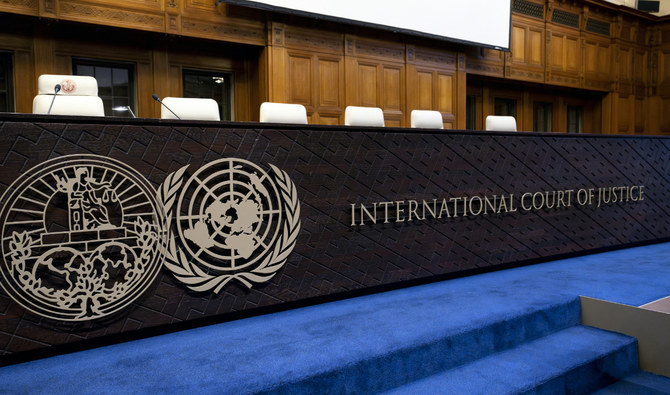
UNITED NATIONS: A leading South African judge said on Thursday that “hardly anything” will deter Israel’s Gaza offensive, but Pretoria’s case against Israel at the International Court of Justice remains vital to highlight the dire situation.

South Africa’s case brought in December 2023 alleges that Israel’s Gaza offensive, launched in retaliation for an unprecedented Hamas attack on Israel, breached the 1948 UN Genocide Convention. Israel has strongly denied the accusation.

In an interview with AFP, Nambitha Dambuza, a judge of appeal in the Supreme Court of South Africa, lamented that Israel faces few constraints in prosecuting its war.

“The cause of the state concerned, Israel, is so deep and they’re convinced they’re in the right and they know there’s hardly anything that’s going to happen if they continue with their conduct,” Dambuza said.

“Accountability can be a choice among states and I’m not saying all states are the same. Some are more sensitive to pressure, and they might adjust their conduct accordingly, but others will not,” added Dambuza who was in New York for the UN’s High Level Political Forum.

South Africa’s case, which Spain said last month it would join along with several Latin American nations, has resulted in several rulings against Israel.

Last month the ICJ ordered Israel to ensure “unimpeded access” to UN-mandated investigators to look into allegations of genocide.

In a ruling on January 26, the ICJ also ordered Israel to do everything it could to prevent acts of genocide during its military operation in Gaza.

South Africa has gone to the ICJ several times arguing that the dire humanitarian situation means the court should issue further fresh emergency measures.

On May 24, the court ordered Israel to immediately halt its military offensive in the city of Rafah and keep open the key border crossing there for unhindered humanitarian aid.

It also called for the unconditional release of hostages taken by Palestinian militant group Hamas during its October 7 assault that sparked the war.

While ICJ rulings are legally binding, the court has no concrete means to enforce them. Dambuza said that even bringing the case publicized the situation and drew attention to the alleged violations.

“It did bring pressure,” she said. “Although the process didn’t result in any tangible relief... putting these issues out in the public, society gets to see justice — or attempts at justice.”

The war was sparked by Hamas’s October 7 attack on Israel, which resulted in the deaths of 1,194 people, mostly civilians, according to an AFP tally based on Israeli official figures.

The militants also seized hostages, 116 of whom remain in Gaza, including 42 the military says are dead.

Israel’s retaliatory military offensive has killed at least 38,345 people in Gaza, also mostly civilians, according to the Hamas-run territory’s health ministry.

Turning to ecological problems, Dambuza, chair of the Africa Judicial Network on Environmental Law, called for an international environmental court to be set up.

She also said traditional courts, which are run by community leaders and are common in rural South Africa, had an important role to play in adjudicating environmental disputes globally.


Ukraine drops NATO goal as Trump envoy sees progress in peace talks

Updated 57 min 18 sec ago
Follow

Ukraine drops NATO goal as Trump envoy sees progress in peace talks

  • The move marks a major shift for Ukraine, which has fought to join NATO as a safeguard against Russian attacks and has such an aspiration included in its constitution

BERLIN/KYIV: President Volodymyr Zelensky offered to drop Ukraine’s aspirations to join the NATO military alliance as he held five hours of talks with US envoys in Berlin on Sunday to end the war with Russia, with negotiations set to continue on Monday.
Trump’s envoy Steve Witkoff said “a lot of progress was made” as he and Trump’s son-in-law Jared Kushner met Zelensky in the latest push to end Europe’s bloodiest conflict since World War Two, though full details were not divulged.
Zelensky’s adviser Dmytro Lytvyn said the president would comment on the talks on Monday once they were completed. Officials, Lytvyn said, were considering the draft documents.
“They went on for more than five hours and ended for today with an agreement to resume tomorrow morning,” Lytvyn told reporters in a WhatsApp chat.
Ahead of the talks, Zelensky offered to drop Ukraine’s goal to join NATO in exchange for Western security guarantees.
The move marks a major shift for Ukraine, which has fought to join NATO as a safeguard against Russian attacks and has such an aspiration included in its constitution. It also meets one of Russia’s war aims, although Kyiv has so far held firm against ceding territory to Moscow.
“Representatives held in-depth discussions regarding the 20-point plan for peace, economic agendas, and more. A lot of progress was made, and they will meet again tomorrow morning,” Witkoff said in a post on X.
The talks were hosted by German Chancellor Friedrich Merz, who a source said had made brief remarks before leaving the two sides to negotiate. Other European leaders are also due in Germany for talks on Monday.
“From the very beginning, Ukraine’s desire was to join NATO, these are real security guarantees. Some partners from the US and Europe did not support this direction,” Zelensky said in answer to questions from reporters in a WhatsApp chat.
“Thus, today, bilateral security guarantees between Ukraine and the US, Article 5-like guarantees for us from the US, and security guarantees from European colleagues, as well as other countries — Canada, Japan — are an opportunity to prevent another Russian invasion,” Zelensky said.
“And it is already a compromise on our part,” he said, adding the security guarantees should be legally binding.
Russian President Vladimir Putin has repeatedly demanded Ukraine officially renounce its NATO ambitions and withdraw troops from the about 10 percent of Donbas which Kyiv still controls. Moscow has also said Ukraine must be a neutral country and no NATO troops can be stationed in Ukraine.
Russian sources said earlier this year that Putin wants a “written” pledge by major Western powers not to enlarge the US-led NATO alliance eastwards — shorthand for formally ruling out membership to Ukraine, Georgia, Moldova and other former Soviet republics.
Sending Witkoff, who has led negotiations with Ukraine and Russia on a US peace proposal, appeared to be a signal that Washington saw a chance of progress nearly four years after Russia’s 2022 invasion.
Under pressure from Trump to sign a peace deal that initially backed Moscow’s demands, Zelensky accused Russia of dragging out the war through deadly bombings of cities and Ukraine’s power and water supplies.
A ceasefire along the current front lines would be a fair option, he added.

‘CRITICAL MOMENT’
Germany’s Defense Minister Boris Pistorius said it was a “good sign” Trump had sent his envoys while fielding questions in an interview with the ZDF broadcaster on the suitability of Witkoff and Kushner, two businessmen, as negotiators.
“It’s certainly anything but an ideal setup for such negotiations. That much is clear. But as they say, you can only dance with the people on the dance floor,” Pistorius said.
On the issue of Ukraine’s offer to give up its NATO aspirations in exchange for security guarantees, Pistorius said Ukraine had bitter prior experience of relying on security assurances. Kyiv had in 1994 agreed to give up its Soviet-era nuclear arsenal in exchange for territorial guarantees from the US, Russia and Britain.
“Therefore, it remains to be seen to what extent this statement Zelensky has now made will actually hold true, and what preconditions must be met,” Pistorius said.
“This concerns territorial issues, commitments from Russia and others,” he said, adding mere security guarantees, especially without significant US involvement, “wouldn’t be worth much.”
Britain, France and Germany have been working to refine the US proposals, which in a draft disclosed last month called for Kyiv to cede more territory, abandon its NATO ambitions and accept limits on its armed forces.
European allies have described this as a “critical moment” that could shape Ukraine’s future, and sought to shore up Kyiv’s finances by leveraging frozen Russian central bank assets to fund Kyiv’s military and civilian budget.