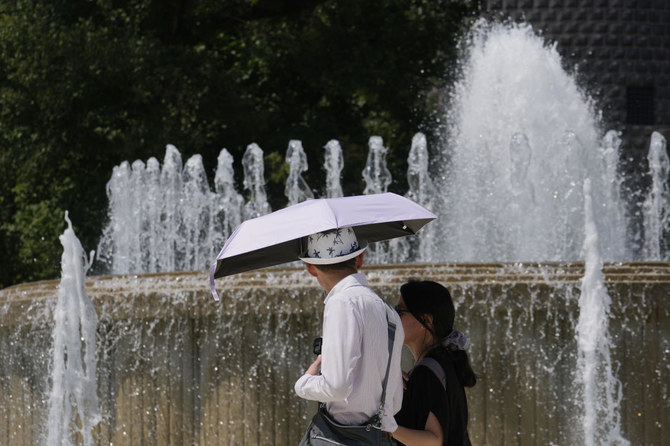
BELGRADE: Weather alerts, forest fires, melting pavement in cities: A sizzling heat wave has sent temperatures in parts of central and southern Europe soaring toward 40 degrees Celsius (104 Fahrenheit) in some places.
From Italy to Romania, authorities warned people to be cautious, drive carefully if going on holiday, drink plenty of water and avoid going out during the hottest hours of the day.
Italian authorities declared a red weather alert in seven cities on Thursday, mostly in the central parts of the country but also the capital Rome and Trieste in the northeast. The heat conditions are aggravated by humidity and could affect healthy people as well as those with health conditions, authorities warned.
Similar warnings were issued in neighboring Croatia and further east and south. Croatia’s main tourism resort, the southern Adriatic Sea town of Dubrovnik, recorded 28 degrees Celsius (82.4 Fahrenheit) at dawn, signalling there won’t be relief when the sun goes down.
Forest fires have been reported this week in Albania, near the border with Greece, as well as in Bosnia and Italy.
Meteorologists said temperatures were even higher than officially reported in big cities where sizzling concrete radiates the heat above the ground and the asphalt softens under one’s feet.
“It was impossible to breathe yesterday,” said Antonela Spičanović, from the Montenegrin capital of Podgorica, where temperatures reached 39C (102F) on Wednesday. The city seemed deserted with many of its residents staying indoors or heading for the Adriatic Sea coast or the mountains.
“I spend my days in the apartment, under the air conditioning,” said Đorđe Stanišić, an electrical engineer also from Podgorica. “It’s hell outside.”
Mendim Rugova, a meteorologist from neighboring Kosovo, said temperatures in the country have risen on average by 2.5 degrees since the 1980s. He said the current heat wave could last until the end of July.
“In the region we could see temperatures above 40C, in parts of Albania, Northern Macedonia, in Greece and also in parts of Serbia,” he predicted.
In Czechia’s capital of Prague, where temperatures reached 34C Wednesday before dropping slightly Thursday, the city zoo delivered ten tons of ice to provide much-needed relief for the animals.
The ice was strategically placed around the zoo Wednesday creating cool spots where animals could find refuge from unusually high temperatures.
In the Romanian capital Bucharest, street thermometers showed 42C ( 107F) on Tuesday and Wednesday though the official measurements were a few degrees lower.
Neighboring Serbia reported record temperatures so far this summer, with thermostats at 35C (95F) Thursday morning in the north of the country. In the capital Belgrade, doctors reported treating people who collapsed, felt dizzy or complained of headaches due to the heat.
Serbian authorities have said that the use of air conditioning led to huge power consumption similar to levels normally seen in winter, when many in the Balkan country use electricity for heating.
During a previous heat wave last month, Montenegro, Bosnia, Croatia and Albania faced a major power outage amid the overload and a collapse of a regional distribution line. Earlier this month, a powerful storm swept the region after days of heat and killed two people, damaged houses while pulling out trees and flooding streets.
Experts say human-induced climate change has brought wild weather swings, increasingly unpredictable storms and heat waves.


![]()

‘It’s hell outside’: Sizzling heat wave in parts of southern and central Europe prompts alerts
Short Url
https://arab.news/p9efu
‘It’s hell outside’: Sizzling heat wave in parts of southern and central Europe prompts alerts
- Italian authorities declared a red weather alert in seven cities on Thursday
- Croatia’s main tourism resort, the southern Adriatic Sea town of Dubrovnik, recorded 28 degrees Celsius


Latest updates


Recommended


© 2026 SAUDI RESEARCH & PUBLISHING COMPANY, All Rights Reserved And subject to Terms of Use Agreement.