Six dead in Tokyo as Japan swelters in heatwave

1 / 4
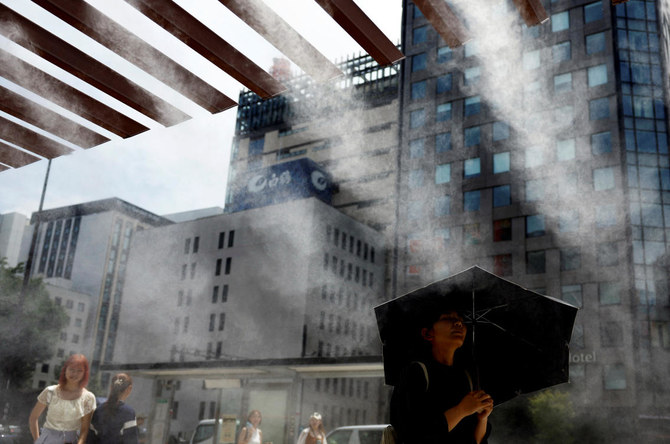
Passersby take a break under a cooling mist as the Japanese government issued a heatstroke alert in Tokyo and other prefectures, in Tokyo, Japan July 9, 2024. (Reuters)
2 / 4
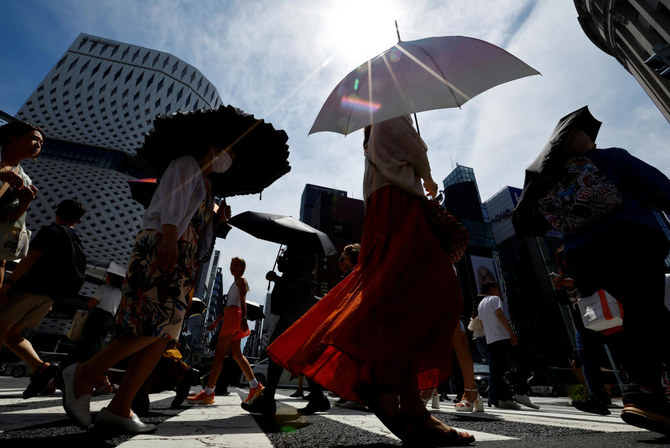
Passersby holding parasols walk on the street under strong sunlight as the Japanese government issued a heatstroke alert in Tokyo and other prefectures, in Tokyo, Japan July 9, 2024. (Reuters)
3 / 4
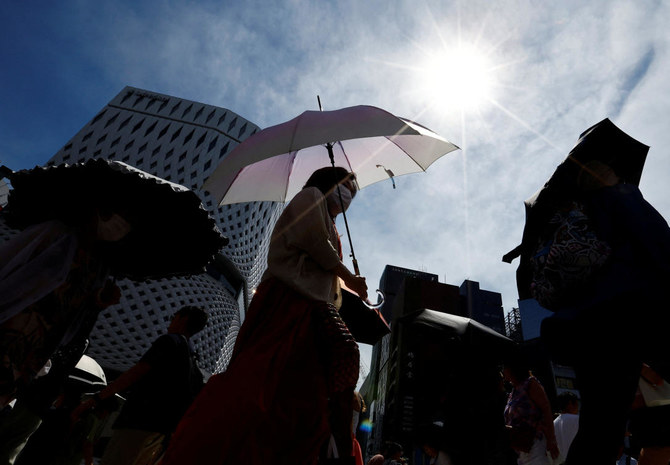
Passersby holding parasols walk under sunlight on the street as the Japanese government issued a heatstroke alert in Tokyo and other prefectures, in Tokyo, Japan July 9, 2024. (Reuters)
4 / 4
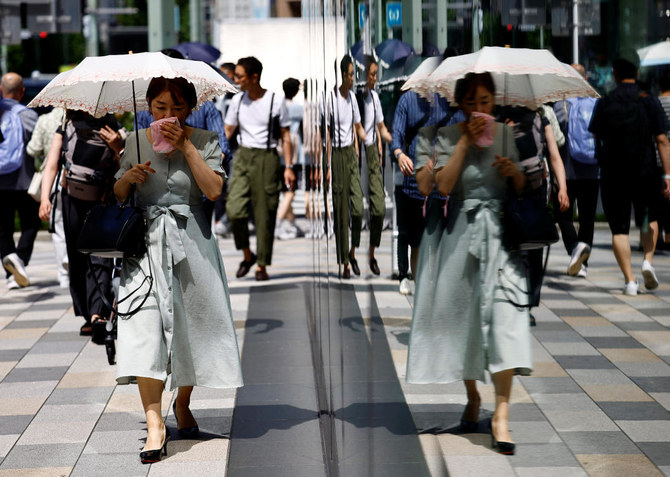
A passerby holding a parasol wipes her face as she walks on the street as the Japanese government issued a heatstroke alert in Tokyo and other prefectures, in Tokyo, Japan July 9, 2024. (Reuters)
Short Url
Updated 09 July 2024
Follow

Six dead in Tokyo as Japan swelters in heatwave

TOKYO: Six people have died of heatstroke in Tokyo as Japan swelters under a rare rainy season heatwave, prompting authorities to issue a flurry of health warnings.
Over the weekend, the central Shizuoka region became the first in Japan to see the mercury reach 40 degrees Celsius (104 Fahrenheit) this year, far surpassing the 35-degree threshold classified by weather officials as “extremely hot.”
Such severe heat in the middle of Japan’s rainy season is “rather rare,” caused in part by a strong South Pacific high-pressure system, a weather agency official told AFP.
Temperatures also hit record highs near 40 degrees Celsius on Monday at observation posts in Tokyo and in the southern Wakayama region, according to local media.
The past few days have seen authorities issue heatstroke alerts in much of the country, urging residents to avoid exercising outside and to use air conditioning.
The capital logged three deaths linked to heatstroke on Saturday and three more on Monday, when the mercury hovered around 35 degrees Celsius at midday, according to the city’s medical examination office.
“Without the AC on, I find it difficult to survive,” Tokyo resident Sumiko Yamamoto, 75, told AFP, adding she feels “it’s gotten drastically hotter” since last year.
“Through the advice given on TV, I try to stay hydrated as much as possible. Because I’m old, I’m being careful not to collapse,” she said.
Heatstroke is particularly deadly in Japan, which has the second-oldest population in the world after Monaco.
Yamamoto’s age puts her in the demographic flagged by health experts as particularly vulnerable to heatstroke, along with infants and those living alone or who are too poor to afford air conditioning.
The Japanese Association for Acute Medicine on Monday warned of the rising death toll from heat exhaustion nationwide, which grew from just a few hundred per year two decades ago to around 1,500 in 2022.
The sheer number of fatalities suggests that heatstroke now poses a danger on par with that of “a major natural disaster,” the group said, warning against non-essential outings.
Tokyo business executive Mikio Nakahara, 67, says the difference between Tokyo 50 years ago and now is stark.
“Tokyo wasn’t as hot as it is now,” he told AFP.
But these days, “I try to work remotely as much as possible so I don’t have to go outside.”
With ever-hotter summers becoming the norm around the world, tourists like Ainhoa Sanchez, 29, aren’t too surprised by Tokyo’s temperatures.
“So the plan is going sightseeing a little bit. Drinking a lot of liquids. Maybe when we get too hot, we can get into a shop, look around, chill a bit and then go back to the street,” she told AFP.


In Puerto Rico, fans thrilled with Bad Bunny’s Super Bowl show

Updated 7 sec ago
Follow

In Puerto Rico, fans thrilled with Bad Bunny’s Super Bowl show

  • In the town square in Vega Baja, a small municipality near Puerto Rico’s capital San Juan, retired teacher Madeline Miranda was bubbling with excitement after watching Bad Bunny perform at the Super
VEGA BAJA: In the town square in Vega Baja, a small municipality near Puerto Rico’s capital San Juan, retired teacher Madeline Miranda was bubbling with excitement after watching Bad Bunny perform at the Super Bowl.
After all, Benito Antonio Martinez Ocasio was once one of her former students, and years away from becoming a global superstar.
“I danced, I screamed, I swore and I gave it my all,” said the 75-year-old Miranda, who joined about 100 other people to watch the performance by Vega Baja’s most famous native son.
People of all ages turned out, many of them bringing beach chairs — and drinks — to wait for the big moment.
Vega Baja is not exactly a place where American football is all that popular, and few of those present really paid attention to the game, which the Seattle Seahawks won over the New England Patriots.
Bad Bunny was the only show in town.
When he finally appeared on screen singing one of his biggest hits, “Titi Me Pregunto,” the crowd shrieked with joy. Some waved Puerto Rican flags and others clapped.
The party had begun.
“I feel so proud that someone from Vega Baja has reached such heights. This shows that our presence is growing stronger in the United States and around the world,” David Fontanez, a 66-year-old retiree, told AFP.
Other watch parties took place in Old San Juan.
’Great inspiration’
Bad Bunny’s performance celebrated Puerto Rico, a US island territory in the Caribbean — from the lyrics of his songs to his set design featuring sugar cane and his salmon-colored “La Casita” (little house). Fans cheered each reference.
He also made history as the first Super Bowl headliner to sing entirely in Spanish. A week ago, he became the first performer to win the Grammy for Album of the Year for a Spanish-language work.
For 14-year-old Pedro Melendez Barrio, the singer is a “great inspiration” for those who live in Vega Baja.
“He makes me feel very proud and also very happy. I think that if he has achieved all this, I can achieve this too. That really motivates me.”
Many said they were grateful to the 31-year-old Bad Bunny for championing his homeland.
Last year, he completed a wildly successful concert residency in San Juan, giving the island a major economic boost as fans flocked to see him.
“He brought to the Super Bowl the essence of what we, Puerto Ricans, are,” said Miranda, who remembers young Benito as a “very quiet and disciplined” child.
“He’s a great ambassador for this community.”
Some Puerto Ricans made mention of the conservative backlash that Bad Bunny faced after he was named as the halftime show headliner, largely due to the fact that he sings in Spanish.
Indeed, after the show, US President Donald Trump suggested that “nobody understands a word this guy is saying.”
But most said what was more important was Bad Bunny’s ability to amplify the voice of Puerto Ricans, who are US citizens but do not have the right to vote for president.
“He has reflected a lot of our culture (in his work), what’s happening in Puerto Rico, and the situation of immigrants,” Madeline Garcia, 31, said after the show.
“We ignore the controversy because, whether they like it or not, we’re also part of the United States. And even if our language is Spanish, most Puerto Ricans speak English.”