Ukraine says seized cargo ship used for Crimea grain exports

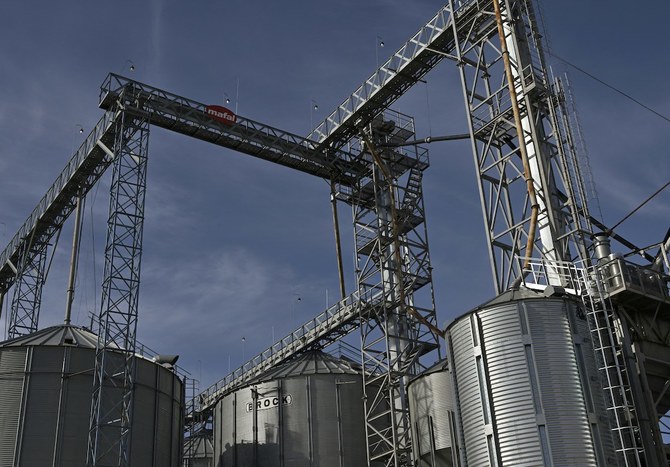
The Security Services of Ukraine claimed that the grain exported by Usko Mfu had been produced in southern Ukraine. (AFP file photo)
Short Url
Updated 11 July 2024
Follow

Ukraine says seized cargo ship used for Crimea grain exports

  • Kyiv has accused Moscow of illegally harvesting and shipping grain produced on occupied territory to third countries
  • Prosecutors say 12 other foreign crew members were on board at the time of the vessel’s seizure

KYIV: Kyiv said Thursday that it had seized a foreign cargo ship and detained its captain, alleging that the vessel had illegally exported Ukrainian grain from the annexed Crimean peninsula.
Since Russia’s capture of swaths of agricultural land in Ukraine in early 2022, Kyiv has accused Moscow of illegally harvesting and shipping grain produced on occupied territory to third countries.
The Ukrainian prosecutor general’s office said it had “seized” a foreign vessel in the Odesa region that had earlier exported agricultural products via the Crimean port of Sevastopol — a key military hub for Russia in the Black Sea.
The Security Services of Ukraine (SBU) said in a separate statement that it had detained the ship’s captain, accusing him of violating rules on entering occupied territory.
It also claimed that the grain exported by the vessel — Usko Mfu — had been produced in southern Ukraine.
The charges carry a maximum penalty of five years in prison, the SBU said, while prosecutors identified the captain as a citizen of Azerbaijan, an ex-Soviet country in the South Caucasus.
Prosecutors said 12 other foreign crew members were also on board at the time of the vessel’s seizure, without elaborating on their nationality or whether they too would face charges.
The Cameroonian-flagged vessel illegally docked at Sevastopol in November 2023 and was loaded with more than 3,000 tons of agricultural products “intended for a Turkish company,” prosecutors said.
“To conceal the illegal activity, the ship’s Automatic Identification System (AIS) was turned off before entering the port of Sevastopol, which is a gross violation of maritime safety requirements,” their statement added.
Prosecutors said the ship returned to Sevastopol a second time in May this year.
It was seized at the Ukrainian port of Reni, they added, where they discovered documents issued by Sevastopol port authorities.
Igor Delanoe — deputy director of the Franco-Russian Observatory — said this was the first time Ukraine had seized an internationally-flagged vessel over the shipments.
“The signal is that they want to make third countries face up to their responsibilities,” he said.
“From the Ukrainian point of view, these countries are supporting Russia by their silence, while at the same time benefiting from grain that Ukrainians consider stolen,” he added.
The European Union in May imposed “prohibitive” duties on grain imports from Russia in a bid to cut off revenues to Moscow for its war on Ukraine.
The bloc’s trade commissioner said the measure would “tackle illegal Russian exports of stolen Ukraine grain into EU markets.”
The head of Ukraine’s southern Kherson region, which the Kremlin claims is part of Russia, said Thursday that Russian forces caused fires on dozens of hectares of Ukrainian land growing grain.
He also said that Russian forces had struck a grain storage facility in the region and attacked firefighters who arrived to extinguish the fire with drones.


Costa Rica’s Grynspan pledges reform in bid for UN chief job

Updated 3 sec ago
Follow

Costa Rica’s Grynspan pledges reform in bid for UN chief job

GENEVA: Rebeca Grynspan is upbeat about her chances of becoming the next head of the United Nations, which she insists must become more agile in tackling the world’s crises.
The Costa Rican former vice president said she wanted to rebuild global trust in the United Nations if she becomes its next secretary-general.
“We are very optimistic. I think that I am more than a viable candidate,” Grynspan said on Friday, her last working day before stepping aside as head of the UN trade and development agency UNCTAD to focus on her campaign.
The second term of current UN chief Antonio Guterres expires at the end of the year.
“My profile is right for this moment. I know the UN enough to reform it and enough to defend it,” she told the UN correspondents’ association ACANU.
“I have a lot of experience in my political life, taking decisions under a lot of stress and in complex situations. I have been in the highest positions in the UN.”
It is Latin America’s turn next for the top UN job and two other candidates are running: former Chilean president Michelle Bachelet, and Rafael Grossi, the Argentinian head of the International Atomic Energy Agency.
Founded in 1945, the UN has never had a woman secretary-general.
Grynspan, an economist, is not looking to be chosen on that basis.
“I don’t need any favors to be elected for the secretary-general; I just need people not to discriminate me for being a woman,” the 70-year-old said.
“If the competition will be fair, with no biases, I will make it. I have the CV; I have the merits.”

- Rebuilding trust -

Last month, Guterres warned that the UN was facing financial collapse and could run out of cash by July, with member states neither paying in full nor or time.
“The UN has to change,” said Grynspan.
There are far greater capacities in civil society and the private sector than in 1945, “and we need to be able to harness that: we don’t have to do everything in the UN.”
As for peace and security, “prevention and mediation are essential. But they need agility and flexibility from the structures of the UN. And I don’t think we have that right now.”
US President Donald Trump has slashed funding to some UN agencies and has repeatedly questioned the UN’s relevance and attacked its priorities, setting up his own “Board of Peace.”
“The UN is unique because it’s the only legitimate, universal organization,” said Grynspan.
“We need to rebuild trust with the member states. We need to regain the belief that the UN is useful to solve problems,” she said, vowing to bring her personal qualities to the task.
“I am able to reach to people not only with logic, but also with inspiration, optimism and hope,” she said.
“We need more of that too, because we need to connect again much more with people. We will need to conquer the hearts and minds again.”

- Leadership style -

The UNCTAD chief said her leadership style revolved around being “direct, honest, and evidence-based... There have to be reasons, not only emotions.”
Grynspan recounted that her parents, who were from Poland, “barely survived” World War II. Her maternal grandparents were killed in the Holocaust.
Her parents went “with nothing” to Costa Rica, a country that “allowed them to have a good life.”
“Costa Rica has taught me a lot. It’s a country that I not only love dearly, but I admire,” she said.
“I am not an impetuous person. I think things through. I have the serenity not to lose it under tension and under pressure. I consult. I hear. And I am brave. I take risks.”
rjm/ceg