WARSAW: Slovakia became the third European Union country to ban food imports from Ukraine on Monday, deepening the challenge for the bloc as it works to help Ukraine transport its grain to world markets.
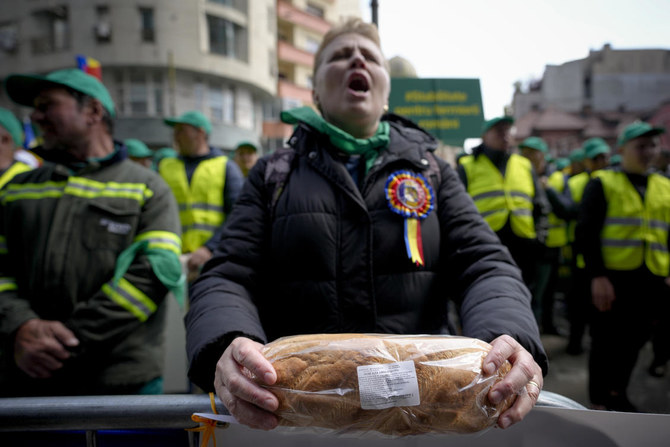
Slovakia followed Poland and Hungary, both of which announced bans Saturday on Ukrainian food imports through June 30. They did so in response to rising anger from farmers who say that a glut of grain in their countries is causing them economic hardship.
The EU’s executive branch, the European Commission, manages trade on behalf of the 27 member countries and objects to them taking unilateral or uncoordinated measures.
At a briefing in Brussels, two spokespeople stressed gratitude to Poland and other Central European countries for supporting Ukraine, but said a solution must be found that respects the EU legal framework.
“We are dealing with a war, right? And this war has consequences, obviously, on farmers and more generally, the population in Ukraine and the European Union and its member states,” said Eric Mamer, chief spokesperson.
He acknowledged that Poland and other countries “have been doing their utmost in order to help Ukraine, adding: “So this is not about sanctioning. This is about finding solutions based on EU law in the interests at the same time of the Ukrainians and of the EU."
Five EU countries that neighbor Ukraine have asked the EU to treat the matter of Ukrainian food with urgency. Poland, Bulgaria, the Czech Republic, Hungary and Slovakia argue that they can’t allow their own farmers to bear the cost of disruption that Ukrainian grain and other agriculture products are causing to their markets.
“The Hungarian government will always stand by Hungarian farmers and will protect Hungarian agriculture,” the agriculture minister, Istvan Nagy, said. He said the surge in Ukrainian products on European markets had made it “impossible” for Hungarian farmers to remain competitive.
Bulgaria is reportedly mulling a similar ban. Meanwhile, a delegation of Ukrainian officials visited Warsaw on Monday for government consultations on the issue.
Nagy also said that low production costs in Ukraine, owing to practices being used that are not permitted in EU countries, had allowed Ukraine to export large quantities of poultry, eggs and honey to the European market, driving costs down to unsustainable levels.
The Slovak Agriculture Ministry announced last week that tests of 1,500 tons of grain from Ukraine in one mill in Slovakia revealed it contained a pesticide banned in the EU. As a result, the Slovak authorities decided to test all Ukrainian grain in the country and temporarily banned its processing.
Ukraine and Russia are both major global suppliers of wheat, barley, sunflower oil and other affordable food products that developing nations depend on. The war upended those supplies to Africa, the Middle East and parts of Asia where people were already going hungry and helped push millions more people into poverty or food insecurity.
After Russia's full-scale invasion of Ukraine, it became too dangerous for ships to sail in the Black Sea, disrupting the flow of large ships carrying food to distant markets. Shipments resumed under a deal brokered by the United Nations and Turkey.
The EU reacted to the crisis by lifting tariffs and other trade duties on Ukraine to help keep its economy afloat. That helped to divert Ukraine’s grain flows destined for Africa and the Middle East through Europe — but much of this food has instead remained in the bordering countries, creating a glut that has caused high losses for local farmers.
The EU measures expire in June, but the EU is expected to renew them.
Ukraine's EU neighbors are, with the exception of Hungary, allies of Ukraine who favor their neighbor’s future membership in the EU.
Yet already the EU’s decision to banish tariffs for Ukrainian goods as a result of Russia’s invasion of its neighbor underlines the challenges that would come with integrating a huge food producer with the rest of the bloc.
Their bans come as Russia threatens to pull out of the Black Sea deal. Moscow is complaining that a separate agreement to facilitate exports of Russian food and fertilizers amid Western sanctions hasn’t worked.
Global food commodity prices surged to record levels after the invasion of Ukraine and have been falling steadily since, but food is still expensive for people in many places because of factors like droughts, trade restrictions and the high cost of buying imported food priced in dollars as some emerging economies’ currencies weaken.


![]()

EU investigates after 3 countries ban Ukraine grain imports
Short Url
https://arab.news/zqk6s
EU investigates after 3 countries ban Ukraine grain imports
- Bans deepens a challenge for the bloc as it works to help Ukraine transport its grain to world markets
- Move in response to rising anger from farmers who say that a glut of grain in their countries is causing them economic hardship


Latest updates





© 2026 SAUDI RESEARCH & PUBLISHING COMPANY, All Rights Reserved And subject to Terms of Use Agreement.