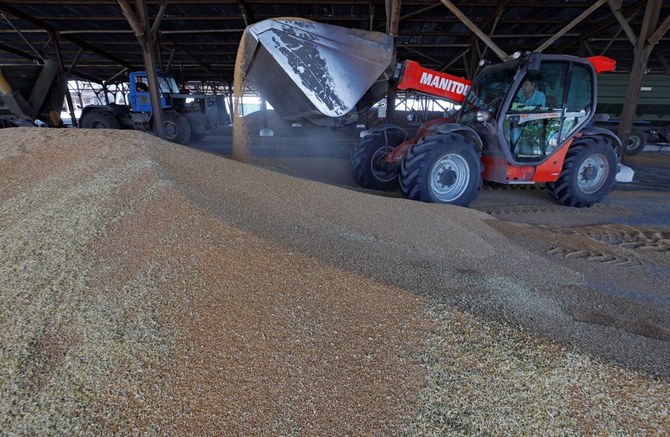

JEDDAH: Russia destroyed at least 60,000 tons of vital grain destined for export in a wave of drone and missile attacks early on Wednesday on the Ukrainian Black Sea port region of Odesa.
Moscow’s refusal to renew an agreement allowing the safe passage of Ukrainian grain through the Black Seahas raised fears for global food security. Ukraine is a major exporter of wheat, corn and maize, and the International Monetary Fund said on Wednesday that Russia's exit from the deal threatened to increase food prices, especially in poor countries.
“Russian terrorists absolutely deliberately targeted the infrastructure of the grain deal,” Ukrainian President Volodymyr Zelensky said. “Every Russian missile is a strike not only on Ukraine but on everyone in the world who wants a normal and safe life.”
Ukraine’s air force said Russia had launched 63 missiles and drones targeting infrastructure and military facilities in the Odesa region. Air defenses shot down 37 of them, it said, a lower proportion than usual.
A large part of the grain export infrastructure at Chornomorsk port southwest of Odesa was damaged, Agriculture Minister Mykola Solsky said, and 60,000 tons of grain had been destroyed.
The attack was "very powerful, truly massive,” Odesa military administration spokesman Serhiy Bratchuk said.“It was a hellish night.”
Ukraine’s southern military command said Russia had used supersonic missiles, including the Kh-22 that was designed to take out aircraft carriers, to hit Odesa's port infrastructure.
Ukraine’s prosecutor general’s office said 10 civilians, including a 9-year-old boy, were injured. Grain terminals were damaged as well as an industrial facility, warehouses, shopping malls, residential and administrative buildings and cars. Flames and smoke rose from shattered warehouses in video footage released by the emergencies ministry, which also showed a residential block with shattered windows.
The UN said there were a “number of ideas being floated” to enable Ukrainian grain to reach global markets. Moscow’s decision raised concern of rising food prices and hunger primarily in Africa and Asia.
The Black Sea deal was brokered by the UN and Turkey in July last year to combat a global food crisis worsened by Russia’s invasion of Ukraine in February 2022.
Russia on Wednesday repeated its threat to attack shipping. “All vessels on the Black Sea sailing to Ukrainian ports will be regarded as potential carriers of military cargo,” the defense ministry said. “The flag states of these vessels will be considered to be party to the Ukrainian conflict on the side of the Kyiv regime.”