WASHINGTON: In their most serious rebuke against Beijing, NATO allies on Wednesday called China a “decisive enabler” of Russia’s war against Ukraine and expressed concerns over Beijing’s nuclear arsenal and its capabilities in space.
The sternly worded final communiqué, approved by the 32 NATO members at their summit in Washington, makes clear that China is becoming a focus of the military alliance. The European and North American members and their partners in the Indo-Pacific increasingly see shared security concerns coming from Russia and its Asian supporters, especially China.
Beijing insists that it does not provide military aid to Russia but has maintained strong trade ties with its northern neighbor throughout the conflict. It also accuses NATO of overreaching and inciting confrontation in the Indo-Pacific region.
In the communiqué, NATO member countries said China has become a war enabler through its “no-limits partnership” with Russia and its large-scale support for Russia’s defense industrial base.
“This increases the threat Russia poses to its neighbors and to Euro-Atlantic security. We call on the PRC, as a permanent member of the United Nations Security Council with a particular responsibility to uphold the purposes and principles of the UN Charter, to cease all material and political support to Russia’s war effort,” read the communiqué, which referred to China by the abbreviation of its official name, the People’s Republic of China.
“The PRC cannot enable the largest war in Europe in recent history without this negatively impacting its interests and reputation,” the document says.
NATO Secretary-General Jens Stoltenberg said China provides equipment, microelectronics and tools that are “enabling Russia to build the missiles, to build the bombs, to build the aircraft, to build the weapons they use to attack Ukraine.”
He said it was the first time all NATO allies have stated this so clearly in an agreed document.
The Chinese embassy in Washington on Wednesday said China is neither a creator of nor a party to the Ukraine crisis. “China does not provide weapons to the parties to the conflict and strictly controls the export of dual-use articles, which is widely applauded by the international community,” said Liu Pengyu, the embassy spokesman.
He said China’s normal trade with Russia is “done aboveboard” and “beyond reproach.”
Danny Russel, a former assistant secretary of state for Asia, called the new wording by NATO “an extraordinary step,” particularly because it was coupled with the warning that Beijing continues to pose “systemic challenges” to European interests and security.
“It is a mark of how badly Beijing’s attempt to straddle Russia and Western Europe has failed and how hollow its claim of neutrality rings,” said Russel, who is vice president for international security and diplomacy at the Asia Society Policy Institute. “China’s attempts at divide-and-conquer have instead produced remarkable solidarity between key nations of the Euro-Atlantic and the Asia-Pacific regions.”
Max Bergmann, director of the Europe, Russia, and Eurasia Program at the Center for Strategic and International Studies, said the statement is “highly significant” because it signals to China that Europe, just like the US, also condemns support to Russia.
“The US believes that Europe has influence in Beijing, and that while China will not pay any attention to US condemnation, they will pay attention to European condemnation because just because Europe trades with China, China also trades with Europe,” Bergmann said.
In this year’s final declaration, NATO member countries reiterated their concerns that China poses “systemic challenges” to Euro-Atlantic security. It was first raised in 2021.
The alliance said China has been behind sustained, malicious cyber and hybrid activities, including disinformation and expressed concerns over China’s space capabilities and activities. It also raised alarms that China is rapidly expanding and diversifying its nuclear arsenal with more warheads and a larger number of sophisticated delivery systems.
Liu, the Chinese embassy spokesman, said China handles such issues “in a responsible manner with transparent policies.”
“Hyping up the so-called ‘China threat’ is completely futile,” Liu said, adding Beijing firmly opposes NATO’s use of regional hotspot issues to smear China and incite a new Cold War.
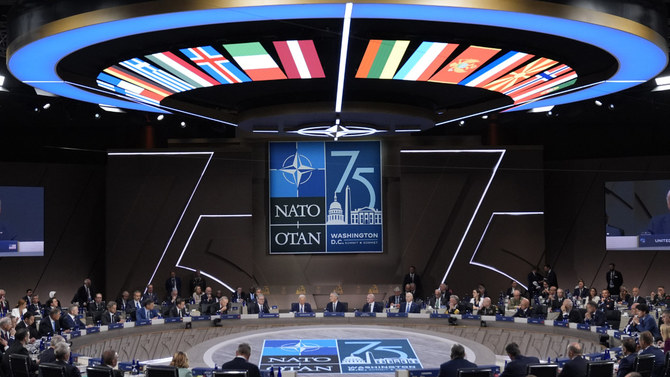
In Washington, where leaders of NATO nations are convening this week to mark the coalition’s 75th anniversary, President Joe Biden said the alliance must not fall behind Russia, which is ramping up weapon production with the help of China, North Korea and Iran.
Australia, New Zealand, Japan and South Korea have sent their leaders or deputies to the NATO summit in Washington this week. They are partners, not members, of the alliance.
In the final declaration, NATO members affirmed the importance of the Indo-Pacific partners to the alliance and said they were “strengthening dialogue to tackle cross-regional challenges.”
NATO and the Indo-Pacific partners plan to launch four projects to support Ukraine, bolster cooperation on cyber defense, counter disinformation and work on artificial intelligence. The NATO members said these projects would “enhance our ability to work together on shared security interests.”


![]()

NATO allies call China a ‘decisive enabler’ of Russia’s war in Ukraine
Short Url
https://arab.news/jxpvj
NATO allies call China a ‘decisive enabler’ of Russia’s war in Ukraine
- NATO Secretary-General said China provides equipment, microelectronics and tools that are “enabling Russia to build the missiles, to build the bombs, to build the aircraft, to build the weapons they use to attack Ukraine”


Latest updates


© 2026 SAUDI RESEARCH & PUBLISHING COMPANY, All Rights Reserved And subject to Terms of Use Agreement.