Turkish volunteer fights to save fire-scarred sheep

1 / 4
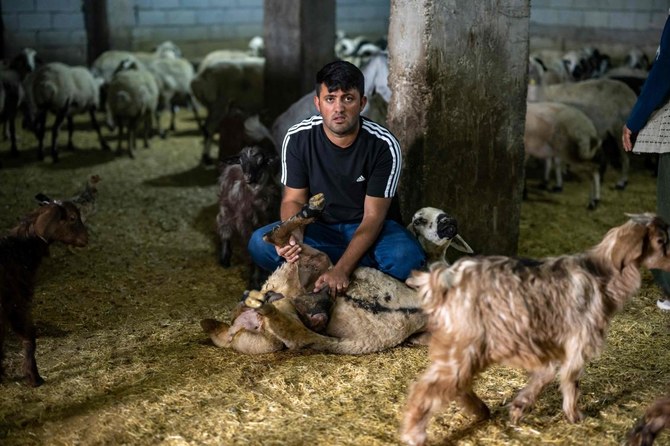
In this picture taken on July 2, 2024, former kebab seller Mehmet Celebioglu checks on the injuries of a sheep that survived a fire in Mardin of Mazidagi province, southeastern Turkey. (AFP)
2 / 4
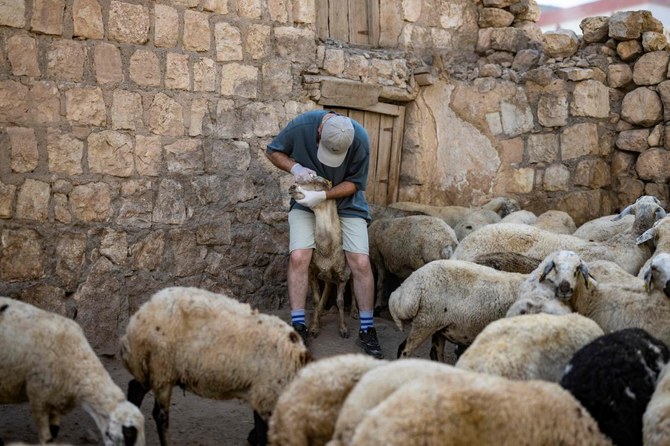
In this photograph taken on July 2, 2024, veterinarian Hasan Kizil treats a sheep injured in a fire in Mardin of Mazidagi province, southeastern Turkey. Lying on her back, the sheep struggled as the vet approached to bandage her udders, which had been burned in a fire last month that killed hundreds of sheep in southeast Turkey. (AFP)
3 / 4
In this photograph taken on July 2, 2024, veterinarian Hasan Kizil treats sheep injured in a fire in Mardin of Mazidagi province, southeastern Turkey.(AFP)
4 / 4
Since the fire, Hasan Kizil has been driving on hilly roads in his van, treating traumatised animals and convincing farmers not to sell the injured sheep to the slaughterhouse. The blaze ripped through the southeastern cities of Diyarbakir and Mardin on June 22, claiming 15 lives. Experts pointed to faulty wiring as a possible cause. (AFP)
Short Url
Updated 10 July 2024
Follow

Turkish volunteer fights to save fire-scarred sheep

MAZIDAGI, Turkiye: Lying on her back, the sheep struggled as the man approached to bandage her udders, which had been burned in a fire last month that killed hundreds of sheep in southeast Turkiye.
Since the fire, Hasan Kizil has been driving on hilly roads in his van, treating traumatized animals and convincing farmers not to sell injured sheep to the slaughterhouse.
The blaze ripped through the southeastern cities of Diyarbakir and Mardin on June 22, claiming 15 lives. Experts pointed to faulty wiring as a possible cause.
More than 1,000 sheep and goats died in the fire, according to the agriculture ministry, including those in the Mazidagi area, 36 kilometers (22 miles) from Mardin.
“Most of them had their eyes completely closed, too swollen to see in front of them,” the 29-year-old, who largely taught himself how to care for the animals, said while treating burns around blackened hooves and udders.
“Had it continued for a few more days, the spoiled milk would have caused septicaemia,” he said, referring to blood poisoning by bacteria. “We almost lost them.”
Every day, Kizil voluntarily visits farms to monitor the animals and convince farmers to keep their damaged herds.
Caring for injured and unproductive animals is a heavy burden for the young breeder, who owes 27,000 Turkish lira ($825) to the bank while also paying for medicine and hay.
Former kebab seller Mehmet Celebioglu, in his 30s, went into debt to buy 160 sheep and a few goats. Now only about 40 remain — female sheep unable to produce milk and young goats orphaned by the fire.
“They were lying in the fields when the fire broke out. 120 sheep burned on the spot. Their eyes melted... these are all that are left,” he said.
“My brothers risked their lives to save them,” added his 18-year-old sister Gulistan, recalling how the fire cut off the electricity and water supplies as hot wind raged over the hills.
But selling the remaining stock is not an option for Celebioglu, originally from Adana, a large city in the south.
“Selling them? They’d pay me 2,000 to 3,000 lira,” he said.
“I’ve spent two years teaching myself this job and most of all, I love my animals.”

Disaster victims
The farmers’ attachment to their sheep encouraged Kizil to support them and reach out to disaster victims, as he did after treating injured animals following the massive earthquake that struck southeastern Turkiye in February 2023, killing 55,000 people.
Now a local star on Instagram, he is known for making braces and prostheses for disabled animals. More than 240,000 followers track his work rehabilitating foxes, cats and injured birds.
Recalling the night of the fire, he said: “It was a battlefield around here.”
“The butchers were trying to grab the wounded animals and slaughter them, while we were trying to keep them alive.”
Images of the animals moved vets from several cities to rush to the scene voluntarily.
The municipality in the predominantly Kurdish city of Diyarbakir took in injured animals at its shelter, while others were sent to clinics in Izmir (west Turkiye), Adana, and Istanbul.
“We are still fighting,” said Kizil, in a region where agriculture and livestock farming are the mainstay of the economy.
Applying ointment to the black wounds on the female sheep, he added: “If we can recover the udders, these will be saved.”


Cambodia takes back looted historic artifacts handled by British art dealer

Updated 28 February 2026
Follow

Cambodia takes back looted historic artifacts handled by British art dealer

  • The objects were returned under a 2020 agreement between the Ministry of Culture and Fine Arts and the family of the late Douglas Latchford, a British art collector and dealer who allegedly had the items smuggled out of Cambodia

PHNOM PENH, Cambodia: Cambodian officials on Friday received more than six dozen historic artifacts described as part of the country’s cultural heritage that had been looted during decades of war and instability.
At a ceremony attended by Deputy Prime Minister Hun Many, the 74 items were unveiled at the National Museum in Phnom Penh after their repatriation from the United Kingdom.
The objects were returned under a 2020 agreement between the Ministry of Culture and Fine Arts and the family of the late Douglas Latchford, a British art collector and dealer who allegedly had the items smuggled out of Cambodia.
“This substantial restitution represents one of the most important returns of Khmer cultural heritage in recent years, following major repatriations in 2021 and 2023 from the same collection,” the Culture Ministry said in a statement. “It marks a significant step forward in Cambodia’s continued efforts to recover, preserve, and restore its ancestral legacy for future generations.”
The artifacts were described as dating from the pre-Angkorian period through the height of the Angkor Empire, including “monumental sandstone sculptures, refined bronze works, and significant ritual objects.” The Angkor Empire, which extended from the ninth to the 15th century, is best known for the Angkor Wat archaeological site, the nation’s biggest tourist attraction.
Latchford was a prominent antiquities dealer who allegedly orchestrated an operation to sell looted Cambodian sculptures on the international market.
From 1970 to the 1980s, during Cambodia’s civil wars and the communist Khmer Rouge ‘s brutal reign, organized looting networks sent artifacts to Latchford, who then sold them to Western collectors, dealers, and institutions. These pieces were often physically damaged, having been pried off temple walls or other structures by the looters.
Latchford was indicted in a New York federal court in 2019 on charges including wire fraud and conspiracy. He died in 2020, aged 88, before he could be extradited to face charges.
Cambodia, like neighboring Thailand, has benefited from a trend in recent decades involving the repatriation of art and archaeological treasures. These include ancient Asian artworks as well as pieces lost or stolen during turmoil in places such as Syria, Iraq and Nazi-occupied Europe. New York’s Metropolitan Museum of Art is one of the prominent institutions that has been returning illegally smuggled art, including to Cambodia.
“The ancient artifacts created and preserved by our ancestors are now being returned to Cambodia, bringing warmth and joy, following the country’s return to peace,” said Hun Many, who is the younger brother of Prime Minister Hun Manet.