

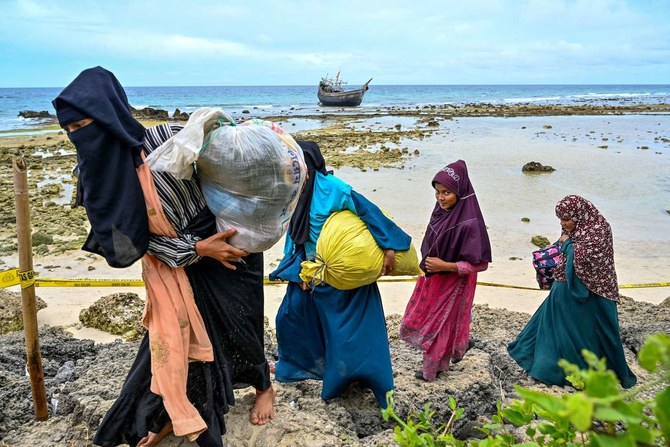

DHAKA: A rising number of Rohingya women in Bangladesh are being targeted by human traffickers who offer them an escape from deteriorating conditions in the world’s largest refugee camp.
Nearly 1 million Rohingya people are living in squalid conditions in Bangladesh’s Cox’s Bazar, which Amnesty International described as “inhumane” last year. Refugees are not allowed to leave the fenced area and are trapped inside with limited food, water and electricity.
Thousands have been trying to flee the overcrowded Bangladeshi camp in recent years, hoping to seek a better life elsewhere, often with the help of human trafficking networks.
“Human trafficking is undoubtedly a problem here. From the government’s side, we are trying to combat this,” Mohammed Mizanur Rahman, Bangladesh’s refugee relief and repatriation commissioner, told Arab News on Tuesday.
“Women and children are being trafficked in many cases, and this is derived from absolute frustration and penniless situations.”
Some 569 Rohingya — out of almost 4,500 — died or went missing in 2023 while trying to relocate to another country through deadly sea crossings, often on rickety boats, the highest figure in nine years, according to data from the UN Refugee Agency.
Many are taken to Malaysia and Indonesia, with Jakarta blaming human traffickers for the increasing number of Rohingya entering the country by boat late last year.
Rahman said that many women take the perilous sea journeys “with the aim of getting married to a Rohingya man” who may have relocated to a country in Southeast Asia.
He said: “Most of the Rohingya living in Malaysia are male. They get married to Rohingya girls living in the camps through (contact by) mobile phones. Later, the male sends money to bring the wife to Malaysia.”
In such cases, the Rohingya involved would “make contact with the human traffickers” to circumvent their lack of legal documents to travel.
Rahman added: “In this process, sometimes they become successful, and sometimes they end up in abusive situations. Sometimes they die by drowning at sea.”
The predominantly Muslim Rohingya people — referred to by the UN as the “world’s most persecuted minority” — have faced decades of persecution in Myanmar.
More than 730,000 Rohingya fled to neighboring Bangladesh in 2017 after a brutal crackdown by the Myanmar military, which the UN said amounted to genocide.
The Rohingya in Bangladesh have faced restrictions on movement and work in the years since, forcing them into being idle amid growing uncertainties over their future, dwindling international aid and languishing attempts for a dignified repatriation.
Dhaka-based migration expert Asif Munir told Arab News: “There’s no permanent solution in sight in the camp-life situation; this has created frustration among the camp population.
“The Rohingya population is vulnerable and also densely populated. In terms of the network of traffickers, they can move more freely and sort of exploit the women who are already in a vulnerable condition within the camps.”
Even the presence of law enforcement officers is not enough to keep up with the Rohingya population, Munir said, as authorities also have to deal with security incidents involving armed groups within and around the refugee camp.
For many Rohingya women, life in Cox’s Bazar is layered with challenges. Many of them have been exploited by local Bangladeshi men with promises of marriage, or lured into commercial sex work.
Munir added: “In a way, they feel at least that if they are somehow able to go to Malaysia, they would have a better life, even if it’s not very legal.
“Traffickers and smugglers are ready to provide the service in exchange for money. And for the women who feel that they’re backed up against a wall, this is an option.”


