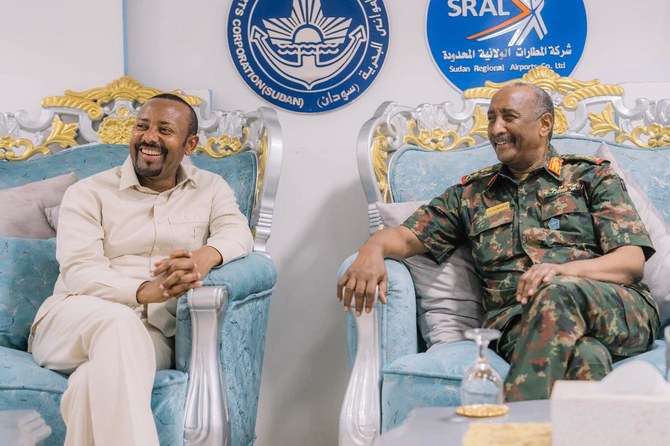
CAIRO: Ethiopian Premier Abiy Ahmed met Sudan's army chief General Abdel Fattah al-Burhan on Tuesday, becoming the first foreign leader to visit him in his war capital Port Sudan since the start of the conflict between the army and the paramilitary Rapid Support Forces (RSF).
Abiy, who was previously seen as closer to the RSF than the army and hosted its leader Mohamed Hamdan Dagalo in Addis Ababa in December, framed the visit as part of a push to bring stability to Sudan after nearly 15 months of conflict.
The war between the Sudanese military factions has forced almost 10 million people from their homes, created famine-like conditions in parts of the country, and threatened to destabilise the region.
While the RSF has taken most of the capital Khartoum and the centre and west of Sudan, the army controls eastern and northern states, including Port Sudan, which has become its base.
Talks hosted by Saudi Arabia and the United States in Jeddah aimed at brokering a ceasefire stalled last year and attempts to bring the army back to the negotiating table have so far failed.
Images shared by both sides showed Burhan and Abiy laughing and walking hand in hand after the Ethiopian leader's arrival. On X, Abiy's office called the visit part of efforts to find "sustainable solutions for Sudan's stability".
A source close to the matter said Abiy had a better chance of achieving a breakthrough by being on the ground.
"The very existence of the Sudan is at stake and when the world turned away, the PM has turned facing the Sudan," the source said.
The visit took place after an RSF attack on the southeastern state of Sennar last month brought the war closer to Sudan's border with Ethiopia. There have been signs the RSF is moving into Gedaref state, which hosts more than 600,000 displaced Sudanese as well as tens of thousands of Ethiopian refugees.
Last month, Sudanese farmers in the state said that Ethiopian Fano militiamen had entered the disputed Fashaga territory between the two countries. Abiy said in a speech on Monday that he would not take advantage of the war to settle the issue, and that his government would not side with any of the parties.
Abiy's visit to Port Sudan also comes despite past tensions with the army.
RSF leader Dagalo, known as Hemedti, chose Addis Ababa as the venue to meet the civilian Taqaddum coalition criticised by the army. One of Burhan's deputies alleged last year that Ethiopian fighters were backing the RSF.


![]()

Ethiopia's Abiy visits Sudan's army chief on Red Sea coast
Short Url
https://arab.news/nky3u
Ethiopia's Abiy visits Sudan's army chief on Red Sea coast
- Abiy framed the visit as part of a push to bring stability to Sudan
- On X, Abiy's office called the visit part of efforts to find "sustainable solutions for Sudan's stability"


Latest updates


© 2026 SAUDI RESEARCH & PUBLISHING COMPANY, All Rights Reserved And subject to Terms of Use Agreement.