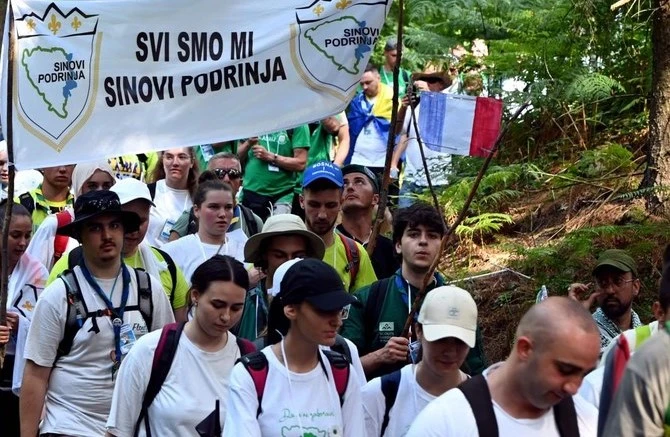
Thousands march to mark Srebrenica genocide anniversary

People participate in the ‘Mars Mira,’ March for Peace, through the woods near the eastern Bosnian village of Nezuk, July 8, 2024. (AFP)
Short Url
Updated 08 July 2024
Follow

Thousands march to mark Srebrenica genocide anniversary

  • Annual march covers a 100-kilometer (62-mile) route to Srebrenica from the village of Nezuk, where the first survivors arrived
  • Bosnian Serb forces captured Srebrenica — a UN protected enclave at the time — on July 11, 1995, and killed 8,000 Muslim men and boys

NEZUK, Bosnia and Herzegovina: Thousands of people began marching on Monday toward Srebrenica in eastern Bosnia to mark the anniversary of the 1995 genocide, the worst massacre in Europe since World War II.
The annual march covers a 100-kilometer (62-mile) route to Srebrenica from the village of Nezuk, where the first survivors arrived.
Bosnian Serb forces captured Srebrenica — a UN protected enclave at the time — on July 11, 1995, and killed 8,000 Muslim men and boys.
The atrocity was deemed genocide by two international courts.
Fatima Ibrahimbegovic Alic told AFP her father, Ramiz, was killed trying to escape.
“I go for him, for all of them, to walk this path where they suffered,” she said.
“We need to keep doing this so we never forget.”
Carrying Bosnian, Palestinian and Turkish flags, the marchers will stop at the sites of dozens of mass graves where the remains of victims were found.
“We are here so that Srebrenica never happens again, anywhere ... that everyone knows” about the crime, said Azra Barakovac, a woman who arrived from Sarajevo to march for the first time.
Marcher Resid Dervisevic is one of the rare massacre survivors. In July 1995, he and his eight male relatives fled Srebrenica, running through the woods. His brother, an uncle and six nephews were killed during the escape.
Returning to the scene “brings back emotions, even in the days before this march,” the 64-year-old said holding back tears.
But it is easier to do it now than in 1995 “under a rain of bullets and shells — hungry, barefoot, without sleep for days,” he added.
“I walked for seven days through the forest. I survived on 250 grams of sugar.
“And when we arrived here, on this territory, people welcomed us by giving us everything they had to eat and drink.”
In late May, the United Nations General Assembly established an annual day of remembrance for the 1995 Srebrenica genocide.
The move drew fierce opposition from the Serbian government and Bosnian Serb leaders, who play down the atrocity and refuse to accept it as a genocide.
“We want to dedicate this march to all the people who did not manage to save themselves and who were killed in the Srebrenica genocide,” Ela Rehic, 14, who joined the march with her mother, said.
“It will certainly be difficult to march for three days, but I want to see and experience a bit of what I learned about their flight from Srebrenica.”
Tofik Sejdic, like Rehic, was born after 1995 and said he felt very emotional.
“It’s important not to forget what happened in those years in our country, especially in Srebrenica.
“For our people, for me, Srebrenica is sacred,” the 24-year-old man said.
In late May, the United Nations General Assembly established an annual day of remembrance for the 1995 Srebrenica genocide.
The move drew fierce opposition from the Serbian government and Bosnian Serb leaders, who play down the atrocity and refuse to call it a genocide.
The marchers will reach the memorial center in Potocari, where nearly 7,000 massacre victims were buried, on Wednesday.
They will attend a ceremony to mark the atrocity’s 29th anniversary the next day.
Bosnia’s war 1992-1995 between its Croats, Muslims and Serbs claimed approximately 100,000 lives.
Nearly three decades since the war ended, the Balkan nation remains deeply divided along ethnic lines.


Will Afghanistan’s pledge against cross-border attacks ease tensions with Pakistan?

Updated 8 sec ago
Follow

Will Afghanistan’s pledge against cross-border attacks ease tensions with Pakistan?

  • Afghan clerics’ decree banned use of Afghan soil for cross-border attacks on Wednesday
  • Latest heavy firing between Afghanistan, Pakistan killed at least 5 people 

KABUL: As tensions flare up again between Afghanistan and Pakistan, the Afghan leadership has moved to reaffirm its commitment against cross-border militancy this week in what is seen as Kabul’s attempt to move the needle on peace negotiations, after multiple rounds of talks failed to produce a lasting truce. 

The neighboring countries have struggled to maintain a fragile ceasefire after border clashes killed dozens in October, the worst fighting since the Taliban took control of Afghanistan in 2021.

While subsequent talks toward a permanent ceasefire yielded little progress, the temporary truce brokered by Qatar and Turkiye collapsed last Friday, with heavy firing along the Spin Boldak-Chaman border that killed at least five people. 

Over the years Pakistan has put much of the blame for the border clashes on the government in Kabul allowing Tehreek-e-Taliban Pakistan — an outlawed armed group, which is separate from the Afghan Taliban — to use Afghan territory for cross-border attacks — a claim that Afghanistan has repeatedly denied.

Afghanistan again pledged to prevent its territory from being used to harm other countries on Thursday, with Taliban Foreign Minister Amir Khan Muttaqi highlighting it as a religious duty, as endorsed just a day earlier by around 1,000 Afghan clerics in a fatwa, or religious decree.

“The fatwa was more political than religious,” Kabul University lecturer Abdullah Awwab told Arab News on Friday. 

“I think it was a smooth way out of the pressure put on them by Pakistan and mediators, who were asking for a fatwa against the TTP. The emirate couldn’t issue that, so instead they had scholars issue a fatwa for ordinary Afghans, banning them from jihad abroad.

“The fatwa shows Pakistan that the Taliban can use a fatwa to stop Afghans from joining the war. It demonstrates Kabul’s power and control over its own soil and people — and, at the same time, it shows Pakistan’s weakness in needing to ask Kabul for a religious fatwa.”

Addressing new graduates at a ceremony in Kabul, Muttaqi said the Taliban had not “permitted anyone to carry out military activities in other countries” and that the government had the right to take action against anyone who violated the directive. 

“The leaders and elders of this Islamic emirate have pledged that Afghan soil will not be used to harm anyone. All the scholars and religious leaders affirmed that obeying this commitment is necessary for all Muslims,” he said. 

“Just as this nation has historically acted upon the fatwas and advice of its scholars, so too will (it) act upon them now. This is our shared duty.” 

Asif Durrani, Pakistan’s former special envoy to Afghanistan, said the decree was a “very significant” development.

“Hopefully, the TTP, which owes allegiance to the Taliban’s Supreme Leader Mullah Hibatullah Akhundzada, will now submit to the collective wisdom of the Afghan Taliban ulema and surrender arms,” he wrote on X. 

Though the decree answers one of Pakistan’s demands, Afghan political analyst Wasi Baheer said it had “no direct impact” in the conflict.

“Pakistan’s harsh words and threats to Kabul don’t mean much, because the real issue is inside Pakistan,” he told Arab News.

“They cannot simply force changes in Kabul. The main reason talks collapsed in Qatar, Istanbul, and Saudi Arabia is that Pakistan demanded the Taliban act harshly against the TTP — which makes no sense, because it is an internal Pakistani problem. Using force here in Afghanistan will not bring any relief to Pakistan’s security.”