Stranded aid trucks in Egypt deepen Gaza’s humanitarian crisis

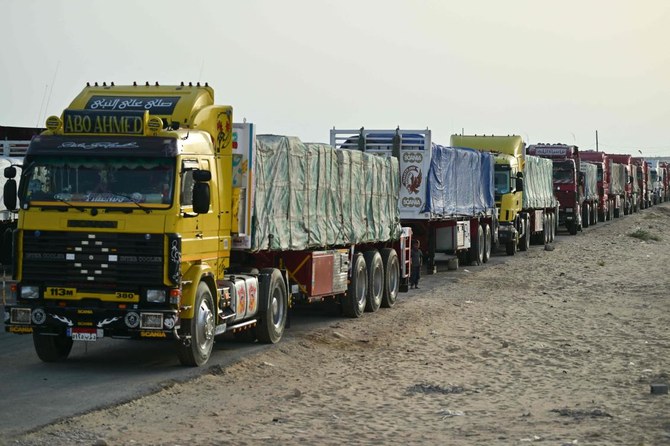
Hundreds of trucks loaded with food and water have been stranded, some for nearly two months, awaiting permission to deliver the much needed humanitarian supplies to war-torn Gaza. (AFP)
Short Url
Updated 08 July 2024
Follow

Stranded aid trucks in Egypt deepen Gaza’s humanitarian crisis

  • Aid groups warn there is a high risk of famine across the besieged coastal territory
  • Talks involving Egypt, the United States and Israel have failed to reopen Rafah

AL-ARISH, Egypt: Hundreds of trucks loaded with food and water have been stranded on a scorching Egyptian road, some for nearly two months, awaiting permission to deliver the much needed humanitarian supplies to war-torn Gaza.
About 50 kilometers from the Gaza border, trucks carrying flour, water and other aid line a dusty road in both directions. The drivers say they have been waiting for several weeks in the searing Egyptian summer heat.
The standstill is exacerbating Gaza’s dire humanitarian crisis after nine months of war between Israel and Palestinian militant group Hamas. Aid groups warn there is a high risk of famine across the besieged coastal territory.
The truck drivers, parked on the outskirts of the Egyptian city of Al-Arish in the Sinai Peninsula, say they have been unable to deliver humanitarian supplies ever since Israel expanded its offensive on the Gaza-Egypt border in May.
Some food has had to be discarded, they said.
“I swear to God, before this load, we came here and stood for more than 50 days and eventually the load was returned because it had expired,” said truck driver Elsayed El-Nabawi.
“We had to turn around and return it. We loaded another batch, and here we are standing again and only God knows if this load will make it before it expires or what will happen to it.”
The Israeli military started its assault on the southern Gazan city of Rafah in May. The Rafah crossing between Gaza and Egypt, a lifeline to the outside world for Gazans, allowing the delivery of aid and the evacuation of patients, has been shut since then.
Talks involving Egypt, the United States and Israel have failed to reopen Rafah, where Egypt wants a Palestinian presence restored on the Gazan side of the border. Israeli flags now fly over Gazan buildings destroyed along the border with Egypt.
“We’ve been stranded here for over a month waiting to deliver this load. We’ve waiting for our turn but nothing yet” said Ahmed Kamel, another of the truck drivers, who sit by their vehicles drinking tea and smoking cigarettes.
“We don’t know our fate — when we will be able to enter? Today? Tomorrow? The day after tomorrow? Only God knows. Will the stuff we’re carrying hold up or most of it will go bad?”
Aid and commercial supplies have still entered Gaza through other land border crossings, through air drops and by sea, but aid groups and Western diplomats say the supplies are far below needs. The drivers say they are waiting for Israeli permission.
‘DIFFICULTIES’
Distribution of aid in Gaza was difficult even before Israel’s assault on Rafah. Israel has enforced restrictions on goods entering the enclave, saying it wants to prevent them reaching Hamas. Some aid convoys have also been hit in Israeli military strikes, resulting in deaths of aid workers.
Palestinian gangs inside Gaza have also reportedly sought to steal aid and commercial supplies entering the territory of some 2.3 million Palestinians. Desperate Palestinians have also overwhelmed trucks, taking much needed humanitarian supplies.
A senior official at the Israeli foreign ministry said the backlog of aid in Egypt was due to humanitarian aid that has piled up on the Gazan side of the Kerem Shalom crossing point, creating a backlog of around 1,200 truckloads worth of aid.
The official said that while Israel continued to facilitate the entry of supplies into Gaza, the distribution network inside Gaza run by international groups had been “disrupted” in recent months, blaming local Palestinian criminal gangs and Hamas.
The Israeli military, which oversees coordination of aid in Gaza, has said that it is letting in enough food in from Israel and Egypt for the entire population. It has also acknowledged that aid agencies face “difficulties” in transporting food once it has entered through crossing points, including from Israel.


Sudan’s prime minister takes his peace plan to the UN, but US urges humanitarian truce now

Updated 23 December 2025
Follow

Sudan’s prime minister takes his peace plan to the UN, but US urges humanitarian truce now

  • Sudan’s prime minister is proposing a wide-ranging peace initiative to end a nearly 1,000-day war with a rival paramilitary force
  • It seems unlikely the RSF would support the proposal, which would essentially give government forces a victory and take away their military power

UNITED NATIONS: Sudan’s prime minister on Monday proposed a wide-ranging peace initiative to end a nearly 1,000-day war with a rival paramilitary force, but the United States urged both sides to accept the Trump administration’s call for an immediate humanitarian truce.
Kamil Idris, who heads Sudan’s transitional civilian government, told the Security Council his plan calls for a ceasefire monitored by the United Nations, African Union and Arab League, and the withdrawal of paramilitary forces from all areas they occupy, their placement in supervised camps and their disarmament.
Sudan plunged into chaos in April 2023 when a power struggle between the military and the powerful paramilitary Rapid Support Forces exploded into open fighting, with widespread mass killings and rapes, and ethnically motivated violence. This has amounted to war crimes and crimes against humanity, according to the UN and international rights groups.
It seemed highly unlikely the RSF would support the prime minister’s proposal, which would essentially give government forces a victory and take away their military power.
In an indirect reference to the truce supported by the US and key mediators Saudi Arabia, Egypt and the United Arab Emirates, known as the Quad, Idris stressed to the UN Security Council that the government’s proposal is “homemade — not imposed on us.”
In early November, the Rapid Support Forces agreed to a humanitarian truce. At that time, a Sudanese military official told The Associated Press the army welcomed the Quad’s proposal but would only agree to a truce when the RSF completely withdraws from civilian areas and gives up their weapons — key provisions in the plan Idris put forward on Monday.
Idris said unless the paramilitary forces were confined to camps, a truce had “no chance for success.” He challenged the 15 members of the Security Council to back his proposal.
“This initiative can mark the moment when Sudan steps back from the edge and the international community — You! You! — stood on the right side of history,” the Sudanese prime minister said. He said the council should “be remembered not as a witness to collapse, but as a partner in recovery.”
US deputy ambassador Jeffrey Bartos, who spoke to the council before Idris, said the Trump administration has offered a humanitarian truce as a way forward and “We urge both belligerents to accept this plan without preconditions immediately.”
Bartos said the Trump administration strongly condemns the horrific violence across Darfur and the Kordofan region — and the atrocities committed by both the Sudanese Armed Forces and the Rapid Support Forces, who must be held accountable.
UAE Ambassador Mohamed Abushahab, a member of the Quad, said there is an immediate opportunity to implement the humanitarian truce and get aid to Sudanese civilians in desperate need.
“Lessons of history and present realities make it clear that unilateral efforts by either of the warring parties are not sustainable and will only prolong the war,” he warned.
Abushahab said a humanitarian truce must be followed by a permanent ceasefire “and a pathway toward civilian rule independent of the warring parties.”
UN Assistant Secretary-General for political affairs Khaled Khiari reflected escalating council concerns about the Sudan war, which has been fueled by the continuing supply of increasingly sophisticated weapons.
He criticized unnamed countries that refuse to stop supplying weapons, and both government and paramilitary forces for remaining unwilling to compromise or de-escalate.
“While they were able to stop fighting to preserve oil revenues, they have so far failed to do the same to protect their population,” Khiari said. “The backers of both sides must use their influence to help stop the slaughter, not to cause further devastation.”
The devastating war in Sudan has killed more than 40,000 people according to UN figures, but aid groups say the true number could be many times higher. The conflict has created the world’s largest humanitarian crisis, with over 14 million people displaced, disease outbreaks and famine spreading in parts of the country.