

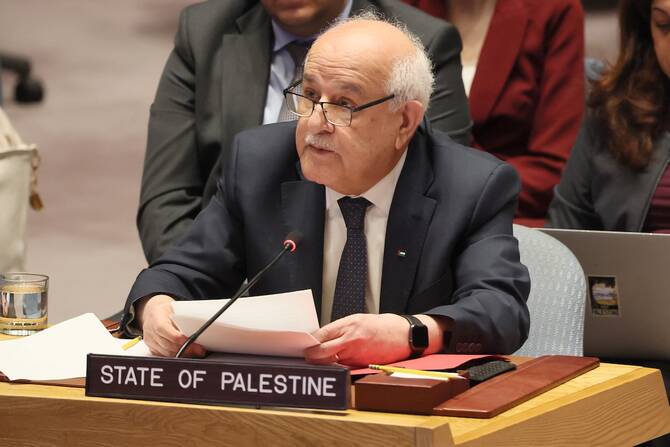

NEW YORK CITY: Palestine’s ambassador to the UN, Riyad Mansour, said on Wednesday that the core principles upon which the UN was founded are under grave threat in the occupied Palestinian territories.
He said that although thousands of lives had been saved by the ceasefire agreement in October, at least 500 Palestinians have been killed in Gaza since then amid Israel’s continuing obstruction of humanitarian aid efforts, which is worsening what he described as the unprecedented humanitarian catastrophe in the territory.
Speaking at a packed, high-level meeting of the UN Security Council, Mansour warned that if the right to self-determination, the prohibition of the acquisition of territory by force, and respect for international law are abandoned in relation to events in Palestine, it would endanger those principles worldwide.
“Asserting them there (in Palestinian territories) is upholding them everywhere; abandoning them there is jeopardizing them everywhere,” he told council members.
He welcomed the ceasefire deal agreed last year under a US-backed plan, praising the role of President Donald Trump’s administration and other international mediators, and said Palestinians have supported the truce in good faith despite repeated breaches by Israel.
While he acknowledged that thousands of lives had been saved through the resumption of humanitarian aid, and welcomed the release of all Israeli hostages and prisoners, Mansour questioned what justice would mean for Palestinian families whose relatives had been killed or remain missing under rubble, or who had suffered displacement, trauma and long-term injuries.
“The suffering of Palestinian civilians — men, women and children — must end with equal urgency,” he said, as he called for the full implementation of ceasefire obligations, an immediate end to the killing, and unrestricted humanitarian access across Gaza.
He condemned the punitive targeting of humanitarian organizations by Israel, including nongovernmental organizations and the UN’s own Relief and Works Agency for Palestine Refugees, citing in particular the seizure and destruction of their facilities and efforts to ban or expel aid groups from Palestinian territory.
Britain’s deputy ambassador to the UN, James Kariuki, echoed the concerns about humanitarian access. He condemned what he described as Israel’s “egregious attacks” against UNRWA facilities in East Jerusalem, and its restrictions on the work of international nongovernmental organizations.
“These are the backbone of the humanitarian response, providing $1 billion of funding annually, and without them Palestinians will face yet more suffering,” he said, as he urged Israeli authorities to honor their humanitarian commitments under the Trump administration’s peace plan, and the wider principles of international law.
The humanitarian situation in Gaza remains catastrophic, Kariuki said, with at least nine infants having died of hypothermia so far this winter, including a 3-month-old baby last week.
“This is completely unconscionable, especially when lifesaving shelter and medical supplies remain at the border, blocked by Israeli authorities,” he added.
The decision by Israel to partially open the Rafah border crossing was insufficient; all crossings must be fully opened to allow aid to enter Gaza at scale, he said.
He also called for swift implementation of phase two of the peace plan, as set out in Security Council Resolution 2803, including the withdrawal of Israeli forces, the disarming of Hamas, deployment of an international stabilization force, and a clear timeline for the transfer of governance in Gaza to a reformed Palestinian Authority. Hamas must have no role in the future running of the territory, he added.
Mansour accused Israeli authorities of defying an advisory opinion by the International Court of Justice on its humanitarian obligations and violations of UN conventions, and said Israel had no sovereign rights in the occupied territories, including East Jerusalem.
Regarding the situation in the West Bank, Mansour warned of escalating Israeli military operations, settler violence and settlement expansions, including the E1 settlement project that threatens to split the West Bank. About 40,000 Palestinians have been displaced in the territory over the past two years, he added, the highest number since 1967.
Despite all this, Palestinians still see an opportunity for peace, Mansour said. He reiterated calls for a two-state solution, and for international efforts to move forward from the ceasefire deal to the end of the occupation and lasting peace under international law.
Gaza must remain an integral part of Palestinian territory and be reunified with the West Bank under the governance of the Palestinian Authority, he said, and he rejected any plan to divide or exert permanent external control over the enclave.
“Gaza belongs to the Palestinian people — nobody else,” Mansour said.
Israel’s ambassador to the UN, Danny Danon, told the council his country had achieved its first war aim by securing the return of all Israeli hostages, and was now focused on its second objective: the full disarmament of Hamas.
Progress toward the rebuilding of Gaza and implementation of the next phase of the ceasefire agreement depends on dismantling the military infrastructure of Hamas, including its weapons, command structures and tunnels, he said. No civilian future was possible while the group was still armed, he added.
Hamas continues to delay its disarmament, Danon said, and he warned of what he described as a broader regional threat posed by Iran.
He accused the regime in Tehran of funding and arming militant groups across the Middle East and repressing its own population. Israel believes the Iranian leadership must be confronted and never be allowed to obtain nuclear weapons, he added.


