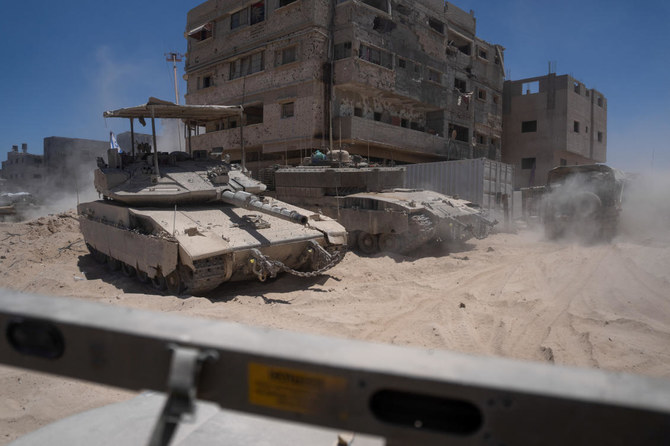
GAZA: Israeli forces advanced deeper into the Gaza Strip’s largest city in pursuit of militants who had regrouped there, sending thousands of Palestinians fleeing on Monday from an area ravaged in the early weeks of the nine-month-long war.
Hamas said it had shown flexibility in indirect talks over a ceasefire and hostage release and accused Israeli Prime Minister Benjamin Netanyahu of setting “obstacles,” including the latest escalation. The incursion into Gaza City came after Israel and Hamas appeared to draw closer to bridging gaps in negotiations.
Israeli troops were again battling militants in areas that the army said had been largely cleared months ago in northern Gaza. The military ordered evacuations ahead of the raids, but Palestinians said nowhere feels safe. Most of the population of 2.3 million has been displaced, often multiple times. Hundreds of thousands are packed into sweltering tent camps.
Israel ordered the evacuation of northern Gaza in the first weeks of the war and has prevented most people from returning. But hundreds of thousands of Palestinians remain, living in shelters or the shells of homes.
“We fled in the darkness amid heavy strikes,” said Sayeda Abdel-Baki, a mother of three who had sheltered with relatives in the Daraj neighborhood. “This is my fifth displacement.”
Residents reported artillery and tank fire, as well as airstrikes. Gaza’s Health Ministry, with limited access to the north, did not immediately report casualties.
Israel issued additional evacuation orders for areas in other neighborhoods of central Gaza City. The military said it had intelligence showing that militants from Hamas and the smaller Islamic Jihad group were in the area, and called on residents to head south to the city of Deir Al-Balah.
Israel accuses Hamas and other militants of hiding among civilians. In Shijaiyah, a Gaza City neighborhood that has seen weeks of fighting, the military said troops raided and destroyed schools and a clinic that had been converted into militant compounds.
The war has decimated large swaths of urban landscape and sparked a humanitarian catastrophe.
Obstacles to a deal
Israel and Hamas seem to be the closest they have been in months to agreeing to a ceasefire deal that would pause the fighting in exchange for the release of dozens of hostages captured by Hamas in the Oct. 7 attack that triggered the war.
CIA Director William Burns returned to the region Monday for talks in Cairo, according to Egypt’s state-run Qahera TV, which is close to the security services. An Israeli delegation was also heading to the Egyptian capital, Israeli media reported.
But obstacles remain, even after Hamas agreed to relent on its key demand that Israel commit to ending the war as part of any agreement. A key part of that shift, officials told The Associated Press, is the level of destruction caused by Israel’s rolling offensive.
Hamas still wants mediators to guarantee that negotiations conclude with a permanent ceasefire, according to two officials with knowledge of the talks. The current draft says the mediators — the United States, Qatar and Egypt — “will do their best” to ensure that negotiations lead to an agreement to wind down the war.
Israel has rejected any deal that would force it to end the war with Hamas intact — a condition Netanyahu reiterated Sunday.
Hamas said in a statement Monday it is “offering flexibility and positivity” to facilitate a deal, while “Netanyahu is putting more obstacles in the way of negotiations, escalating his aggression and crimes against our people and persisting in attempts to forcibly displace them in order to thwart all efforts to reach an agreement.”
The two officials said there’s also an impasse around whether Hamas can choose the high-profile prisoners held by Israel that it wants released in exchange for hostages. Some prisoners were convicted of killing Israelis, and Israel does not want Hamas to determine who is released. The officials spoke on condition of anonymity because they were not authorized to discuss the sensitive talks with the media.
Bombing keeps responders from bodies
Inside Gaza, residents saw no end to their suffering.
Maha Mahfouz fled her home with her two children and many neighbors in Gaza City’s Zaytoun neighborhood. She said their area was not included in the latest evacuation orders but “we are panicked because the bombing and gunfire are very close to us.”
Fadel Naeem, the director of the Al-Ahli hospital, said patients fled the facility even though there was no evacuation order for the surrounding area. He said those in critical condition had been evacuated to other hospitals in northern Gaza.
Marwan Al-Sultan, director of the Indonesian Hospital, said it received 80 patients and wounded people from Al-Ahli who were packed into “every corner.”
“Many cases require urgent surgeries. Many cases suffer from direct shots in the head and require intensive care. Fuel and medical supplies are dwindling,” he said in a text message. He said the hospital also received 16 bodies of people killed in the Israeli incursion, half of them women and children.
Mahmoud Bassal, a spokesman for the Civil Defense first responders who operate under the Hamas-run government, said the neighborhoods of Tufah, Daraj and Shijaiyah had become inaccessible because of Israeli bombing. In a voice message, he said the military shelled houses in Gaza City’s Jaffa area and first responders “saw people lying on the ground and were not able to retrieve them.”
The war has killed more than 38,000 people in Gaza, according to the Health Ministry, which does not distinguish between combatants and civilians in its count.
Hamas’ cross-border raid on Oct. 7 killed 1,200 people in southern Israel, most of them civilians, according to Israeli authorities. The militants took roughly 250 people hostage. About 120 are still in captivity, with about a third said to be dead.


![]()

Israel pushes deeper into Gaza as Hamas accuses Netanyahu of new ‘obstacles’ to deal
Short Url
https://arab.news/6d9ty
Israel pushes deeper into Gaza as Hamas accuses Netanyahu of new ‘obstacles’ to deal
- Ongoing offensives in Daraj and Tuffah in east and Tel Al-Hawa, Sabra, and Rimal further west
- Heavy armor push comes as Egypt, Qatar and US step up efforts to mediate ceasefire pact


Latest updates


Recommended


© 2026 SAUDI RESEARCH & PUBLISHING COMPANY, All Rights Reserved And subject to Terms of Use Agreement.