


DUBAI: The devastation of Gaza’s health system and the magnitude and complexity of the trauma endured by the Palestinian people are difficult for aid workers to wrap their heads around, Dr. Hanan Balkhy, the World Health Organization’s regional director for the Eastern Mediterranean, has said.
Appearing on the Arab News current affairs program “Frankly Speaking,” the Saudi-born WHO official described the reality facing Palestinians and aid workers operating under Israeli bombardment in the embattled enclave.
“It is difficult for me to interact with and listen to those devastating stories, let alone … the photos and the videos that we see every day on TV,” Balkhy said.
“I was at the Rafah border crossing from the Egypt side. I was able to visit the patients that were hosted in the hospitals in Al-Arish … The stories that I’ve heard and the types of trauma that I have seen are quite significant.”
Balkhy, who took up her appointment as regional director in February this year and is the first woman to hold the position, described witnessing “maimed children and women” and “young adults with lost limbs.”
She said: “The devastation that we’re seeing, and the magnitude and complexity of trauma, is something that we will need to wrap our heads around and be able to find very creative ways to work with partners, the member states who have been very thankfully supporting us. But none of this is enough.”
Since the war in Gaza began on Oct. 7 last year following the Hamas-led attack on southern Israel, the Palestinian enclave on the Mediterranean coast has endured heavy Israeli bombardment and a fierce ground offensive, which has displaced much of the population.
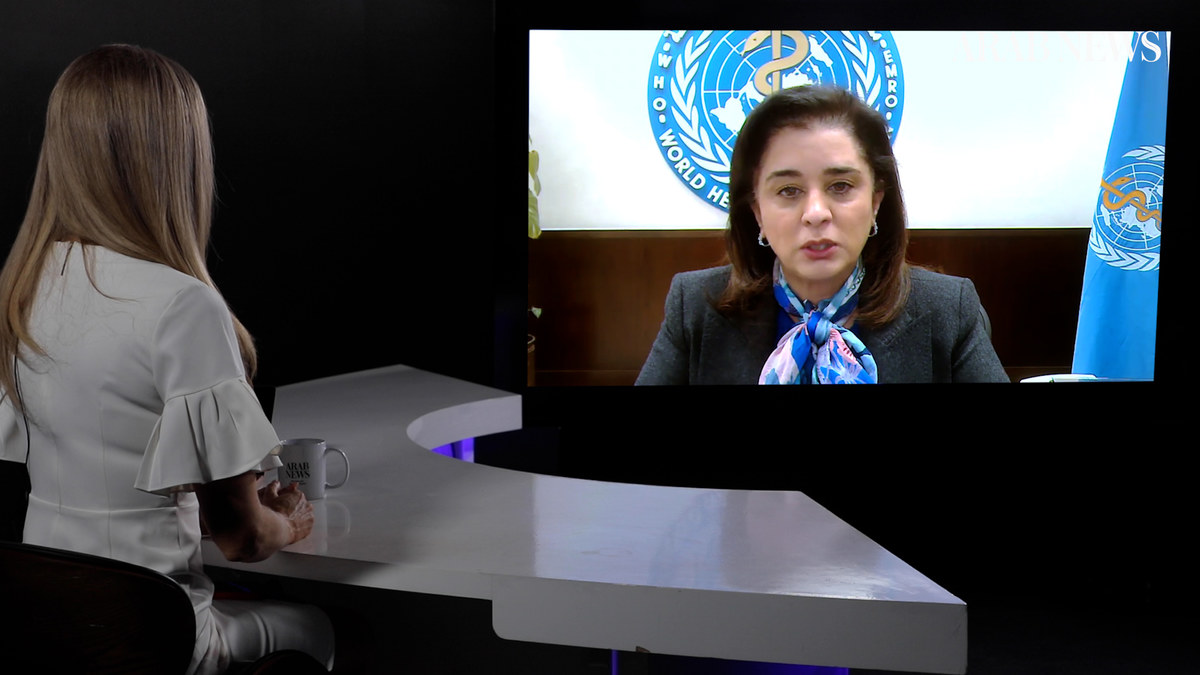
Appearing on the Arab News current affairs program “Frankly Speaking,” the Saudi-born WHO official described the reality facing Palestinians and aid workers. (AN Photo)
The bombing raids, the collapse of civilian infrastructure including sanitation services, and chronic shortages of food, drinking water and medications have brought Gaza’s health system to its knees.
Just 33 percent of Gaza’s 36 hospitals and 30 percent of its primary healthcare centers are functional in some capacity. Asked whether the health situation in Gaza is beyond saving, Balkhy said the WHO would continue to do its best to serve patients and those injured.
“The situation in Gaza has been quite devastating for all of us, especially the partners working on the ground,” she told “Frankly Speaking” host Katie Jensen. “But WHO continues to work with its partners and with whoever’s on the ground at the moment in delivering fuel, medical supplies, and other aid.”
In particular, Balkhy highlighted the important role played by the UN Relief and Works Agency for Palestine Refugees in the Near East.
The agency came under significant financial pressure earlier this year after major Western donors suspended their funding in response to Israeli allegations that 12 UNRWA staff members had participated in the Oct. 7 attack.
Balkhy said UNRWA “is very important as we work with them to try to sustain what is left of the primary healthcare (system) and restore what has been significantly damaged, but also to work together with the partners to evacuate the necessary patients.”
Despite the challenges faced by the aid community, Balkhy said: “We stay, we serve, and we continue to do our best to serve the patients and the injured in Gaza.”
Compounding the health crisis in Gaza are the chronic shortages of food reaching civilians via the limited number of border crossings from Israel and from Egypt through the Rafah crossing.
Since the conflict began, Israel has limited the flow of aid permitted to enter the territory, claiming it was being commandeered by Hamas. As a result of these delays at the border, a significant proportion of the population is facing catastrophic hunger and famine-like conditions.
To add insult to injury, Balkhy said truckloads of urgently needed foodstuffs provided by aid agencies and donor nations were going rotten while awaiting clearance to enter Gaza.
“The catastrophic situation is in the numbers if you look at them,” said Balkhy. “So, 96 percent of the population of Gaza is facing acute food insecurity on a regular basis, and more than half of that population does not have any food to eat in their house, and 20 percent go for entire days and nights without any eating.
“I actually have been at the Rafah crossing, and I visited the hospitals in Al-Arish on the soil of Egypt and I’ve seen the tens or hundreds of trucks lined up to try to cross and provide the necessary aid, including food.
“Now, facing the summer months right now, it’s going to be even more difficult. Already we have information that the extreme waiting at the border and the delays (are) allowing for this food and some of this sensitive aid to go rotten or go bad, and that is really very difficult for us to manage.
“So, the situation is dire, the food catastrophe is significant. On top of (that is), of course, the lack of our ability to deliver as much health aid as we would wish.”
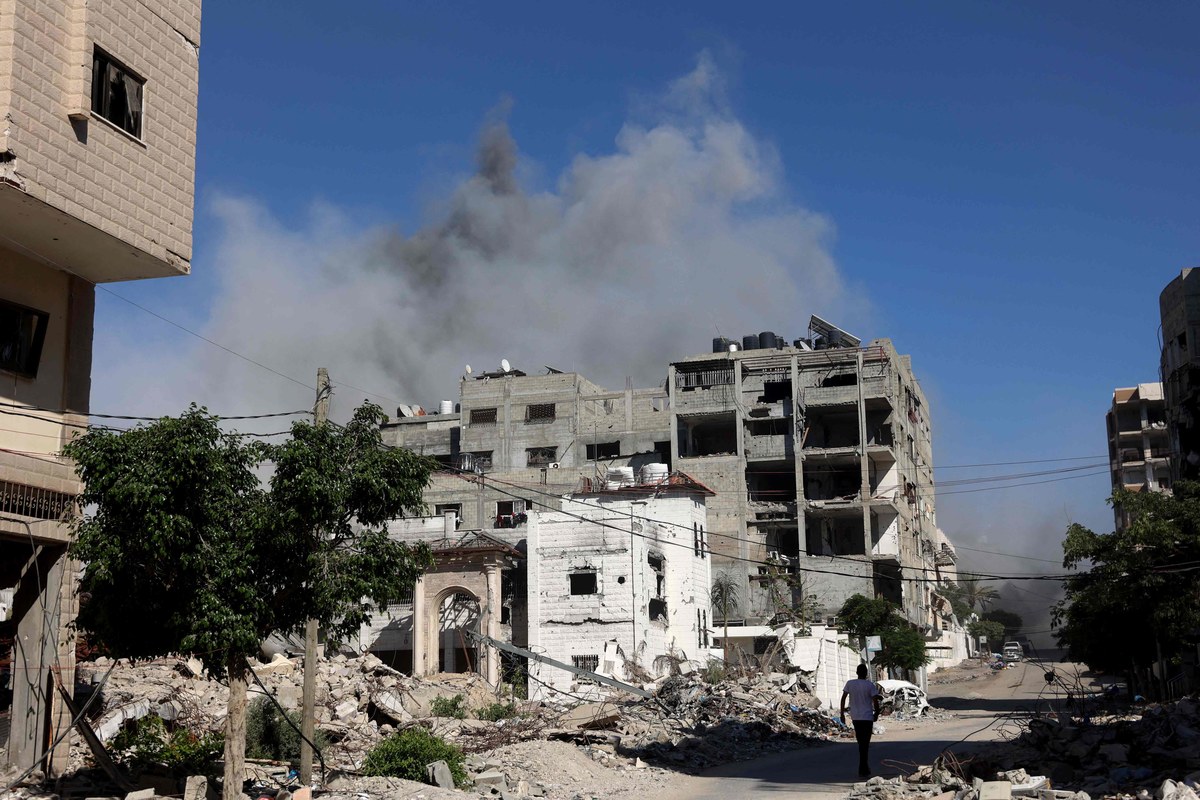
A Palestinian man walks along a road past damaged buildings during the Israeli military bombardment of Gaza City on July 7 amid the ongoing conflict in the Palestinian territory between Israel and Hamas. (AFP)
Efforts to secure a ceasefire have been repeatedly thwarted in recent months, first by US vetoes at the UN Security Council, and later by the unwillingness of the warring parties to reach a compromise.
Although the UN Security Council has since passed a resolution calling on Israel and Hamas to agree to a ceasefire, coupled with the Biden administration’s own peace plan, a pause in the fighting to allow an exchange of prisoners and the delivery of more aid has proved elusive.
Asked what difference a ceasefire would make to Gaza’s health crisis, Balkhy said it would allow the WHO and other aid agencies to move freely within the enclave to reach those most in need and to restore its shattered infrastructure.
“We very much welcome the Security Council resolution. Peace is the only way for us to move forward with helping the people in Gaza,” she said.
“The significant impact that has been taking place on the healthcare settings, on the health workforce, the complexities of the trauma that are taking place, requires that we are capable to freely move within Gaza, accessing the very difficult areas, even in the north, the middle and the south, to be able to have the people move back into their homes, to be able to have access to healthcare for not just the traumas.
“Remember, there are people who have chronic diseases. People are not having access to their hypertension medications, for example, their dialysis treatment, people who require a treatment for their cancers. All of these things … have been jeopardized to a very big degree.
“The benefit of a ceasefire today and a permanent peace agreement will allow us to go back and build with all of the partners on the ground and with the staff from Gaza themselves.”
International humanitarian law prohibits attacks on medical workers and infrastructure, and yet, from Ukraine to Syria and more recently in Sudan, such infrastructure has been damaged and destroyed by warring parties, drawing accusations of war crimes.
Asked whether similar destruction of health infrastructure in Gaza amounted to a war crime, Balkhy said the level of protection required under international law appears to have been lacking.
“Healthcare facilities and health workforces are protected under international humanitarian law. And, unfortunately, that has not been the case so far,” she said.
“When we talk about the amount of people that have been injured and killed during the past few months, and large numbers of them are women and children, then that question definitely comes up quite strongly.”
Since the beginning of the war in Gaza, there have been regular claims from Israeli authorities that Hamas has been using a network of tunnels, command centers and weapons caches hidden under hospitals, thereby using patients and medical staff as human shields.
Asked whether WHO staff had seen any evidence to support or debunk the Israeli claims, Balkhy said: “I have not been aware of any evidence that supports that the hospitals have been used for such reasons.
“Of course, we are not the entity that has the role or the mandate to investigate this. So, the evidence, even if it existed, does not come to us and we have not seen anything that supports those claims.”
A major concern among regional governments and the wider international community is the potential for the war in Gaza to spill over into a broader conflict, dragging in vulnerable neighbors, Iran and its regional proxies, and even the US.
Lebanon is especially vulnerable, with months of cross-border fire between Israel and the Iran-backed Hezbollah militia threatening to escalate into a full-blown war. Balkhy said an escalation would be “catastrophic” for Lebanon.
“We do hope and pray that this escalation does not take place because the health systems within Lebanon and within many of the countries bordering the Occupied Palestinian Territories are already overwhelmed with what is happening,” she said.
“And at any rate, none of us would wish for further war, further destruction. It’s really not what any human being … would want to see. So, we do hope that diplomacy plays its role and the region can calm down and that this escalation does not happen.
“If it does happen, then I can tell you it will be extremely catastrophic for the fragile health systems.”
Indeed, since Lebanon plunged into a grave economic crisis in late 2019, medical workers have been leaving the country in droves in search of better opportunities.
Likewise in Syria, following more than a decade of civil war, sanctions and isolation, compounded by the catastrophic twin earthquakes of February 2023, medical staff have been abandoning the country.
Asked what could be done to convince medical workers to remain and serve their compatriots, Balkhy said it was a matter of economics, security and dignity.

Balkhy took up her appointment as regional director in February this year and is the first woman to hold the position. (AN Photo)
“It’s very important to understand that every individual, and this is coming from my personal perspective, every individual seeks to live a dignified, healthy life,” she said.
“So, if you have been trained as a healthcare provider and you’re not able to perform and to practice the medicine that you have learned, then it’s very difficult.
“It’s not about convincing. It’s about the economy. It’s about the lifestyle. It’s about the security and the safety for them to be able to feel that they can practice and do what they want to do when it comes to the healthcare provision.
“And that has not been secured at the moment because of the lack of the equipment, the lack of the medications and the lack of opportunities to progress in their career as healthcare providers.”
She added: “I come from the region, so I know quite well that they would love nothing more than to stay in their country. They would love nothing more than to serve their own people.
“And that applies by the way to several other countries in the region. In Lebanon, it’s the same thing. And Palestine, it’s the same thing. The people do not want to leave their countries and their lands, but the situation that they’re in pushes them to seek a better life elsewhere.”


