

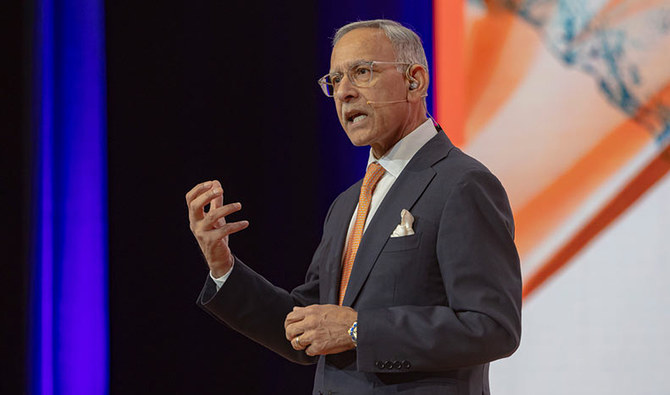

ISLAMABAD: A Pakistani scientist who was brought up in England and went to a medical university is among the first recipients of Saudi citizenship, according to a list published by the financial news portal Argaam.
Saudi Arabia opened its citizenship to highly skilled professionals as part of its Vision 2030, aiming to attract and retain exceptional global talent to enhance the kingdom’s economic and social development.
A royal decree to this effect was issued in November 2021, allowing people belonging to specialized fields such as science, medicine, culture, sports and technology to apply for citizenship.
Dr. Mehmood Khan, who earned his medical degree from the University of Liverpool Medical School in England, was also mentioned in the list of all the high achievers who received Saudi citizenship.
Khan’s distinguished career includes a number of senior corporate roles, including Vice Chairman and Chief Scientific Officer of Global Research and Development at PepsiCo. and President of the Global R&D Center at Takeda Pharmaceuticals.
“I grew up in England. I haven’t had the chance to grow up in Pakistan,” he told OPEN Silicon Valley, an international organization of Pakistani entrepreneurs, in an interview wherein he said he was “proud to be Pakistani.”
Khan is now the CEO of Hevolution Foundation, a nonprofit organization in Riyadh that funds research through grants and provides investments in biotechnology to stimulate health sciences.
He has also managed academic programs like the Diabetes, Endocrinology, and Nutrition Trials Unit at the Mayo Clinic.
Other recipients of Saudi citizenship include:
Islam Zween, CEO of Argaam

Mohammed Zween is deemed a pioneer in the Arab world of a media model that emphasizes qualitative and educational content aimed at profitability. (File/Argaam)
Zween holds a Master’s degree from Alexandria University in Egypt, with over 25 years of experience in technology, media, and business management.
Over the past 18 years, Zween has dedicated his efforts to building pioneering digital projects in Saudi Arabia, the UAE, and Egypt, including “Argaam Financial Portal” and Akhbaar 24.com.
Since 2013, he has implemented a new strategy at Argaam, transforming it into the leading provider of financial media and data journalism in Saudi Arabia and the GCC. He also revamped the company’s business model, contributing to diversifying its revenue streams and achieving profitability.
Through Argaam, Zween has launched numerous initiatives and projects that enriched content related to financial data and investment awareness in the Kingdom. He has led many successful partnerships in the media and financial data fields with local and Gulf entities and made significant contributions to the development of financial media in the Kingdom and the Gulf. Under his leadership, Argaam won the Dubai Media Award for the best economic platform in 2023.
Jackie Y. Ying, Chair, Bioengineering & Nanomedicine Department, King Faisal Specialist Hospital & Research Center
Ying is an American scientist of Singaporean origin, who served as the founding executive director of the Institute of Bioengineering and Nanotechnology in Singapore (2003-2018). She currently leads the NanoBio Lab and is a senior research fellow at the Agency for Science, Technology and Research (A*STAR). She has published extensively on biomedical engineering and nanotechnology topics. Professor Ying was elected a Young Global Leader by the World Economic Forum, a member of the German National Academy of Sciences, and named one of the “100 Engineers of the Modern Era.” Professor Ying was elected a World Economic Forum Young Global Leader and a member of the German National Academy of Sciences, Leopoldina.
Niveen Khashab, founding member of KAUST

Following the completion of her PhD at the University of Florida, Niveen Khashab joined KAUST and became a professor of chemical science. (Supplied)
Khashab is a Lebanese scientist with advanced expertise and contributions in bioengineering and nanomaterials. She is a founding member of King Abdullah University of Science and Technology (KAUST) and has been an associate professor of chemical science and engineering there since 2009. She is one of the laureates of the L’Oréal-UNESCO For Women in Science Award in 2017 for her contributions to inventing innovative smart hybrid materials aimed at drug delivery and developing new technology to observe antioxidant activity between cells.
Noreddine Ghaffour, Water Desalination and Reuse Center, KAUST
Ghaffour is a French scientist who holds a PhD in membrane separation techniques from the University of Montpellier (1995) and is currently a professor of environmental science and engineering at KAUST. He specializes in water desalination techniques and has published articles and research on environmental science, renewable energy, and membrane separation.
Faraz Khalid, CEO of Noon

Khalid, who holds an MBA from The Wharton School, played an instrumental role in the success of Namshi, which was launched in 2012. (Supplied)
Khalid is an Indian entrepreneur with an MBA in entrepreneurial project management from the Wharton School of the University of Pennsylvania. He is the CEO of the e-commerce platform Noon and co-founded Namshi, where he served as managing director and was responsible for creating, launching, and expanding the website.
Dr. Moutassem Azzubi, Chief Pediatric Neurosurgery at King Abdullah Specialized Children’s Hospital

Neurosurgeon Dr. Moutassem Azzubi has been recognised for his expertise and success in numerous conjoined twins separation surgeries. (X: @Moutasem7)
Azzubi is a Syrian neurosurgeon who has performed numerous conjoined twin separation surgeries in the Kingdom and abroad. He was recognized for his extension contributions to the Saudi Conjoined Twins Programme and the team of surgeons under Dr. Abdullah Al Rabeeah, adviser to the Royal Court, supervisor general of KSrelief.
Rami Al-Qawasmi, CEO of Mawdoo3.com

Rami Al-Qawasni holds a bachelor`s degree in Economics from Sussex University in the United Kingdom and started his business journey in Jordan. (Supplied)
Al-Qawasmi is known for his passion for artificial intelligence and startup development. He has created and developed over 10 companies before the age of 30. Under his leadership, Mawdoo3.com raised $23.5 million in a funding round.
Ahmed Mirghani, partner at BIM Ventures

Ahmed Mirghani has contributed to bringing many traditional investors into the world of venture capital. (Supplied)
Mirghani is a Sudanese entrepreneur with an MBA in entrepreneurship from Prince Mohammed bin Salman College of Business and Entrepreneurship. He is a co-founder and a leading figure at BIM Ventures and founded the “Angel Investor Mine” network, which has significantly contributed to bringing many traditional investors into the world of venture capital and the entrepreneurship ecosystem.


