Philippines looks to ‘halal ecosystem’ to boost tourism, trade

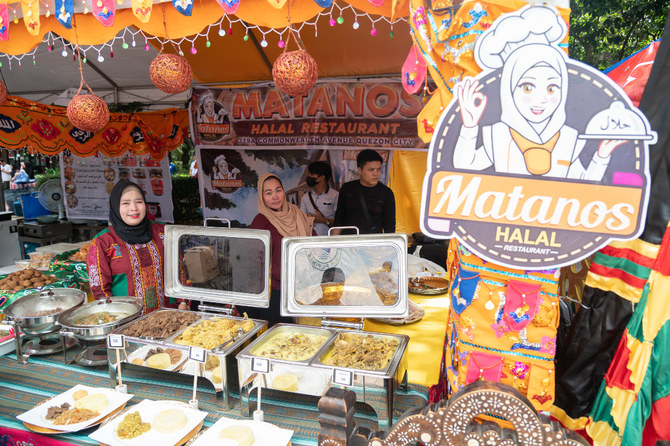
Halal food is on display during the Manila Halal Food Festival in the Philippine capital. (Manila Public Information Office)
Short Url
Updated 06 July 2024
Follow

Philippines looks to ‘halal ecosystem’ to boost tourism, trade

  • National Commission on Muslim Filipinos in touch with hotels, restaurants for halal certification
  • Expansion of halal industry beneficial for all of Philippine society, NCMF chief says

MANILA: The Philippines is developing a “halal ecosystem” to try and boost tourism and trade, according to the National Commission on Muslim Filipinos, as the country targets more commercial exchanges with Arab and Muslim countries.

There are only around 10 million Muslims among the nearly 120 million, predominantly Catholic, population of the Philippines, but the country is looking to expand its domestic halal industry considerably.

The government wants to raise 230 billion pesos ($4 billion) in investments and generate around 120,000 jobs by 2028 by tapping into the global halal market, which is estimated to be worth more than $7 trillion.

The NCMF, a government agency whose mandate is to promote the rights and welfare of Muslim Filipinos, is central to ensuring that the products and initiatives developed under the country’s halal drive comply with Islamic regulations.

“Since NCMF is the only (Islamic) religious institution in the government structure, NCMF should lead in the implementation of programs and activities pertaining to halal,” Sabbudin Abdurahim, the commission’s new secretary, told Arab News this week.

“The NCMF is now spearheading the implementation of programs and activities for the development ... Through collaboration with partner stakeholders, we are looking to establish a halal ecosystem in the Philippines.”

The commission is cooperating with other government agencies — including the Department of Trade, Department of Agriculture, and Department of Tourism — as the Philippines seeks to expand the market presence of its halal-certified products, which include not only food and beverage products and services, but also travel.

Since the Philippines won the Emerging Muslim-friendly Destination award at the Halal in Travel Global Summit in 2023, it has invested significantly to attract visitors from the Middle East and the nearby Muslim-majority countries of Indonesia, Malaysia and Brunei, particularly by ensuring that they have access to halal products and services.

Without developing a halal ecosystem, many potential visitors from Arab and Muslim countries might choose to visit other countries like Malaysia instead, “because they are confident they can easily find halal food there, unlike in the Philippines,” Abdurahim said.

“If we have halal restaurants here in the Philippines, many visitors from Arab or Muslim countries will come here ... Our halal division is already meeting with hotels, restaurants, and other establishments (about collaborating).”

Abdurahim sees the expansion of the halal industry as beneficial for all of Philippine society.

“It will benefit not only the Muslims in the Philippines, but the economy in general,” he said.


‘Keep dreaming’: NATO chief says Europe can’t defend itself without US

Updated 27 January 2026
Follow

‘Keep dreaming’: NATO chief says Europe can’t defend itself without US

BRUSSELS: NATO chief Mark Rutte warned Monday Europe cannot defend itself without the United States, in the face of calls for the continent to stand on its own feet after tensions over Greenland.
US President Donald Trump roiled the transatlantic alliance by threatening to seize the autonomous Danish territory — before backing off after talks with Rutte last week.
The diplomatic crisis sparked gave fresh momentum to those advocating for Europe to take a tougher line against Trump and break its military reliance on Washington.
“If anyone thinks here again, that the European Union, or Europe as a whole, can defend itself without the US — keep on dreaming. You can’t,” Rutte told lawmakers at the European Parliament.
He said that EU countries would have to double defense spending from the five percent NATO target agreed last year to 10 percent and spend “billions and billions” on building nuclear arms.
“You would lose the ultimate guarantor of our freedom, which is the US nuclear umbrella,” Rutte said. “So hey, good luck.”
The former Dutch prime minister insisted that US commitment to NATO’s Article Five mutual defense clause remained “total,” but that the United States expected European countries to keep spending more on their militaries.
“They need a secure Euro-Atlantic, and they also need a secure Europe. So the US has every interest in NATO,” he said.
The NATO head reiterated his repeated praise for Trump for pressuring reluctant European allies to step up defense spending.
He also appeared to knock back a suggestion floated by the EU’s defense commissioner Andrius Kubilius earlier this month for a possible European defense force that could replace US troops on the continent.
“It will make things more complicated. I think  Putin will love it. So think again,” Rutte said.
On Greenland, Rutte said he had agreed with Trump that NATO would “take more responsibility for the defense of the Arctic,” but it was up to Greenlandic and Danish authorities to negotiate over US presence on the island.
“I have no mandate to negotiate on behalf of Denmark, so I didn’t, and I will not,” he said.
Rutte reiterated that he had stressed to Trump the cost paid by NATO allies in Afghanistan after the US leader caused outrage by playing down their contribution.
“For every two American soldiers who paid the ultimate price, one soldier of an ally or a partner, a NATO ally or a partner country, did not return home,” he said.
“I know that America greatly appreciates all the efforts.”