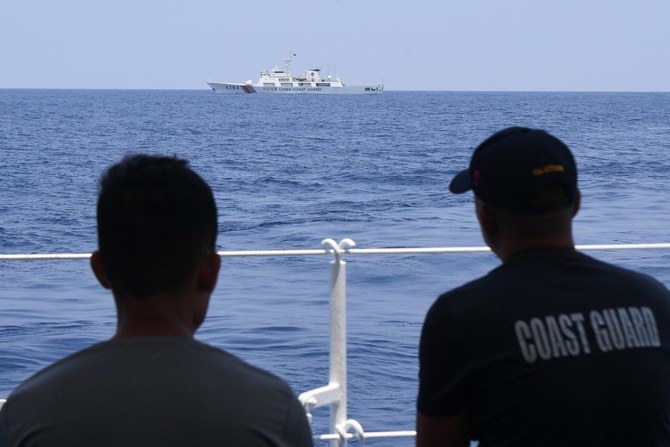
MANILA: The Philippine Coast Guard (PCG) said on Saturday that China’s largest coast guard vessel has anchored in Manila’s exclusive economic zone (EEZ) in the South China Sea, and is meant to intimidate its smaller Asian neighbor.
The China coast guard’s 165-meter ‘monster ship’ entered Manila’s 200-nautical mile EEZ on July 2, spokesperson for the PCG Jay Tarriela told a news forum.
The PCG warned the Chinese vessel it was in the Philippine’s EEZ and asked about their intentions, he said.
“It’s an intimidation on the part of the China Coast Guard,” Tarriela said. “We’re not going to pull out and we’re not going to be intimidated.”
China’s embassy in Manila and the Chinese foreign ministry did not immediately respond to a request for comment. China’s coast guard has no publicly available contact information.
The Chinese ship, which has also deployed a small boat, was anchored 800 yards away from the PCG’s vessel, Tarriela said.
In May, the PCG deployed a ship to the Sabina shoal to deter small-scale reclamation by China, which denied the claim. China has carried out extensive land reclamation on some islands in the South China Sea, building air force and other military facilities, causing concern in Washington and around the region.
China claims most of the South China Sea, a key conduit for $3 trillion of annual ship-borne trade, as its own territory. Beijing rejects the 2016 ruling by The Hague-based Permanent Court of Arbitration which said its expansive maritime claims had no legal basis.
Following a high-level dialogue, the Philippines and China agreed on Tuesday for the need to “restore trust” and “rebuild confidence” to better manage maritime disputes.
The Philippines has turned down offers from the United States, its treaty ally, to assist operations in the South China Sea, despite a flare-up with China over routing resupply missions to Filipino troops on a contested shoal.


![]()

China anchors ‘monster ship’ in South China Sea, Philippine coast guard says
Short Url
https://arab.news/z43uj
China anchors ‘monster ship’ in South China Sea, Philippine coast guard says
Latest updates


Recommended


© 2026 SAUDI RESEARCH & PUBLISHING COMPANY, All Rights Reserved And subject to Terms of Use Agreement.